Showing posts with label rules addition. Show all posts

Tuesday, March 3, 2026

"I Share My Dreams with Ghosts" - Espionage Mechanics for Star Wars d6

I've been running the Andor Game for nearly 20 sessions (19 as of this past Saturday), and I've been really happy with the results so far. I've been sticking primarily with the original West End Games 1e ruleset, but supplementing with material from later WEG supplements, tools from Traveller and the various Sine Nomine games, and fan materials. I've also switched to using rules tweaks put together by Bill Slavicsek, the original d6 game designer, for speeding up d6 1e combat. I'm used to the quick resolution of OSR combats, and the original opposed rolls of the system were really inhibiting my ability to run lively and engaging combats. 

"Morlana One Concept Art,"
Peter McKinstry, Andor

The original WEG system is highly cinematic in nature, drawing from the swashbuckly pulpy feel of A New Hope in particular, and doesn't accommodate some of the more espionage-forward components I want to include in this particular game, so it's time to start hacking together some rules.

Agents and Networks

I wanted my players to run their own spy network, giving them a chance to conduct legwork and even operations without player characters needing to be on hand at each turn. Cribbing from the Domain Skills  and Advisor Ring concepts used in the Hill Cantons campaign, I put together seven espionage stats for NPC agents: Analysis, Combat, Ranger, Social, Stealth, Technical, Unusual. These attributes, rated in Xd6+Y (just like the standard WEG d6 stats) are used for resolving the espionage shenanigans that the PCs may direct their agents to each week, if they choose to abstract out an agent's actions. Not every agent has ratings in every attribute, however. "Nek," the pugnacious Duros logistics officer, has Combat 3D and Ranger 3D, but no ratings in any other stat. Nek can fight or lead expeditions, but won't be able to schmooze his way through high society. In contrast, the Sullustan maintenance worker "Dewback" has Analysis 2D+2, Stealth 2D+1, and Technical 4D; he's able to tackle technical problems (construed broadly here, things that a Star Trek science officer or engineer might work on) and can maybe handle the occasional research project or stealth mission, but isn't going to be any good at a stand-up fight or a schmoozing scene (which would require Social). 

If the PCs want to interact with the agent as a standard NPC (like having them come along on an operation during a game session), then I'd fully stat out the NPC as normal; the espionage stats are to be used for resolving a given week's mission in one or two rolls, and interpreting the result based on the d6 difficulty thresholds (Easy DC 10, Moderate DC 15, Difficult DC 20, etc). 

In contrast to the Domain Skills framework of the Hill Cantons, the PCs don't have espionage stats of their own. This facilitates the PCs going out and doing adventure-y things while still letting their cell make progress on slow-burn projects and work towards their mission goals through the agents.

Example: Fronz wants to have an agent surveil a known ISB operative, see who he's talking to over the course of a week, and assemble a dossier of his contacts. The GM informs Fronz that this will be a Stealth roll. Looking through the available agents, Fronz selects the one with the highest Stealth, Krim, rated at a 3d+2. Fronz rolls and reports that Krim has gotten a 12 -- the GM checks and determines that Krim's succeeded on an Easy difficulty challenge, but failed at something that's Moderate or higher. 

"Jedha Crowd," concept art
Matt Alsop, Rogue One
A major inspiration here was the usage of Attributes in the browser game Fallen London, where a given storylet in the game will often resolve perhaps a week's worth of actions and decisions with a single Attribute check. I wanted to do the same thing, using broad evocative attributes to capture a bunch of activities and getting to a quick resolution. Some examples of Operation Lamplighter activities that used a single stat check were surveilling Imperial Security Bureau offices and trying to find targets potentially vulnerable to blackmail (Social), or assisting an allied local gang in setting up defenses against increased Imperial repression (Combat). 

To prevent eager-beaver PCs from just overwhelming a beleaguered GM with downtime instructions, PC groups are limited in the number of cells they can control (i.e. groupings that can be given specific downtime tasks); it's capped at the number of dice of the group's highest command score. Operation Lamplighter's highest command rating is 6D (the Wookiee demolitionist/surgeon Dr. Grozdak), so the players can control up to 6 cells. Even if Dr. Grozdak increases his command skill to 6D+1 or 6D+2, he still maxes out at 6 cells; it's only when command gets to 7D that they'd be able to add another cell.

Cells can have individual agents (statted out as discussed above) or "mooks," faceless cell members. If a cell rolls badly on a crucial test, the players may elect to reroll at the cost of losing one cell member (presumably a mook when possible, but theoretically it could also be losing a full agent). This would usually represent some misadventure and the cell member being killed during the action, but it could also mean them needing to withdraw from the cell for any reason (should the downtime action in question be something unlikely to generate lethal results). 

Progress Bars and Opposition

Some tasks will take a bit longer to resolve, like analyzing monthly shipments going to/from the local ISB research facility and trying to determine information about what's going on inside (appropriately enough, an Analysis test). In these circumstances, the agent's roll is added to a progress chart. As GM, I decide that pulling information about the ISB base through freighter logs is going to require 50 points of research; each week, the agent is allowed to roll their 2d6+2 Analysis stat and add those results until they get to 50. 

In the event that an action might be resisted, I can quickly assign a skill level for the local ISB office or other opposition (using the WEG framework of 2d being an average stat, 4d for a specialist) and roll against the agent's stat. An opposition success might mean a simple negation of the agent's action ("Ronto reports that he hasn't been able to find a way into the base; their patrols are too frequent and he aborted the recon"), increasing surveillance or prepping defenses (making future checks harder, summoning more security), or even killing or capturing the unlucky Rebel agent. 

Depending on GM adjudication, a mook (or mooks) may sometimes be sacrificed by the PCs in order to let an agent escape an opposition roll that would otherwise have killed them. 

Street Scene concept art
Gus Mendonca. Star Wars 1313 (cancelled)

Designing NPC Agents 

So far I've been custom creating most of the Operation Lamplighter recruits, but I'm working on putting together tables for quickly generating new potential agents. The main inspiration for this is my beloved HBS Battletech game, which featured a lifepath generator for the mercs you hire. (Check out Kiva's design diary about it here - and read her other design diaries and work while you're at it.) Obviously granddaddy Traveller's lifepaths play a role here, as do the lifepaths of other MechWarrior RPGs. But the HBS Battletech game also adds both specific statboosts and descriptive tags that characters can acquire when being generated by the system - so a character doing a stint as an assassin as part of their backstory might not only get increased Gunnery or Tactics scores, but also has the "assassin" tag that can feed into random events. 

My hacked-together implementation of lifepaths for Op Lamplighter (still VERY work-in-progress) takes some of the tags and pathway progressions developed for Battletech (like "Spacer" or "Lucky") and adds in some professions that are particularly Star Wars-coded (many specifically taken from the old Decipher CCG, which thought it was worth calling out a few niche professions as really fitting the Star Wars vibe). The ultimate goal is to be able to put together a series of lifepath rolls that both develop an NPCs background/history and assign espionage stats and tags, ideally automatable like a space version of Meatshields.


Dark Money

While I'm a fan of the grubby grotty "count every coin" vibe in my OSR games, that didn't quite feel right for Operation Lamplighter. Inspired by the "Mon Mothma needs to commit financial crimes to fund the Rebellion" subplot in Andor, I decided that the game would only look at kilocredits, and that purchases of anything underneath 1000 credits can be handwaved. 

"Bespin Citizen" concept art
Ralph McQuarrie, Empire Strikes Back
The PCs have access to "clear" accounts (standard official banking, but under Imperial audit scrutiny), "dark" accounts (available for shady dealings, but potentially subject to loss / volatility), and cash on hand (subject to loss/destruction/holdup/etc). In a given month, one can only transfer 10 kcr from dark accounts, or 5 kcr from clear accounts, into cash, so spending large amounts of cash on sketchy expenditures can be tricky. 

Tracking this has necessitated a lot more spreadsheet play than I'm used to, but given that we're dealing with the regular PCs, their horde of NPC agents, tracking a calendar,* and potentially having multiple freighters swanning about the sector, using a spreadsheet was inevitable. 

*"I warned you," the ghost of Gygax smirks. "'IT IS IMPOSSIBLE TO HAVE A MEANINGFUL CAMPAIGN UNLESS STRICT TIME RECORDS ARE KEPT,' in all caps and everything, but all of you laughed at me. Who's laughing now??" 

Double-Blind Imperial Opposition

Note: I started prepping this component of play around Christmas, but cancelled the process after checking in with my players. One player specifically (and very reasonably) did not want to have player-vs-player dynamics in the game, so this component remains unimplemented in practice.


ISB Board, Andor

I was considering trying to add in a bit of active opposition to the players by roping in some other friends to play the role of the ISB supervisors of the Dusk Nebula sector. The ISB players would see the weekly newsbriefs that I was already writing for the players (along with other sector-wide ISB-exclusive reports), and would direct the active efforts to root out rebel cells. I wrote up five ISB special agents, each with their own espionage stats as described above. These would function as the active units for the ISB supervisors, agents who they could deploy across the sector to form their own intelligence networks and operate against the PC cell. Both sides would submit weekly actions for their agents in a double-blind system, with neither side having concrete information on exactly what the others were up to...up until someone's forces were discovered, or went kinetic. 

Having a group of players actively taking on the ISB roles was intended to be freeing, by helping reduce the cognitive load in generating large-scale opposition activity and adding a frisson of competition between the ISB and Rebellion players. But it would have fostered a PvP element which is entirely reasonable for someone to want to avoid -- and it would also have increased the cognitive load in terms of resolving double the NPC agent interactions each week!

(Plus, I was hoping for snide bickering and moustache-twirling from the ISB players in their "ISB-briefing-room" channel in Discord, riffing off the wonderful ISB board scenes in Andor.)

Double-blind play is always tricky to implement from a logistics standpoint, if nothing else, but the ability to restrict channel access in a Discord server makes it much more feasible. I had fun trying to GM a Battletech invasion mini-campaign a few years ago, and I think that the double-blind format would fit delightfully well into an espionage framework.

What sorts of actions would you want to see in an espionage game framework? What sort of play would you want systems to facilitate? 

Thursday, August 10, 2023

Modified Death & Dismemberment; Campaign Update

During my time playing in the Hill Cantons campaign, I faced far too many rolls on Chris's Death and Dismemberment chart to not have its tension seared into my brain. As a result (and because I am a lazy/overwhelmed GM) I've been using it in my own Legacy of the Bieth sessions. 

After the most recent roll on the chart, my players and I discussed the feel of some of the consequences on the chart. Due to the limited scheduling and times of play, some of the nastier rolls on the table were effectively the same as removing a character permanently from the campaign. Sure, there wasn't a sting of death, but the practical result was the same.

After a few suggestions from Rustam's player (spawned in part from discussion on the OSR Discord server) I wound up putting together a revised Death and Dismemberment table which I think I'll be using, going forward.

Death & Dismemberment:

When a PC hits 0 to -10 HP, roll 1d10.

1: Stunned. Knocked out for 1d6 rounds. At the end of this time, is at 0 HP and able to slowly crawl along, but another hit of any sort will kill the character until they get back to positive HP.
2-5: Lingering Wound. Character is incapacitated for 1 week, and player + GM jointly figure what sort of lasting but largely cosmetic scar the wound has left.
6-8: Lasting Wound. Character is incapacitated for 1 week, and some other permanent damage to the character also results (missing eye, mis-set bone, permanently weak knee, etc.). Again jointly determined by player + GM, but will result in some statistical change to the character.
9+: Dead dead dead

Add 1 to a Death & Dismemberment roll (and to number of weeks incapacitated) for every Lingering or Lasting Wound your PC has taken throughout the course of play.

(This was inspired in part by the game Battle Brothers, where your WFRP-esque mercenary scum can take on lasting wounds if reduced to 0 HP, or through a bad crit.)


Tuco and the one-armed man discuss the
effects of Lasting Wounds on a PC.

On the campaign front, the players have continued delving into the sanctum of a long-vanished wizard, hoping to track down the bandit Red Mansur and recover some anti-mutagenic compounds created by the alchemist the Whisper. 

I attach some notes from Rustam the Red, a bounty hunter and one of the PCs (played by Kalin). These are clearly in no way me shirking the task of writing campaign updates and instead foisting it off on the players. 

(Oh, don't look at me like that. All the players get 100 XP times their PC level for a session report. Hell, sometimes a session report might be more XP than the session itself!)

~~Fragments from the journal of Rustam the Red~~
Sketch of Rustam by Kalin.


Entry 7

Did I forget I had a journal? You’ll never know! 

The last six months were spent in recovery and recuperation. After a mostly successful job, the details of which I shall not put down in writing (because you do not put that kind of stuff down in writing) I was in possession of several rare and valuable tomes. Those tomes were traded in to a witch for an amulet that she fashioned me, and by God’s name my knees have stopped hurting for the first time in the past 10 years! 

NOTE TO SELF: Does it make sense to praise God when a witch did all the work? Is asking this question damning already? Do I care?

[In the middle of the journal is a rough sketch of some blocks arranged in geometric patterns]

Just in time, as we are off on another job. I find myself once again in the employ of Saleema and alongside Krim the Rat. Despite my desire to pursue another avenue of business, I am now yet again off chasing after a bandit. Perhaps this is my punishment from God for the sins I have done in my life? To always be stuck in this endless cycle. 

The band, Red Mansur, is apparently hiding in the lair of some deceased magician. We do not appear to have any magicians with us on this job. That’s a bad sign. This thing is in some cave, there’s green magical images appearing everywhere, some of them harmful, some of them just babbling on in some unknown tongue. Magician stuff, in short.

We find a corpse and a dead end. I missed the first foray into this place, so I make sure the others (Krim, as I said, and a….snake person named Sybaris? I don’t even know if I am actually surprised at this point.) actually do their due diligence.

Lo and behold, they had not. I find a secret passageway behind one of the statues. The passage went into a small room of some kind, a study or a bedroom. There’s valuables in here, this is more like it! Less bandit chasing and more making up the money spent on the previous job.  The lamia could not break open one of the chests and got struck by a needle, ageing her significantly. 

NOTE TO SELF: Commission reinforced leather gloves when back in Maaqil. 

The desk had strange playing tiles on it, arranged in geometric patterns. Some of these were made of ivory, so they are coming with us too. Same with the rugs and the various jewels we found. For the sake of everyone’s health, we did not open the smaller chest. 

Satisfied with the haul, I suggested we secure all of this back at base camp, before we proceed. The lamia kept insisting on finding these anti-mutagen vials that Red Mansur stole. I have no idea why this being is so focused on the task, is it like a guard dog in how it stays on orders? Maybe not my place to question. 

Problem - how to get the chests and rugs out through the stupid obsidian magical image in the entryway? I tried to put a bag over it. I don’t know, I miss Wali and the other magicians from the old crew. They would know what to do about it. The bag worked. The thing went crazy and kept repeating itself, its defensive attack growing weaker and weaker. Krim read poetry to it. He seemed happy with its reaction, so I let him have this one.

We took the loot out. It feels good to once again write those words. 

Personal thought of the Day: Why is it that magicians can’t simply place a poisoned needle in their protective mechanisms like a normal person? Why try and age someone? Who does that??

Entry 8

I suppose this is what I get for blasphemy, huh? Returning once more into this accursed magician’s lair, this time with a magician of our own just to be safe, we did not unfortunately get too far. While back in camp we did realise that the strange brass disks we got last time were, in fact, some kind of magical spell book, we did not get too much more information from Izohr once we were back inside.

Opening the last remaining door we were accosted by those strange lion-headed beasts that appear out of thin air, though Sybaris the Lamia says she saw a strange machine that might be responsible for them.

That thing was a nightmare. It slew two of our fellows but with a slash of its tentacled limbs, nearly managed to kill the last one and almost was the end of me as well. By God’s will I only came away with an awful headache and a nasty scar on my cheek to add to the collection that has been growing there for the last few years. 

I need rest. 

Personal Thought of the Day: Magicians are awful people, but their places of residence are somehow worse. Also, I need to get more flaming oil. It is time to start using extreme measures.

Rustam, post-scar. Art by Kalin.
Entry 9

Writing this in a spare moment. I am done with this place and this wizard nonsense. Going to burn this place down, one flask of oil at a time.

Working pretty well so far. Found a room with loads of skulls and strange helmets. Got one with bat wings on it. 

Killed a strange warrior made of shadow. Fire consumes all, even shadows. Found one box of the anti-mutagens, two more to go. Burned down the nest of an enormous spider too. 

Zaynab is quite competent. She is someone to keep contact with when I need muscle for the future. 

[The notes end as a mess of scribbles.] 

Wednesday, September 23, 2020

Rush In and Die, Dogs! -- 4e Minions in B/X

 Inspired by a query from ZharethZhen on Reddit.

Stormtroopers advancing; deleted scene from Return of the Jedi4e D+D introduced the minion - a variant of a monster defined by having just a single hit point. This has utility in classic D+D frameworks for modelling hard-hitting groups of creatures that can nevertheless be defeated easily -- even more easily than a the baseline monster with minimum values on its hit dice. (An ogre, at 4+1 HD, will have a minimum of 5 HP, but an ogre minion only 1.)

Adjusting a classic D+D statblock to reflect a single hit point is trivial. But how would one value a minion for purposes of XP assessment? It doesn't seem to make sense to rate them as either a 1/2 or 1 HD creature if they're hitting more strongly and have special abilities (flight, save-or-die, etc.). 

So here's how I might address the issue for B/X-alikes.

  • Monsters use d8 for HD in B/X, which averages out to 4.5 HP per HD.
  • B/X monster XP is based on both the base HD and any special abilities.
  • To calculate XP for a minion, divide minion HD by 4 to determine base HD, but add special ability XP based on the original HD. The dangerous nature of abilities from the higher-tier monster is reflected, but the HD-based XP is reduced to reflect the vastly reduced hit point capacity.

Have you used minions in your classic D+D? What do you see as guidelines for how to implement them effectively, or if at all?


Tuesday, March 12, 2019

Hymn to the Bow: the Hunters

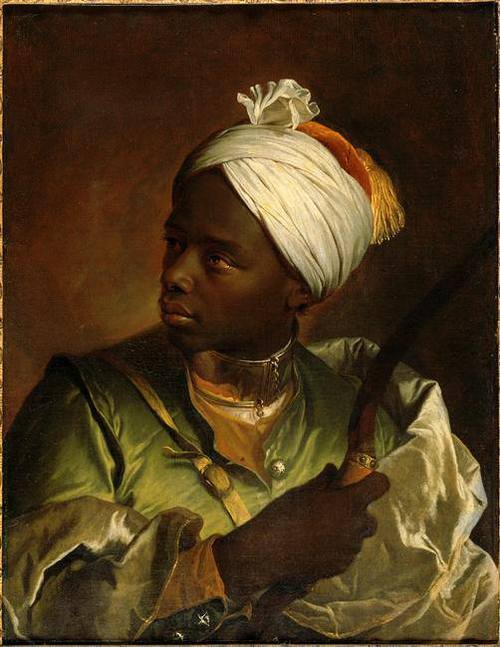
“Portrait de Jeune Noir avec Arc”
Hyacinthe Rigaud.
Special thanks to Jerry Grayson and Lloyd Gyan for their input and guidance.

Chill-of-Death and Unflinching-Gaze! The Two-who-are-One, the Hunters Without Peer! Some say that they are eternal rivals, vying for greater success in the hunt. Some say that they are twins, or parent and child. Some that they are lovers, forever together. Many in Manden hold that they are the left and right hands of the Path to Justice, the Orisha Oshossi. Many in Sukiyya believe that the Two-who-are-One were once human before they crossed over into the world of the jinn. But who can know the truth of that otherworld?

They are certainly not a god, despite the rumors that are sometimes spread. If they were a god, would the princes of Manden be required to swear to the Two-in-One before their ascension to the throne? It would be unthinkable for peers of the Caliphate to forsake Ar-Rahman.

So. Chill-of-Death and Unflinching-Gaze are manifestly not gods. 

But all agree that they are mighty spirits, the lords of brush and forest. They are the Hunters, knowers of the paths and the way. They see what is to come, and move towards the future and the past as they track their prey.

Chief among the simbon, those who are favored in the eyes of Chill-of-Death and Unflinching-Gaze, are the princes of Manden. But any who desire the favor of Chill-of-Death and Unflinching-Gaze may swear to their service, should they be willing to abide by the Code of the Hunter.


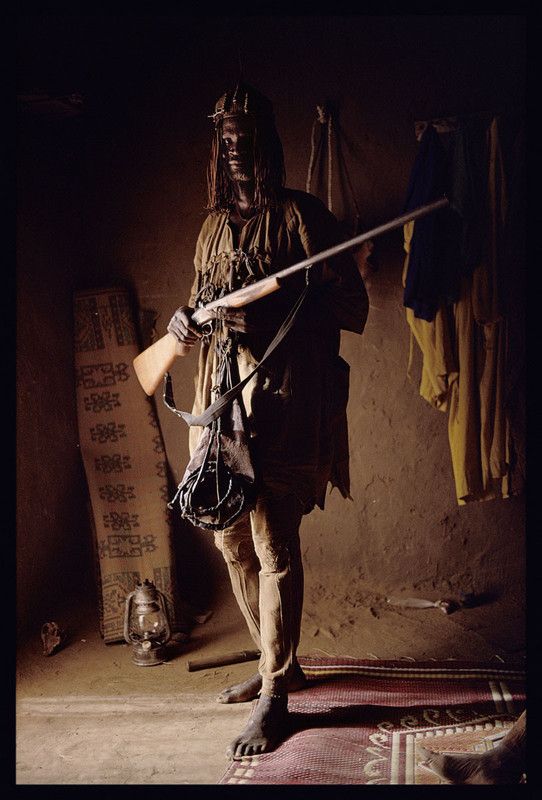
"Hunters of Mali" - Philippe Bordas.
Membership Requirements

An applicant who has proven their worth as a hunter may seek the blessing of Chill-of-Death and Unflinching-Gaze. They must find a simbon, a Master Hunter, who is willing to sponsor them in the ranks of the donso, and then they must hunt and defeat an animal or beast that plagues a community. This hunt is a spiritual trial for the applicant, that will test not only their skills as a hunter, but their connection to the wilderness and their willingness to serve Chill-of-Death and Unflinching-Gaze.

Once they have returned victorious, the simbon will ask them three questions:

"Will you learn to obey Chill-of-Death and Unflinching-Gaze before your own father and mother?"
"Will you learn that honor is never slavery, and give your honor and your submission to the simbon?"
"Will you learn that kola nuts are good, tobacco is good, honey is sweet - and give them over to your master?"

Once they have agreed, they are of the donso. The new initiates must obey the code of their brotherhood and annually fulfill its requirements, or be the sworn enemy of all other donso.

Trappings

Donso wear skin-tight leggings and bear cowrie shells upon their cloak or blouse as the marks of a hunter. Simbons of great prowess likely carry a pouch of goatskin, the sassa, filled with sand and cowries for use in divination. They favor the spear, the bow, and the rifle. Simbons are likely to bear a hunter's whistle, to signal with others of the band.

Hunter's shirt. Mali.
Date unknown. Minneapolis Institute of Art.
Mechanics

Prerequisites
A character seeking to become a donso must have a ranged attack bonus of +5 or greater without any magic assistance - only a combination of their base attack and any Dexterity modifications. They must gain the sponsorship of a simbon who will continue to sponsor and bear responsibility for their candidates.

Initiation

After becoming a donso a character continues to level normally, but gains the following benefits in addition to their standard gained abilities at a given level (see below).

Benefits

A donso character gains the benefits of the skills listed below when they achieve the level in question. No additional XP is required; however a donso must always adhere to the requirements listed below, or else the favor of Chill-of-Death and Unflinching-Gaze is withdrawn. 
  • Peerless Trackers: Improve base hunting skill by 1-in-6, 3 points, or 15% depending on your game system of choice (1st)
  • Herbs of the Healer: 25 + (level * 3)% chance in wilderness to find herbs that can grant a second saving throw vs poison (1st)
  • Future Paths: may cast augury 3x/week (2nd). 
  • Tongues of Jinn: may converse normally with jinn of brush and forest; has 10x level chance to invoke a jinn of brush or forest and converse or bargain, 1x/month (4th)
  • Simbon: Master hunter, may sponsor another applicant into the donso (6th)
  • "Hunters of Mali" - Philippe Bordas, Le Monde
  • Window to the World of Jinn: May cast commune 1x/month (9th)

Requirements
A donso must always obey their oaths to their simbon regarding the three questions.

1. Even the rulers of Manden swear to obey Chill-of-Death and Unflinching-Gaze (and their servant the simbon) above their own fathers, giving the royal court of Manden an unexpected dual loyalty. However, each ruler is sponsored by a different simbon, ensuring that no one person continues to dominate the course of the nation.

2. Along with the duties of respect and obedience to the simbon, donso are expected to oppose slavery at every turn, rooting it out when encountered. Where open confrontation is not viable, donso may take the time to operate in a clandestine manner, but they may never abandon a slave to their fate.

3. Each year, a donso must present their simbon with their level x 1000 dinars worth of trade goods (tobacco, kola nuts, etc.). This does not have to be all at once, but can be presented to the simbon over the course of the year.

In return, a simbon must prepare the medicines and powders for their students to ensure that the creatures they hunt do not continue to haunt them.  Donso take a risk when they hunt. The greater power and role that their quarry plays in the cosmos, the greater the danger is that its wraith will stalk the donso that harmed it -- unless the simbon provides guidance and protection.

Simbon speak each season with the jinn of brush and forest to ensure that they are satisfied, and to confirm that their students have followed their oaths - to guide them if they falter, and to punish them if they fail. They must teach their students the ways to talk with jinn. They must ensure that all those who hunt in their lands (donso or not) obey the traditions of the hunt. They must ensure that no prince or emir or caliph or chief encroaches upon the bounds of the donso, or answer to Chill-of-Death and Unflinching-Gaze at their peril.

Cultural Note

This entry derives strongly from the hunters of Kondolon ni Sané as related by Djibril Niane. Niane's work (as he directly acknowledges) came from speaking with the griot Mamadou Kouyaté of Guinea. The Epic of Sundiata is an oral tradition, and cannot fully be conveyed through the written word. Similarly, as you can see from the Guillot article linked below (and the Bordas photographs used for illustration here) the brotherhood of hunters continues to exist in Mali. The abilities I have referenced in this post reflect those mentioned in the Epic of Sundiata, and do not touch upon any other abilities or secret traditions that the hunters may have.

I have no connection to the Mandingo people beyond those shared from a common Islamic religious and cultural tradition. I believe that Mamadou Kouyaté's work through Niane is a valid subject for interpretation in game material because of the intended public-facing nature of the work that Niane relates, and additional discussion in the preface.

Bibliography:


Friday, November 16, 2018

Dungeons + Dominion II: The Domain Game

Firstly: a salute to Evlyn M, an artist who was formerly a vibrant part of the online OSR community, but who has since withdrawn as a result of toxicity in the scene. Evlyn does some absolutely charming work, and we are made much poorer by her departure.

Secondly: a shoutout to Stuart Robertson, creator of the ubiquitous "OSR" logo, on taking a stand re: the usage (and misuse) of the logo.  I haven't spoken out as forthrightly about misuses of community position and power in our community as I should have, and I'm glad that I've got another good example here to try and live up to.

* * *

This post was inspired by a query on the /rpg subreddit, where someone asked for a simple way to generate a domain setup for his kids' game, and asked if it were possible to use the cardbuilder Dominion as a framework.

I've written about using Dominion as a setting generation element before, but I think that this new query is a way to set up an evolving domain framework without too much back-end work. It's pretty abstracted, but if you had to do something in a pinch I think this could work.

This post assumes a decent knowledge of the mechanics behind Dominion. If you're unfamiliar, it might read a bit gobbledygook to you (you can check out the rules from RGG here)

Martin Hoffman, Dominion
Setup

Play a 3- or 4-player game of Dominion. At the end, pick one of the decks to determine what resources the players' domain has - victory point cards mean territory, treasures mean fiscal resources on hand, and action cards mean buildings or resources within the fiefdom.

Feel free to abstract meanings from the cards present - having a Golem in the deck might mean that the domain has a construct or warforged present...or, drawing upon the the original Golem of Prague story, it might mean that the polity has a strong and unflagging defender.

Gameplay

Each month (or other 'domain turn'), the domain can expend resources to take on new projects and keep growing and improving. The victory point cards present at the end of the setup phase serve to increase the number of potential improvements and projects that a domain can seek to take on as a card draw from the randomizer deck for the next month - the players can choose what they want the fiefdom to try and construct/purchase (adding to the deck). They'll have to keep gathering gold and resources to get what they need for the fiefdom, though (unrelated to the money cards acquired in playing the setup game).

Resources acquired through standard play sessions (treasure, magical artifacts, alliances) wind up being translated into cards for the fiefdom deck. The game text doesn't matter too much - villages don't give you +2 Actions, +1 Card on the domain turn, but just symbolize that there's a village associated with the fiefdom that's significant in some way. You're using the deck to generate opportunities for randomization, NOT playing a game of Dominion anymore.

Example:

After playing an intro game of Dominion with three AI players, I win. My deck contains: 8 Estates, 4 Duchies, and 3 Provinces (Victory cards), 1 Cellar, 1 Village, 1 Remodel, 3 Markets, and 2 Mines (Action Cards).

Matthias Catrein, Dominion
Translating the Action cards into domain resources: well, the two mines are simple, as is the village. 3 Markets suggest strong mercantile connections (as would make sense with two extant mines). The tricky ones are Cellar and Remodel, which have no easy direct analog. I might render Cellar as a series of storage vaults untouched through the various ages by the previous domain-holders (strange new swag for the PCs?), and Remodel as the presence of a new builder who's able to start new construction projects right away.

Now I need to translate the Estates, Duchies, and Provinces into draws from the randomizer. Each Estate is worth a quarter of a card (round down), each Duchy is worth half a card, and each Province is worth a card. This gives us 7 randomly selected cards that the domain will be able to choose its next upgrade from.

The draw is: Shanty Town, Bridge, Mining Village, Spy, Masquerade, Caravan, and Laboratory.

Mining Village suggests that there's been expansion around the mines and they're going to be more productive; Shanty Town suggests that the largest settlement in the domain has expanded, Bridge suggests that roads and infrastructure are developed further. Spy would suggest either the creation of an espionage network, or just developing information on one of your neighbors. Masquerade might be hosting a major social event, Caravan a greater focus on inter-domain trading, and Laboratory the creation of a wizard's or alchemist's sanctum.

Some might (reasonably) suggest that the things listed are all things that a domain should be able to do anyway - why should mercantile expansion be limited by drawing a single card? Well, if you're looking for a very light overhead system, then that's just the random event that's available to you. If you want something that allows for a bit more player agency in the domain turns, then make these random events a bit more powerful -- the caravans here might be higher payoff, or reaching out to farther destinations, or the like.

Saturday, September 9, 2017

To Battle in Hell - L'Mercenaire!

A brief plug before the main entry: the Hydra Cooperative is participating in a Hurricane Harvey relief bundle on DriveThruRPG, running through 9/12/2017. Pick up over $400 of PDFs for only $25 - and help out the Houston Harvey Relief Fund  and the Coastal Bend Disaster Recovery Group Fund. Play elfgames AND assist those in need - win-win!

Mercenaries have been a subject of fascination for me for ages. As a kid, I devoured books about the Flying Tigers and other merc pilot outfits, but also fell in love with Arthur Conan Doyle's The White Company and Corwin raising his army of Earth mercs to take Amber. Later, Glen Cook's legendary Black Company books and Steven Erikson's Malazan Book of the Fallen continue to loom large for me, as do Iain M Banks's Use of Weapons and Drake's Hammer's Slammers.
NC Wyeth's "The White Company"

Driving back home just now, I listened to a great interview on why Erik Price's plan for Afghanistan is terrible. Price, the founder of Blackwater/Xe/Academi/Constellis, was described by the guests as (among other things) "Gyro Gearloose" and "[a guy who] thinks he's Tony Stark but is really Lex Luthor." Hell of a listen. (See also this 2007 piece, by Paul Tullis and one of the folks on the interview, Robert Young Pelton.)

Grizzly APC.jpg
Blackwater's Grizzly AFV
By Dominguez2 - Own workCC BY-SA 3.0Link
Prince's outlook, combining a strong religious fervor (and profit-motive driven amorality) with wildly ambitious ideas (both sensible and awful) rang a few bells of recognition in my mind from a gaming perspective. Price certainly fits the mold of a recurring NPC, if not a PC himself. His peripatetic post-Iraq schemes for BlackXeCademi (an abortive attempt to foment a war with Iran, creating an anti-piracy force in Somalia before abandoning his forces in the field to go rogue, creating an oil refinery scheme in South Sudan before being kicked out for trying to skim off the top) sound like the sort of harebrained ideas that, well, a bunch of PCs would come up with. And when I hear about Blackwater creating its own COIN planes and AFVs, visions of folks geeking out over how to minmax and optimize their own vehicles in GURPS or Traveller flash before my eyes.

Even while I listened with horror to the Blackwater podcast, a treacherous 13-year-old who lurks in my brain was going "that's so cooooool" at some of the Blackwater shenanigans. To be clear, the cool bits were more the homegrown vehicles and wild antipiracy plans than the civilian massacres, heedless destruction, and disregard for human life. (Those last bits are...kind of not so hot, to say the least).

Joel DuQue, for HareBrained Schemes's Battletech
This train of thought got me wondering why we don't see more discussion of PCs-as-mercenaries in RPGs. While there are certainly several games that do support this (Traveller and Battletech both pop primarily to mind, but also several games from this list - interesting to note the strong presence in all three lists of the Keith brothers), I don't know that there's too much support for the mercenary company in fantasy games. Certainly you have games like ACKS that integrate a wargame/economy system into the core rules, but given the presence of computer games like Mount & Blade and Battle Brothers, not to mention all the literary sources I've mentioned above, I'd have expected a bit more support and/or exploration of the idea.

So. What makes playing a merc campaign interesting? One of the settings I would have expected to cover this in more detail doesn't; Green Ronin's Black Company Campaign Setting fails to engage with what playing through a merc perspective ought to entail, instead treating the issue as simply "fielding a small army." (This isn't intended to slag the BCCS, which is one of like two d20 books that I have actually sought out and really like, but just noting what it doesn't cover.) Even worse is the AD&D 2e "For Gold and Glory," which lists a slew of uninspiring and incoherent Forgotten Realms mercenary groups and their Battlesystem statistics - perhaps expandable with work into something useful, but it would be hard going.

Instead, a better place to start is something like the Mercenary's Handbook for Battletech. This book (1st ed by J Andrew Keith - see above) lays out a few principles that help clarify what makes a merc campaign interesting:
Niclas Meldeman - "A Landsknecht Brandmeister"

  •  It's about logistics, economics, and survival as much as it is about strategy and tactics.
    A merc unit isn't just about warfare and fighting - it's also about doing so at a profit (or else you wouldn't be mercs in the first place). While this can (if taken to extremes) lead to excessive spreadsheet management taking over play, it also helps focus the players on long-term decisions. While it's possible for PCs to take extraordinary measures to heal (or even resurrect) a single companion, it's harder to do so for whole units. Players have to conserve their forces and ensure that they're spending their money wisely. (As forces increase, player overhead does as well - perhaps a refreshing change for GMs who are all too familiar with player power creep combining with money meaning less and less throughout play.) This point seems like it might interact interestingly with the traditional "1 GP = 1 XP" rule for classic D&D.
  • The merc has two concerns to keep track of - the actions of their enemy and the actions of their employer. Corollary: the employer feels the same way about the mercs.
    Hiring a mercenary unit means that a state actor has delegated one of the state's core functions (the monopoly and control of violence) over to an actor that is operating from financial gain. This sets up a slew and a half of dangerous incentives for both patron and mercenary. Shadowrun is infamous for including a stereotypical "Mr. Johnson" patron who generally intends to screw the players over upon completion of the job (either because they Know Too Much or to avoid paying the contract.) Battletech takes a more subtle approach, with constant struggles between patron and merc regarding both payment and the amount of control that the patron will ultimately be able to exert over the mercenary unit. Long-term, the mercs have to worry about being hung out to dry, sacrificed for either financial gain or simplifying the playing board. In turn, the patron has to worry about the mercs being unreliable (failing to fight or turning their coat) or even staging a coup once they're in a commanding position. 
  • It's not all about the fighting.

    As I mentioned, many discussions of mercenaries in RPGs (primarily fantasy gaming) seem to abstract mercenary play to merely mass combat. However, this undersells several of the strange and outre mission types that lend themselves exceedingly well to RPGs in particular - the ones that require out-of-the-box thinking and unusual actions to supplement maneuver and force. In the Mercenary's Handbook, Keith identifies a few contract types that fit this bill: cadre duty, security/riot duty, siege warfare, recon and objective raids, and guerrilla warfare.

    These contracts place the players in situations where they either have interesting responsibilities not usually present in PC groups (shepherding and training green troops, conducting security rather than breaching it), or situations ideally suited to PC organization and scheming (infiltration to shorten a siege, guerrilla warfare). These are frameworks which offer social interaction, sneaky tricks, and lateral thought a chance to shine alongside direct application of force, while giving players increased resources (and responsibilities) to manage.
  • A mercenary campaign is a shortcut to domain game play.

    Classic D&D has the domain game - rulership, land management, and building a kingdom/dynasty - as a traditional endgame. The mercenary campaign lets players engage with a section of those widgets earlier than they might otherwise (and in novel ways that don't quite match up to standard domain game play). It also places PCs in a situation where they have to engage with the broader setting, interacting with movers and shakers in a situation where the PCs have got an inherent value and potential leverage for the bigwigs. 

Rievers' raid on Gilknockie Tower, G. Cattermole
The most difficult component of a satisfying mercenary RPG campaign will be economic balance and a satisfying campaign economic system. Normally I'm not too fussed about game balance, but since the merc campaign revolves around keeping the company in the black and not the red, this component will need to be robust enough to keep a core gameplay experience satisfying.

The next component is a good, quick, and easy-to-integrate/translate mass combat system. (It is a merc campaign after all. Even though force on force conflicts may not be the core gameplay from session to session, you'll want to have a robust enough system to allow players to take on force engagements in a fun and engaging manner. (You'll also need players who are interested in mercenary gaming, but that's not really something I can provide assistance with here, beyond noting that such players are objectively smarter and more attractive than others.)

It's a tricky thing to put together and organize. I've tried before and had it either peter out or crash and burn very rapidly. But I'm convinced that there's a core gameplay loop here that's immensely satisfying, and I want to explore this space further.

...or maybe I just want to field some homegrown AFVs along with some landsknechts.

How have you worked war and mercenaries into your campaign? What's worked and what hasn't?


Saturday, December 5, 2015

People of the Serpent

Much pleased with the peace and good order of the city, the Caliph and his vizir made their way to a bridge, which led straight back to the palace, and had already crossed it, when they were stopped by an old and blind man, who begged for alms.

The Caliph gave him a piece of money, and was passing on, but the blind man seized his hand, and held him fast.

"Yusuf of the Granite Hands has betrayed you and seeks to supplant you upon the throne," the man whispered. "He has issued false orders to your commanders and sent them away from you, and even now rides to spit your head upon a pike. If you return to the palace you will surely be slain."

"How do you know this?" asked the vizir in full confusion, for neither he nor the Caliph had suspected any treachery from Yusuf.

"Alas! As Yusuf plotted with his lieutenant Arij, the two of them came upon my daughter, lying upon a rock. Seeing her there, Arij struck at her with his sword. Mortally wounded, my daughter sought me out before expiring, and now I have sought you out to assist me. For I would gain my vengeance upon Arij." 

As he spoke the blind man grew and grew, scales covering his body, until a giant serpent with milky eyes coiled in front of the Caliph and his vizir. And thus was the alliance between the Asbari Caliphate and the Takshakeen Naga sealed.

Iravan
From Zayplay Animation Studio
Naga


Requirements: Str 13, Wis 13
Prime Requisite: Str, Wis
HD: d6
Maximum Level: 8

Naga attack as fighters but save as clerics of the same level. They have infravision out to 60’.


They cast spells from the cleric spell list (or druid spell list, if you use druids in your game). However, replace the 2nd level Charm Person or Mammal with the 1st level Charm Person.


A naga may select two forms from the following:
  • Human (with subtle snake features like fangs, scales on the sides of the neck, etc.)
  • Snake
  • Hybrid (human head or upper half on snake body)


Transforming between one form and another takes one round, but also uses up the lowest level spell slot available to the PC.  


They are unable to use armor and instead have a base AC which improves slightly over time (see table below).


At 3rd level they can breathe normally in water.
At 5th level, their bite in snake or hybrid form causes paralysis for 1d4 turns (save vs poison at +3 negates).


Upon their death, a naga’s spirit is automatically reincarnated elsewhere in the world; a PC cannot be brought back through raise dead, resurrect, or reincarnate.


Level Progression
Ulupi
From Zayplay Animation Studio
Experience
Level
Hit Dice (1d6)
Armor Class
0
1
1
6
4500
2
2
6
9000
3
3
5
18750
4
4
4
37500
5
5
4
75000
6
6
4
150000
7
7
3
375000
8
8
3


Spellcasting


Class Level
1
2
3
4
1
1
0
0
0
2
2
0
0
0
3
2
1
0
0
4
3
2
0
0
5
3
2
1
0
6
3
3
2
0
7
4
3
2
1
8
4
3
3
2

Influenced by Dan Proctor's Sea Blood (Realms of Crawling Chaos), Chris's War-Bear, and Bruce Heard's Aranea