I just finished up a GenCon Online panel, War at the Table, with Basheer Ghouse. You should all go check out Basheer's work here. This was a heck of a lot of fun, and I really loved talking with Basheer and the folks chiming in with questions.
Take a look, see what you think:
(And if this is of interest, I'm still working on my "Wargaming Ain't A Dirty Word" post!)
Special thanks to Richard Ruane for helping us majorly with backend streaming stuff, and @LilRedAlchemist for an amazing organizing effort for PoC presenters at cons. This would seriously not have happened without her.
The presentation that we were using (and our sources list) is available here.
Special thanks to Kazumi Chin, Fiona Geist, Camilla Greer, Michael Lombardi, and Robert Parker for their feedback and guidance.
The design space associated with OSR games is often assumed to be
inherently reactionary, an interest in classic games coinciding with a desire for social regression and oppression. Setting the incorrect nature of that assumption aside, I
started wondering what an explicitly leftist OSR framework might look
like. This pondering was accelerated by a query on the same topic that Mabel Harper* raised on Discord a while back.
Inspired
by Marx + Monsters, I concluded that a leftist OSR framework would move
away from a simple advancement through gold route, and instead work
through improving the community that PCs reside in. The approach I list below is strongly influenced by Mayfair Games's 1993 RPG Underground, a game centered around superhero-veterans attempting to improve their communities as the world around them went mad.
This is a potential new framework for experience gain that a GM can use to frame a social format for their campaign. It assumes that PCs are still taking on adventurous projects, but seeks to present greater ties to the communities that they are a part of.
Communities and Experience
1. PCs start out as members of the same community. While they may have wildly different origins and backgrounds, they're all united by current location and ties. (This can be a city or town, or even a neighborhood. For higher powered games, a province or nation might be apropos.)
Figures outside the tombs of the caliphs, Cairo, Egypt.
Coloured lithograph by L. Haghe after D. Roberts, 1848.
Credit: Wellcome Collection.
Public Domain
2. This community is assessed on six stats:
Identity - How strongly the community identifies as a group together, with a shared culture. Identity 4 or 5 might be a newborn boomtown, Identity 14 or 15 might be a longstanding ethnic enclave in a larger city. Prosperity - Whether the community is economically stable. Are folks able to get by comfortably? Are folks living hand-to-mouth? Safety - Are people physically safe in this community? Is their security under threat? Governance - The breadth and scope of government function. How well do governing institutions respond to the requirements of the community? Legitimacy - Is the government regarded as representative of the community's people? Are these seen as interlopers or leaders? Sustainability - Is the community's usage of resources sustainable in the long run? Is support infrastructure properly available for the residents?
These stats are rated on a 3-18 scale, just as character stats are. The GM may either work with the PCs to collaboratively generate a community, as in Beyond the Wall or Dream Askew/Apart, may assign stats to a pre-existing community setting, or may roll 3d4 (not 3d6) for each stat.
3. During downtime, between adventures, PCs may place money and time into raising one of the categories. They must describe how they are using their resources and time to combat problems or improve conditions for their community.
Ex: Shaghab and Arslan live in a community with Legitimacy of 6. They decide to improve this stat by ousting the famously corrupt qadi, or chief judge, and seeking to install someone a bit better. Shaghab describes how she'll be spending three weeks organizing street protests against the qadi as he attempts to rule on cases, shouting out the stories of those he's screwed over, while Arslan will try to force the local governor to be confronted with this evidence of the population's unrest. They hope that through this, the governor will consider removing the qadi and replacing him with someone new. While the replacement's unknown, Shaghab and Arslan believe that they'll be able to influence the selection and pressure the governor to find a more virtuous replacement.
Tizemt lives in the same community, but they think that trying to replace the qadi is merely supplanting one outside leader for another. Instead, they decide to spend a month organizing a community council that will resolve disputes outside the scope of the qadi and avoid having to appear before the corrupt pustule. Tizemt sees this as improving the community's Governance rating (conveniently, also 6), but it might also apply to Identity or maaaaybe even Legitimacy as well. Tizemt plans to support this council through holding meetings and determining who among the community will have sufficient stature to be seen as legitimate decision-makers.
4. The GM assesses their plan, mentally considers counterarguments and forces that will operate to protect the status quo, and places it in a matrix framework to assess how effective this is at addressing the issue in question. (See: Matrix Games.)
Strength of Argument
Adjustment to Roll
Very Strong Argument
Roll 5d6 against stat
Strong Argument
Roll 4d6 against
stat
Average Argument
Roll 3d6 against stat
Weak Argument
Roll 2d6 against stat
Very Weak Argument
Roll 1d6 against stat
Abysmal Argument
Roll fails!
Ex. The GM thinks that Shaghab and Arslan's plan isn't too great -- aside from trusting in the benevolence of the governor, they also don't know that the governor and qadi have been working together to feather both nests, and that the qadi has some compromising information on the governor. But significant enough street protests might be able to sway the governor, if it becomes clear that the city won't quiet down until the qadi is removed. It's not the best thought out and there are hidden factors, but it's not completely unreasonable - the GM considers it a weak argument. They get a 4 on 2d6 against the community’s Legitimacy 6 -- the plan fails.
The GM thinks that Tizemt's plan is more likely to receive results, since there isn't any hidden information in play, the scope of the change is enough to merit increasing the Governance stat, and Tizemt's player has identified prominent NPCs who they think have established a solid community reputation, even in the cynical Vancian atmosphere of the setting. While it's more likely to get off the ground since there's no particular opposition, having an alternative dispute structure may not necessarily take off and gain community support. It is considered an average argument. They roll 3d6 against the community’s Governance 6 and get an 11 -- the plan succeeds!
5. After the time and resources have been invested, the GM rolls against the stat as above:
a) If the roll is above the stat in question, the PCs' effort is successful. The stat is raised by one, and all PCs who contributed to this effort gain experience: Firstly, each PC gains 1500 x the number of times the stat in question has been raised (so, 1500 XP for the first improvement, 3000 for the second, etc.) Secondly, they gain 1.5x the GP value of resources that were contributed as XP. Finally, the GM makes an explicit note of the method that the PCs have used to shape the community, to ensure that its effects continue to be remembered (and leveraged) as play continues.
b) If the roll is under the stat in question, then the PCs have failed to improve conditions. The stat remains unchanged, and no experience is awarded. The GM keeps a tally of how much resources have been put into improving the stat in question; if the PCs manage to improve the stat later, then all PCs who have contributed (past or present) gain both the stat-raise experience, the benefit of 1.5x the resources of the successful attempt, and 0.5x the value of all prior resources put in, combining failed attempts with the most recent success. Long-term campaigns may not succeed at first, but they continue to build the foundation for subsequent success.
Sao Paolo General Strike, 1917
Unknown artist. Source: Wikimedia
Note: Application of extra resources beyond the base requirements can
grant rerolls on step 5, allowing a second chance at a failed increase: When a stat is 3-8, putting in an additional 3000 gp grants one reroll. When a stat is 9-12, this amount increases to 9000 gp. When a stat is 13-17, the amount increases to 27000 gp. Resources spent towards rerolls do not grant additional XP.
6. After a stat has been increased successfully, the GM determines another stat to be tested against, and rolls 3d6 against that stat. (The statistic is either determined randomly, or emerges naturally from the nature of the improvement.) If the GM rolls under, that stat decreases by 1, to a minimum of the lowest stat present (if the two lowest stats are both 5s, one cannot lower to a 4 through this method). Decreases represent additional challenges that have begun facing the community; the GM should generate new adventure hooks from these.
Ex. Tizemt's plan to create a community council as an alternative to the qadi was successful. Given that the community council now serves as an alternative form of governance to the incumbent, the GM chooses to decrease Legitimacy by 1, since there is now uncertainty over who really rules the neighborhood.
7. This process can be used on its own, but ideally it would also take into account dynamic shifts in the campaign from the actions of other parties. The next steps would be tying additional shifts to a Chaos Index (reflecting further changing dynamics outside the control of player characters) and ensuring that adventure hooks can also present opportunities for changing a community's stats, or at least laying the groundwork for doing so.
As a community improves, it will become harder and harder for PCs to improve its stats. PCs may choose to expand their focus (working to improve a city instead of a neighborhood, a province instead of a city). If PCs elect to expand, they begin working to improve the larger polity's stats (which are likely worse than the smaller area PCs have been focusing on). Multiply experience gains by 5 each time a player group chooses to expand. Multiply reroll resource costs by ten (and adjust costs for open-ended resource allocation accordingly as well).
Note: Players may try and solve some of the problems that their communities are facing through violence -- their PCs are likely still adventurers or revolutionaries, after all. GMs should be cautious with this. In some cases, violence may absolutely be necessary - but it is not enough, in and of itself, to generate long-term systemic change. There must be positive action taken in order to create a sustainable improvement in a community.
Design Notes
XP as Central Driver
Much has been made about 1 GP = 1 XP as the core gameplay loop driver of TSR D+D. But XP for gold retrieved also winds up being something of a de facto capitalistic outlook as well. Success is driven by accumulation of individual wealth -- by an adventuring company, even! So what's a new framework that can be used for underpinning a leftist OSR campaign?
Marx + Monsters raises two proposals: XP for direct redistribution of wealth, or XP awarded through communal questions (a la Dungeon World). I found neither of these satisfying for my purposes. Direct redistribution of wealth is basically a slightly tweaked version of "XP through spending," and communal questions seems too far at odds with the mechanical framework of OSR games. Admittedly the system proposed here is still related to "XP through spending," but ideally generates a bit more thought and focus regarding how people attempt to help others.
Campaign Framing
"Standard" OSR gaming is focused aroundthe pulp-inspired picaresque.
James's bullet-point list of what that entails (assumption of PCs at
the margins, a corrupt/venal society) can fit well into a radical
framing. The change is that instead of focusing on the individual rise
of a small group of people (PCs), this proposed campaign explicitly
looks at how a community or society changes (through the actions of a
small group).
Community Creation and Interaction
Beyond the Wall features group creation of the party's starting-hub town, and ties the player characters together with each other and the shared NPCs they've created. (See also the communal creation of Dream Askew/Dream Apart, which focus even more tightly on communal setting as play center.) I don't know that group setting creation is a necessary part of this framing, but it can help to provide players with a strong connection to the community they are a part of, combating the detachment with which PCs can sometimes view their surroundings.
"You Know Nothing, Jon Snow"
Obligatory pop culture references aside, I recognize that this is a game system that's discussing social resistance and community building: areas which are pretty important at the moment, and areas which which I don't have a full grounding in. While I'm slowly learning more on these topics, I also recognize that I have LOTS of blind spots regarding these areas. If I've said something boneheaaded here, please do let me know.
"And standing there, facing the pure horrifying precision, I came to
realize the obviousness of the truth. What is the Matrix? Control (of a game through preselected verbs and a fluid resolution mechanic)."
A while back Chris wrote about the Engle Matrix game and examples for implementing it in RPGs. It's a method for running and adjudicating wargames in a mostly stat-less manner, by allowing players to construct explanations/arguments for what they think ought to happen, and then providing the referee a method by which to adjudicate these while still maintaining uncertainty (the original explanation by Engle has more detail, as does Chris's first post).
The original Engle implementation (and the part giving it the title of Matrix game) involves a pre-selected list of cues ("Anger," "Large Formation," "Love," "Skirmish"). Players select five words from the matrix to construct their arguments ("I will have my troops break into SMALL FORMATIONS and SKIRMISH with the enemy in guerrilla warfare. This will succeed because my troops 1) KNOW THE TERRAIN, 2) and are ANGRY over enemy atrocities, while 3) enemy forces are FATIGUED from overextension.") The referee evaluates how strong an argument is, then rolls to see whether it succeeds or fails.
We've used matrix games in the Hill Cantons campaign as part of
domain-game level play, during the Feral Shore phase of the campaign. In these instances, though, Chris elided over the word selection component of the matrix game, focusing on having players construct arguments over the group's intentions, assessing their strength, and rolling based on that.
I see the appeal of this method. It takes away the artificial feeling of selecting words, which I suspect at its worst would start to run into the same trap that bad FATE games do - spurious tagging of aspects to fit into the mechanistic requirements of the system. Obviously the referee's judgment can moderate these tendencies, but it's easy to see how the implementation can spiral downhill.
And yet.
Something still draws me to the use and implementation of a matrix in resolving situations. The incense of integration alludes to a magic system I've begun conceptualizing, that requires players to draw analogies between the qualities of a zodiac sign and the magical effects that the player wishes to achieve.
“Because I thought the serpent was cunning, like a spy out to be, and the crucible could mean knowledge, what you kind of distill, and the beehive was hard work, like bees are always working hard; so out of the hard work and the cunning comes knowledge, see, and that’s they spy’s job; and I pointed to them and I thought the question in my mind, and the needle stopped at death…D’you think that could be really working, Farder Coram?” -- Phillip Pullman,The Golden Compass, displaying the intuitively engaging feel of magical analogies
Beyond magic systems, I think there's fallow ground in playing with the list of words that compose the matrix and adapting it for targeted use in other situations away from the geopolitical. Adjusting these might provide the tools for a sweet spot in mechanical implementation of social interactions, between the unsatisfying "social combat" and the extremely broad "free RP."
Have any of you used matrix games (or similar tools) in your campaigns? Any thoughts for how to best employ them?
Over on G+, there's been some discussion about how the blogosphere is dead and gone -- how the environment that made it fruitful no longer exists to provide a viable discussion zone.
(For my part, I continue to blame the death of Google Reader, but that's neither here nor there.)
So here's my part to try and provide some revitalization - a curated list of some recent posts, plus what I liked or found interesting about them.
From The Sorceror's Skull - Weird Revisited: In Arcadia - Trey is running a few old posts here, which is really good because there are a lot of his older posts that I haven't seen! Trey's post provides a slight taste of the realm and presents discussion as to how you'd integrate it into a game:
"Magical practitioners view Arcadia and its neighboring realms as places to salvage materials and items out of myth and legend, and to parley with powers that--though perhaps consciously forgotten--still retain great mythic resonance in Man's unconscious. As with all extraplanar dealings, caution is warranted: These primal beings have agendas of their own."
This touches upon something I'd like to see more of - ways in which a setting's myths and legends can rebound upon and affect the setting as players grapple with them.
Ynas Midgard's RPG Blog - XP for Exploration in Hyperborea - this post takes on Jeff's eXPloration post and provides a worked example beyond Jeff's original post. The new wrinkle here is the "completionist" aspect, where finding different hidden wonders provides ever-increasing XP benefits. The players may not necessarily know how many of these hidden wonders there are, but discovering each one provides greater and greater rewards. I like this because it speeds up the process of evaluating how much each site is worth, and provides the players with an interesting incentive to go into deep exploration of a given region.
Cavegirl's Game Stuff - Dolorous Stroke - Playtests! - I'm pretty hyped about Emmy's work on Dolorous Stroke (and not just because I suggested the name!). It's taking a look at the design space that Inquisitor delved into, re-fusing RPGs and skirmish games back together.
Tales of the Grotesque and Dungeonesque - Mama Lesidi Gheda, the Cult Leader of Cinderheim - Jack's almost done with the Cinderheim book, and these warlord profiles are good teasers. I wish it were a bit more simulationistic in terms of breaking down a few more of the details (how strong is Mama Gheda in relation to the other warlords?) but it's a great format to construct a punchy, evocative snapshot of a character and their domain.
Rolltop Indigo - Lexicon - Robert recently pointed me towards S John Ross's blog. This series, looking at developing a new set of terminology for talking about RPGs, seems to me to be setting out some useful and handy frameworks. Invisible Rulebooks, for example, is a nice and clear discussion of some of the unstated assumptions that go into a gaming group's decisions and game framework.
Papers and Pencils - Questions To Ask Yourself After A Session - If you're like me, wrapping up a game session leaves you with both a sudden frenzy of energy and a lack of direction (particularly if all your players are toddling sensibly off to sleep). Beloch's questions here help provide a bit of that direction, and let you tap into that post-game high in order to provide some dynamic directions for the next session.
I liked writing this. No promises, but I'd like to continue putting out further roundups.
So. Stuff is awful in the real world. Hell, between the time I started this blog post and the time I'm writing this sentence, things have gotten worse.
Aaron Allston (RIP) had a long-running and stellar RPG resume, but I think his most highly regarded work may be the Champions supplement Strike Force. Strike Force was a sourcebook detailing in-depth Allston's home Champions campaign, tips and tricks for GMing a long-running campaign, analysis of how the campaign developed, etc. Jeff took a look at it a while back; it's a great "how-to" for constructing your own supers campaign in the same mode. Allston's example provides guidance for the issues that will likely come up in a supers campaign, and gives the prospective GM a framework and set of tools for being able to deal with them.
"Face Loran" by Midhat Kapetanovic
(a fan artist whose work Allston enjoyed)
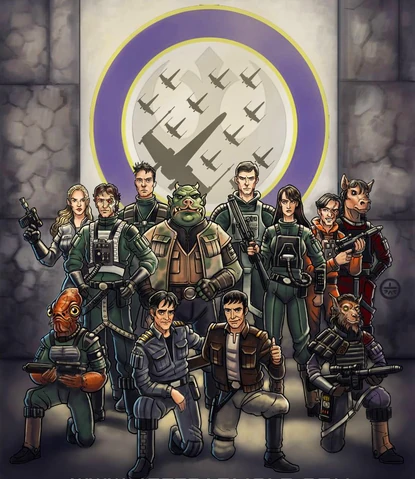
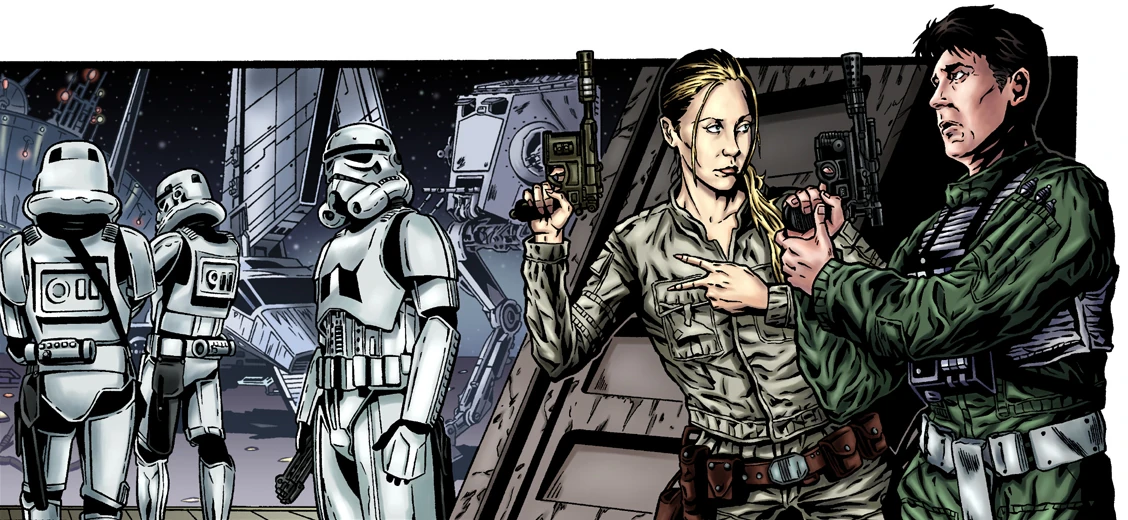
I was taking a bus to NYC recently on little sleep, and needed something to keep me awake and upright. So I started flipping through and rereading one of the Wraith Squadron books - Allston's first entries into writing Star Wars fiction. They focus on a ragtag bunch of near-washouts with nevertheless exceptional skills, multiclass commando/pilots tasked with special operations for the New Republic.
The three initial Wraith Squadron books center on the squadron's operations against Warlord Zsinj, an ex-Imperial warlord with a Super Star Destroyer who's managed to carve out his own personal empire (lowercase 'e' there). The Wraiths wind up staging multiple false-flag and covert operations, masquerading first as Zsinj's own forces, then as independent mercenaries...
As I was blearily paging through, I had a sudden realization born of equal parts brilliance and sleep deprivation.
The Wraith Squadron books (and to a lesser degree, their Rogue Squadron predecessors) serve as a great how-to for setting up an insurgency-focused RPG campaign. I don't just mean that they're crackingly fun novels about an insurgency-style conflict (although they are that), or even that they feel akin to the vibe given by the best parts of the WEG Star Wars RPG (although they are that too). The Wraith Squadron books give you a sample set of characters (and showcase their evolution over time), raise a clear set of problems that insurgent cells might face, and provide examples of how to structure a campaign framework that meaningfully combines strategic decisions with engaging roleplay-friendly tactical frameworks (the traditional "adventure session").
The Wraiths do seem like a traditional PC selection - one part Central Casting (Star Wars), one part goofy off-the-wall character concepts ("A Gamorrean mathematical savant!" "Imperial double agent with artificially induced dissociative identity disorder!"). But the most interesting thing for RPG purposes is the framework that Allston places the Wraiths in.
There's a bit of throat-clearing in the first Wraith book (character introductions, training montages) but it gets going with a interesting problem that the PCs have to wrestle with: most of their X-wings are disabled in space, and they're pretty sure that a hostile ship is inbound to their location to scoop up the disabled craft. How do you deal with this?
In short order this turns into a new problem/opportunity - 1) you've captured the hostile ship that was coming for your squadron, and 2) the enemy doesn't know that you've taken it. What do you do? How do you turn this into your advantage, in an open-ended setting with no immediate mission orders beyond "deny the enemy"? (Oh, and 'how do you modify the ship to be cooler,' in swift accordance with the gear fascination that regularly crops up in RPGs.)
As I've written before, special operations make for a compelling campaign framework. The Wraiths continually have to deal with resource shortfalls - both personnel (as casualties mount) and starfighters (generally their most effective, but also most irreplaceable, equipment asset). Missions are designed, on both sides, with the objective of gathering factual intelligence, but also an understanding of the motivations and personality dynamics behind the opposition.
Wraith Squadron, by Jeffrey Carlisle
(WotC, Galaxy at War)
The additional component that the Wraith Squadron books bring is a discussion of sources of power, legitimacy, and the dynamics of control - the heart of an insurgency discussion. Directly duelling Zsinj is repeatedly shown to be a mug's game - he refuses to give direct battle with his fleet unless he has a clear numerical advantage, and only fights on ground that he has chosen (something most explored in the third Wraith book, Solo Command). Here, Zsinj is in the position of the insurgent against the incumbent New Republic. The NR forces wind up gaming out a few possibilities - how is he maintaining support? What are the crucial components of his empire's infrastructure, and the sources of his legitimacy? Insurgencies are about convincing a population that you are going to be a better source of government than your opposition (however that population ranks 'government'). This is the fundamental objective of an insurgency-centric RPG campaign as well (regardless of which side one's on, insurgent or incumbent) - degrading your opposition's capability to govern and exert force, while demonstrating to the populace that you're able to do better on those fronts.
Chris has written before about the incorporation of a Chaos Index into a campaign to present a campaign framework that reacts to player actions. (If curious to see a worked example of a chaos index, check out Misty Isles of the Eld; all of the Hill Cantons products from Hydra have Chaos Indices but Misty Isles is the most directly helpful for today's discussion). As Chris alludes to in his blogpost, the Chaos Index framework has origins in the political track that some wargames incorporate to determine the allegiance of a population. So here, we're bringing the Index back to its roots.
Wraith Squadron, by Joe Corroney
(WotC, Star Wars Gamer #9)
If players are taking on the role of an insurgent cell, then it makes sense for the GM to track two variables in particular: the "Heat" that player actions have generated, and the population's inclinations towards one side or the other. (More ambitious GMs might wish to track the population's affiliation towards each side on its own separate track, in order to model disillusioned populaces who can trust neither belligerent, or populaces seeking alternative governance when one side is insufficiently responsive.) As players continue to take action, Heat will continue to rise, and the incumbent will devote more and more resources to countering their actions and reasserting control over the areas that the players are striking at. Notably, Heat will rise with both successful and failed operations - but if the players lie low for too long, the ability to win over the population will begin to diminish.
On the other hand, if the players are the incumbent, then the inclinations track might be paired with a Public Will or Official Support track; as fighting and conflict continues on, the incumbent's capacity to exert sustained influence begins to wane. So the incumbent has a strong desire to bring things to a head quickly...but the quick way is often the way that decreases legitimacy, and therefore decreases inclination.
Either way, dealing with an insurgency conflict is a fundamentally political issue, since it hinges so strongly upon gaining the support of the population (or at the very least, preventing their active opposition). It requires interaction and bargaining with with multiple factions, and mandates interaction with various stripes of leaders. This isn't 'just' a wargame, but a framework that combines strategic and tactical objectives with a deeply personal framework that makes it suitable for RPGs.
Have any of you dabbled with insurgencies in your games? What would you want to ensure is present?
One final note - as with any campaign framework dealing with war and conflict, an insurgency-centric campaign can go dark places. However, given the very real-world insurgency conflicts that we've seen over the past two decades, those dark places may touch too close to home for folks. Getting player buy-in (and evaluating the areas folks are comfortable delving into) is going to be crucial here.
Mercenaries have been a subject of fascination for me for ages. As a kid, I devoured books about the Flying Tigers and other merc pilot outfits, but also fell in love with Arthur Conan Doyle's The White Company and Corwin raising his army of Earth mercs to take Amber. Later, Glen Cook's legendary Black Company books and Steven Erikson's Malazan Book of the Fallen continue to loom large for me, as do Iain M Banks's Use of Weapons and Drake's Hammer's Slammers.
NC Wyeth's "The White Company"
Driving back home just now, I listened to a great interview on why Erik Price's plan for Afghanistan is terrible. Price, the founder of Blackwater/Xe/Academi/Constellis, was described by the guests as (among other things) "Gyro Gearloose" and "[a guy who] thinks he's Tony Stark but is really Lex Luthor." Hell of a listen. (See also this 2007 piece, by Paul Tullis and one of the folks on the interview, Robert Young Pelton.)
Prince's outlook, combining a strong religious fervor (and profit-motive driven amorality) with wildly ambitious ideas (both sensible and awful) rang a few bells of recognition in my mind from a gaming perspective. Price certainly fits the mold of a recurring NPC, if not a PC himself. His peripatetic post-Iraq schemes for BlackXeCademi (an abortive attempt to foment a war with Iran, creating an anti-piracy force in Somalia before abandoning his forces in the field to go rogue, creating an oil refinery scheme in South Sudan before being kicked out for trying to skim off the top) sound like the sort of harebrained ideas that, well, a bunch of PCs would come up with. And when I hear about Blackwater creating its own COIN planes and AFVs, visions of folks geeking out over how to minmax and optimize their own vehicles in GURPS or Traveller flash before my eyes.
Even while I listened with horror to the Blackwater podcast, a treacherous 13-year-old who lurks in my brain was going "that's so cooooool" at some of the Blackwater shenanigans. To be clear, the cool bits were more the homegrown vehicles and wild antipiracy plans than the civilian massacres, heedless destruction, and disregard for human life. (Those last bits are...kind of not so hot, to say the least).
Joel DuQue, for HareBrained Schemes's Battletech
This train of thought got me wondering why we don't see more discussion of PCs-as-mercenaries in RPGs. While there are certainly several games that do support this (Traveller and Battletech both pop primarily to mind, but also several games from this list - interesting to note the strong presence in all three lists of the Keith brothers), I don't know that there's too much support for the mercenary company in fantasy games. Certainly you have games like ACKS that integrate a wargame/economy system into the core rules, but given the presence of computer games like Mount & Blade and Battle Brothers, not to mention all the literary sources I've mentioned above, I'd have expected a bit more support and/or exploration of the idea.
So. What makes playing a merc campaign interesting? One of the settings I would have expected to cover this in more detail doesn't; Green Ronin's Black Company Campaign Setting fails to engage with what playing through a merc perspective ought to entail, instead treating the issue as simply "fielding a small army." (This isn't intended to slag the BCCS, which is one of like two d20 books that I have actually sought out and really like, but just noting what it doesn't cover.) Even worse is the AD&D 2e "For Gold and Glory," which lists a slew of uninspiring and incoherent Forgotten Realms mercenary groups and their Battlesystem statistics - perhaps expandable with work into something useful, but it would be hard going.
Instead, a better place to start is something like the Mercenary's Handbook for Battletech. This book (1st ed by J Andrew Keith - see above) lays out a few principles that help clarify what makes a merc campaign interesting:
Niclas Meldeman - "A Landsknecht Brandmeister"
It's about logistics, economics, and survival as much as it is about strategy and tactics. A merc unit isn't just about warfare and fighting - it's also about doing so at a profit (or else you wouldn't be mercs in the first place). While this can (if taken to extremes) lead to excessive spreadsheet management taking over play, it also helps focus the players on long-term decisions. While it's possible for PCs to take extraordinary measures to heal (or even resurrect) a single companion, it's harder to do so for whole units. Players have to conserve their forces and ensure that they're spending their money wisely. (As forces increase, player overhead does as well - perhaps a refreshing change for GMs who are all too familiar with player power creep combining with money meaning less and less throughout play.) This point seems like it might interact interestingly with the traditional "1 GP = 1 XP" rule for classic D&D.
The merc has two concerns to keep track of - the actions of their enemy and the actions of their employer. Corollary: the employer feels the same way about the mercs. Hiring a mercenary unit means that a state actor has delegated one of the state's core functions (the monopoly and control of violence) over to an actor that is operating from financial gain. This sets up a slew and a half of dangerous incentives for both patron and mercenary. Shadowrun is infamous for including a stereotypical "Mr. Johnson" patron who generally intends to screw the players over upon completion of the job (either because they Know Too Much or to avoid paying the contract.) Battletech takes a more subtle approach, with constant struggles between patron and merc regarding both payment and the amount of control that the patron will ultimately be able to exert over the mercenary unit. Long-term, the mercs have to worry about being hung out to dry, sacrificed for either financial gain or simplifying the playing board. In turn, the patron has to worry about the mercs being unreliable (failing to fight or turning their coat) or even staging a coup once they're in a commanding position.
It's not all about the fighting.
As I mentioned, many discussions of mercenaries in RPGs (primarily fantasy gaming) seem to abstract mercenary play to merely mass combat. However, this undersells several of the strange and outre mission types that lend themselves exceedingly well to RPGs in particular - the ones that require out-of-the-box thinking and unusual actions to supplement maneuver and force. In the Mercenary's Handbook, Keith identifies a few contract types that fit this bill: cadre duty, security/riot duty, siege warfare, recon and objective raids, and guerrilla warfare.
These contracts place the players in situations where they either have interesting responsibilities not usually present in PC groups (shepherding and training green troops, conducting security rather than breaching it), or situations ideally suited to PC organization and scheming (infiltration to shorten a siege, guerrilla warfare). These are frameworks which offer social interaction, sneaky tricks, and lateral thought a chance to shine alongside direct application of force, while giving players increased resources (and responsibilities) to manage.
A mercenary campaign is a shortcut to domain game play.
Classic D&D has the domain game - rulership, land management, and building a kingdom/dynasty - as a traditional endgame. The mercenary campaign lets players engage with a section of those widgets earlier than they might otherwise (and in novel ways that don't quite match up to standard domain game play). It also places PCs in a situation where they have to engage with the broader setting, interacting with movers and shakers in a situation where the PCs have got an inherent value and potential leverage for the bigwigs.
Rievers' raid on Gilknockie Tower, G. Cattermole
The most difficult component of a satisfying mercenary RPG campaign will be economic balance and a satisfying campaign economic system. Normally I'm not too fussed about game balance, but since the merc campaign revolves around keeping the company in the black and not the red, this component will need to be robust enough to keep a core gameplay experience satisfying.
The next component is a good, quick, and easy-to-integrate/translate mass combat system. (It is a merc campaign after all. Even though force on force conflicts may not be the core gameplay from session to session, you'll want to have a robust enough system to allow players to take on force engagements in a fun and engaging manner. (You'll also need players who are interested in mercenary gaming, but that's not really something I can provide assistance with here, beyond noting that such players are objectively smarter and more attractive than others.)
It's a tricky thing to put together and organize. I've tried before and had it either peter out or crash and burn very rapidly. But I'm convinced that there's a core gameplay loop here that's immensely satisfying, and I want to explore this space further.
...or maybe I just want to field some homegrown AFVs along with some landsknechts.
How have you worked war and mercenaries into your campaign? What's worked and what hasn't?
Evan asked me "How do I get into Dark Heresy stuff if I normally find 40k impenetrable?"
Well, the short answer is to go read some Dan Abnett - the Eisenhorn and Ravenor trilogies. Yes, that's a big chunk of text - but they're good reads. Not just "good licensed fiction reads," but actually good reads in their own right. And if you're like me, you'll read them and instantly go "Crap! I really want to be playing in a Dark Heresy game right now!" (#121). Hell, just reading the Ravenor prologue does that for me.
But that's a mediocre response.
Here's my take on Dark Heresy: it's 40k, but it's not about 40k. Just like Warhammer Fantasy takes the Warhammer tabletop minis game and diverges into its own universe, so does Dark Heresy diverge from the 40k tabletop game. Frankly, I suspect the less chance there is for a single damn Space Marine to show up the better your Dark Heresy game is going to be. (Also note that this is all my take on the concept of Dark Heresy, not necessarily one that's borne out by the actual rulebooks or published background or whatever.)
Warhammer Fantasy has an implicit setup of "average folks making their way in a crapsack world while dealing with the hidden spectre of Chaos creeping out to gnaw at the roots of society, Ratatosk-like" Obviously individual campaigns can diverge from this, but it is an assumed backdrop. Dark Heresy isn't too far off - except instead of average folks, the assumption is that you're playing agents of the Inquisition, and the assumption is somewhat less sandboxy than WFRP can be.
The existing games that I think are most valuable for getting into the Dark Heresy frame of mind are Delta Green and Night's Black Agents.
In both DG and NBA, players are tasked with uncovering what's really going on. They're games with a high focus on tradecraft, investigation, and ambiguity. Sure you have the ooky monsters who are the baddies (Mi-Go and other Mythos creatures, vampires) but dealing with the mundane threats of exposure, corruption, betrayal, and secrets form a major component as well. Dark Heresy fits the same paradigm - you're working your way through layers of conspiracy and skullduggery, trying to trace these things back to their source, while attempting to avoid being found out by the opposition or burned by your bosses.
In all of these games, the players have access to a great deal of power, with a catch involved. In Delta Green, the PCs (usually) have the apparent weight of the federal government...counterbalanced by the fact that they're operating rogue, without actual federal auspices, and therefore have to remain covert. In NBA, players are frickin' movie superspies with all that entails, but AFAIK don't necessarily have official backing (and/or have a strong likelihood that the official backing is actually compromised by vampires).
I tend to see Dark Heresy as taking the option that's most advantageous for the PCs from both of these, which is not necessarily a bad thing. The PCs are pitched as being strongly competent agents - perhaps not the superspies of NBA but not too far removed from them either. And unlike the doomed agents of Delta Green, Dark Heresy PCs usually do have the full weight of the Inquisition behind them, assuming that their relationship with their Inquisitor isn't frayed, or that their Inquisitor isn't actually involved in one of the conspiracies themselves...
Does this large throw weight decrease the interesting options for the players? I don't think so. As the scope of player power expands in Dark Heresy, so does the scope of both the threats and the universe. The conspiracies they're fighting, both supernatural and mundane, have their tendrils in just about everything. And again, these tendrils can be of either the supernatural or the mundane sort.
Also worth reading when thinking about Dark Heresy: Zak S's "Zero Dark 29, 28, 27...", which discusses the difference in paradigms between Night's Black Agents and Call of Cthulhu. Check out the bit about revelations and showdowns, reading (in part):
Games relying mostly on Showdowns want the world to feel connected and, ultimately, knowable--everything is about you and your big fight coming up. Games relying on Revelation want the world to feel abstract and unknowable--everything beyond you is a mystery in the great beyond.
In the revelation story, the players are small and the world is large. In the showdown story, the players are large and the threat is large and the world is a backdrop.
Dark Heresy is mostly focused on showdowns, with the focus being on hostile conspiracies, but I believe that those showdowns work best when leading to a revelation - that sort of peeling back the curtain and seeing that despite all their power and influence and clout the PCs are still just tiny smidges against the unknowable.
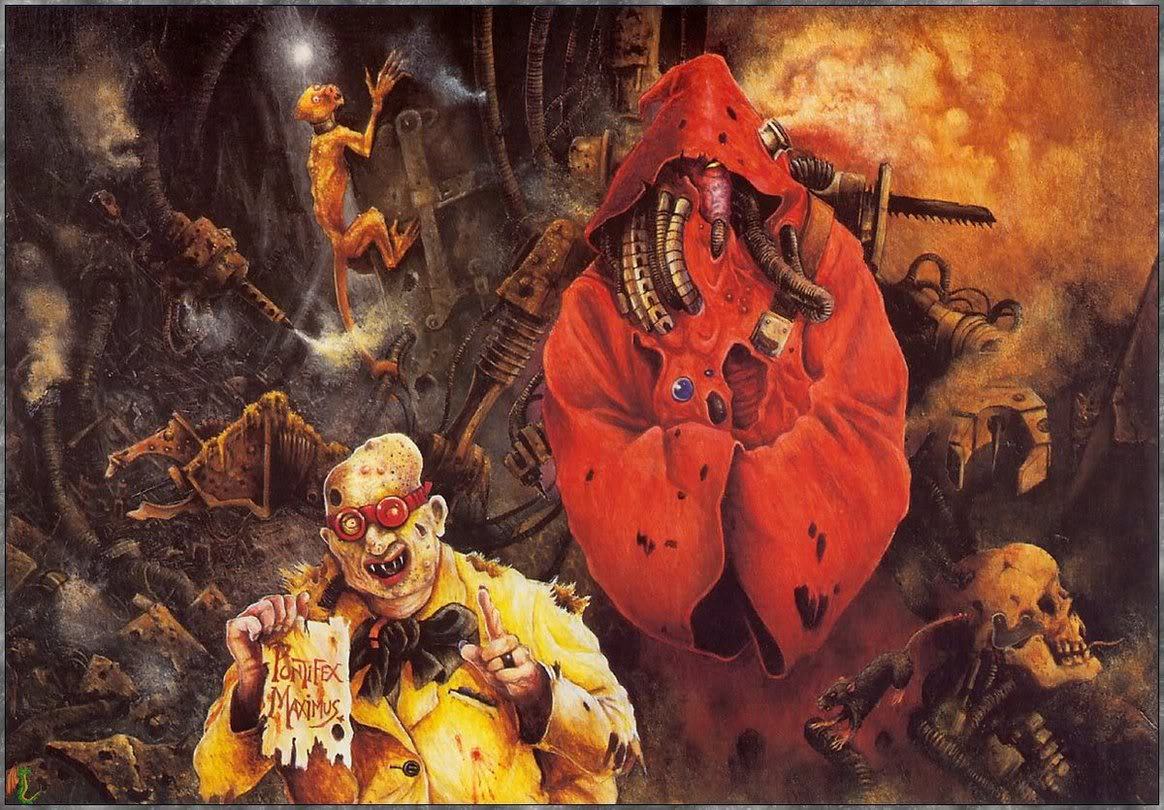
Other must-reads for Dark Heresy play are Chris's series on constructing sandbox networks (here, here, here) Robert's discussion of a campaign frame for Marvel '78 (here), and Evan's own related Superheroes Year One work - obviously you'll have to do some tweaking here to get something appropriate for Dark Heresy rather than superheroes. I view those last two as the "main phase" of a Dark Heresy campaign, after an initial startup seed -- the main focus of play is trying to strike a balance between thwarting the hostile actions of conspiracies within a bounded area (planet? subsector?) and conducting the investigations to root them out.
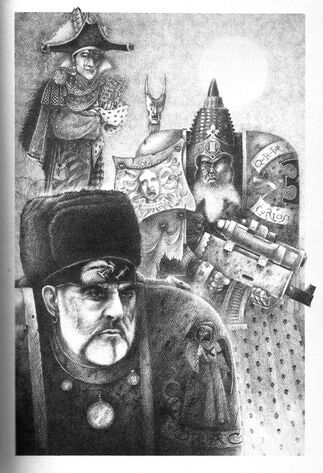
"Pontifex Maximus" John Blanche
So why the hell would you want to play Dark Heresy?
You
want to play this if you're looking to strike a middle ground,
gameplay-wise and tonally, between Delta Green and WFRP. Both NBA and
Delta Green take a strong focus on the psychological well-being of the
agents and seeing how they spiral into depression and sadness and lose
their bonds with their family members and stuff. That's all well and
good, but it's not what I want from my general gaming. Sometimes you want to be able to fearlessly blast beings of Chaos with a plasma pistol (and have a minuscule chance of taking them down), instead of your character heading straight to PTSD-ville.
(As
a side note: Dark Heresy and the wide-open nature of the 40k setting means that you can do things like going from a
big ol' Blade Runner/Coruscant cityscape to a Mad Max planet to
basically anything that you might see in Traveller, and it'll all fit
just fine. Plus mutants, zombies, and the undead, which I suspect might
be a selling point to anyone who might write about a Galaxy of Fear.)
Dark Heresy provides you a venue for playing through and unraveling fantastic espionage and conspiracy in a high-powered environment (allowing for genre shifts when you want a change of pace). Depending on how high you want to ramp up some of the 40k elements, it can have paranoia, PARANOIA, or both.
So how to get into Dark Heresy? Well, you could read Eisenhorn or Ravenor. You could stick Traveller, PARANOIA, WFRP, Delta Green and Night's Black Agents into a blender. You could look at a bunch of John Blanche art, read Dune and Tinker Tailor Soldier Spy and 2000 AD, watch Dredd...
A few days ago, Trey wrote about his preferences in play for gaming, after being instigated by known rabblerousers and troublemakers Jack and Paul. This looks like a neat exercise, so I figured I'd jump in.
So what do I want out of games, tone- and presentation-wise?
"What do you want?"
I like my characters to fall into the "mercenary heroism" box - they're trying to strike it big and succeed personally, but they're also willing to lend a hand and help out those in need. The convenient thing here is that this sort of character can mesh decently with the standard Vancian scoundrel that seems to serve as the baseline for OSR play. (A sidebar to this is that I also want there to be factions and groups who aren't wholly corrupt and awful; I want there to be someone, even flawed someones, I can root for and support.)
I enjoy a wide variety of tone in terms of what I play, but I strongly prefer running games with very high potential lethality. I try to leaven this a bit; I don't want to have a character meatgrinder situation, and I want to make sure players aren't feeling disheartened or frustrated with the game. There's something that's particularly compelling about the idea of the survival horror situation, with everyone desperately attempting to stay alive and the idea that nobody is safe, and I do gravitate towards that.
I crave weird unusual worlds with depth and internal coherence. I want games to feel like their settings are lived-in, that there are people present rather than Background NPCs.
I really love tense dungeon exploration. There's something special about creeping along at low level trying to make sure the next room, monster, trap, or whatever doesn't kill you - about frantically improvising something, anything, to jury-rig your way out of trouble. I'm perfectly happy with other environments, and do relish the chance to engage with NPCs in a city environment rather than the confines of the dungeon, but...man, sneaking along. It's great.
I like roleplay and funny voices and having that roleplay drive the action, rather than loading that all onto the result of a Cha check or equivalent. I don't want that for every single interaction ("Holy crap you're going to be haggling over another cloak?") but for the major significant ones, I want the focus to be on the players and their creativity rather than the PC's stats.
ANYHOW. Watch this space; major announcement (for me) coming shortly, plus hopefully some more content and gaming ideas.
First-level D&D characters are fragile. At best they start out with d8+Con bonus for HP, and a general weapon does d6 points of damage. At worst, you're playing a mage (or B/X thief) with d4 on the hit die, and maybe even a Con penalty.
Adventurer, Erol Otus, B/X Basic Rules.
Some games in the OSR family try to mitigate the fragility of 1st-level characters, either with boosted initial level, max HP at first level, or even HP kickers like Hackmaster. And some games (OK, just DCC) embrace the idea of having a bunch of schlubs enter the dungeon, and toss players a 4-pack of characters, with the expectation that some of these lunkheads are, by definition, going to die screaming.
But with most of the games as written, the rules mean that you're probably going to see a lot of low-level PC death. Some have remarked on the enhanced characterization that this gives the survivors, and there have been oodles of posts about why PC death-as-stakes (or just death) is interesting and intriguing.
I just saw an article on NPR discussing the intersection of (video) gaming and learning, where author Greg Toppo touches upon the utility of repeated failures in engagement and learning (bolds mine):
I guess I look at myself as a learner and see value not much in the ability to fail but what happens next. That is, you do something, you fail at it and you are able to try again with essentially no comment on it. A good game doesn't say, "That's the 34th time you're trying. You really sure about this?" Nothing transpires except your next chance. For me the most vivid experience of this is playing a motorcycle racing game once. I was so bad at it. I kept hitting the reset button again and again and again. And at one point I went back and looked how many times I'd restarted this level and it was something like 1,800 times! So it's not so much failure but the lack of comment around the failure and what you do afterwards.
This sounds remarkably like the experience that roguelikes and Dark Souls tap into: progress, but a lack of comment on failure and an encouragement to keep trying, generates significant engagement with the material.
In some videogames, like Mario or the motorcycle racing game that Toppo mentions, the engagement and learning generates a familiarity with the map and the level progression ("OK, I have to hit jump HERE to make it past this pit, and then there's an invisible block THERE that lets me get up high..."). In roguelikes, there's more of a focus on learning how to play -- while obviously you learn about Mario's speed and jump capability and can gauge things better in the fixed-level games, the roguelikes keep hitting you with a fresh new environment each time.
Again with the Great Heap, guys?
You don't wanna check out some of
the other caves...?
What strikes me as interesting about D&D is that it offers a combination of the two - if an adventurer dies in the Slumbering Ursine Dunes (capitalism, ho!), their party is likely to still be in the region, and the adventurer's death provides information about the site and its inhabitants, AND affords the player more insight into what they can and cannot likely get away with. It's a return to a dynamic, rather than static, version of the environment. (Perhaps this is why Jeff was so tolerant of all of us bumbling around in the same parts of Wessex forever!)
The other component of Toppo's statement I found interesting is the idea that it's a lack of comment around the failure that fosters continued experimentation. This bit has been touched upon by other folks elsewhere (noting the difference in character generation times between earlier and later editions of D&D, serving as a strong disincentive for risky / exploratory play, since the tedium in generating a new character serves as an implicit 'comment').
Rey had a nifty post over here discussing a cool idea, where fighters can wear ridiculous outfits and gain the equivalent of chainmail armor class. My first thought was "I totally want to steal that" and my next thought was "Definitely shouldn't steal that."
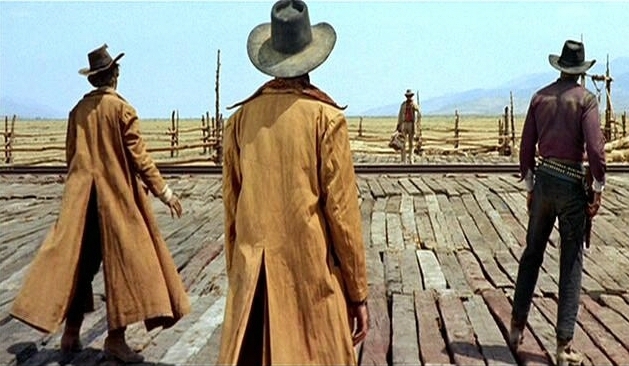
Or at least, definitely shouldn't steal it for Legacy of the Bieth. I'm shooting to have a certain theme and atmosphere in my setting, where things are washed out and sun-blasted and Sergio Leone cinematography, even in the Zone itself. The fancy peacock outfits of the Imperials and other city slickers wilt and fade in the borderlands. Life means little, death sometimes has its price.
Once Upon a Time in the West
I find myself finding all sorts of things that sound really cool, but I've got to keep reminding myself about what I want in my setting and how I need to get that across. Once I've gotten that established in the setting (and importantly, convinced myself I've gotten that established in the setting), then I can maybe start to expand other areas and use some of the cool bits I've seen elsewhere. But until my stuff...makes its bones, for lack of a better term, I don't want to start heading out of the areas I need to get right.
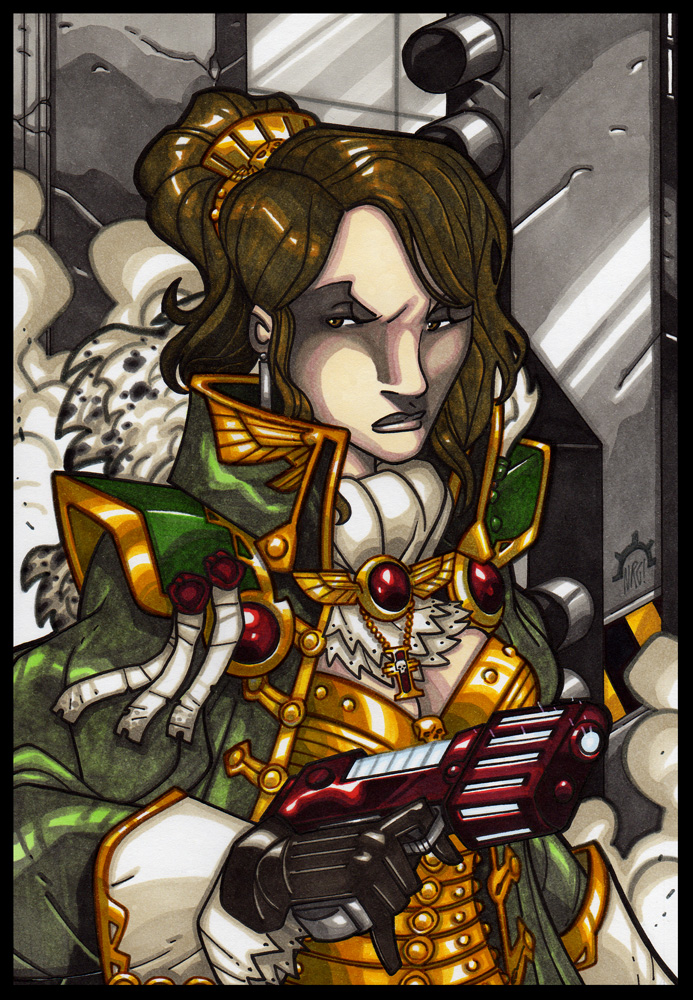
The same thing applies with the 40K stuff I'm working on. I need to get the right balance between the weird and grotty John Blanche of the early days
"Jaq Draco" - John Blanche
"Ryan, be careful what you shoot at.
Shome things in here don't react too well
to bolter shells."
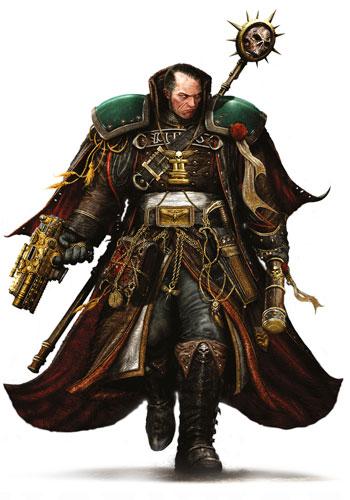
...with the slick fancy Adrian Smith stuff
"Eisenhorn" - Adrian Smith
"I am a badass despite the fact
that I am also ludicrously microcephalic."
And the question there is going to determine how I reshape everything. I know I want to have something that embraces a lot of the universe and setting assumptions of early 40K, but I know that I want something of the slickness and baroque tomfoolery that goes along with Dark Heresy and the Abnettquisition works. Early 40K fits in really well with Traveller (at least the STARSLUGS Traveller I've been playing recently), but it's an Abnettquisition premise that I've been noodling at for about two years that's got me started on the conversion process in the first place.
None of this is dealing with players, mind you. They're going to keep engaging in their ridiculous-awesome plots and crazy shenanigans and not giving a crap about my fretting over themes. As well they should.
Joesky Note: Dark Heresy weapons and armor would be a pain in the ass to convert into Traveller's regular combat system. Thankfully, the alternate combat system that Sun-Lord Chris posted over at Hill Cantons actually allows for really rapid conversion. The penetration and armor values from Dark Heresy can come over into Traveller almost directly (with a few tweaks to account for Traveller's baseline weapons assumptions).
(Yeah, this isn't a full tax. Shut up, I'll do more later.)
This is a cross-post from a forum I frequent, Intangibility. A lot of the stuff here is commonplace wisdom among the folks likely reading this blog, but I figure it's worthwhile for me to get my thoughts out on this, if nothing else. So over on RPGnet someone posted a question about how to make exploration exciting and fun in RPGs. I've been having some good luck with this in the Hill Cantons (~2 years now, forth the Nefarious Nine!) so I thought I'd start the ball rolling on a parallel discussion here. Chris has a few thoughts here and here. From the player perspective, some things that have worked well for exploring the Hill Cantons (but now flipped around as statements to the GM) have been: Dungeons a) Having a coherent theme/themes. It's important to have dungeons that are not only weird and fantastic, but also have a structure and logic to them. Being able to determine things about the dungeon from your surroundings helps fix the environment together and provide ideas for what else can be around, driving exploration efforts.
Concept Art for Linage II
b) Using random encounters to provide time pressure. This means that choices have a significance to them because the longer you take to explore, the more dangerous the site becomes. c) Jacquaying the dungeon. Creating interesting structures to explore, that have multiple branching paths. Weird geometry, shortcuts, loops - these things make exploration exciting, provide opportunities for sudden windfalls, and suggest new ideas. ("This flooded tunnel might be a path to the next level; let's see if we can figure out some way to get through it!") Wilderness
Unsure of this image's origin, alas
a) Provide options. In contrast to the dungeon, where you're navigating a presumably utterly unknown environment, I think wilderness exploration benefits from having known landmarks as guideposts to provide immediate areas of choice. The dungeon provides a series of constrained options ("doors are north, south, and the trap door in the corner leading down") but the wilderness is wide open. Give players a map and let them know what the major things around them are! Those options serve as the initial "dungeon doors" of exploration, providing the option for players to set goals and formulate plans. But remember Korzybski here: the map is not the territory. Toss in curveballs, make the map inaccurate (maybe let the players know beforehand that it may be inaccurate!) and add in things that the mapmaker may not have known about. b) Provide for altering the wilderness. In the HC, we're in a pseudo-domain-game stage, which requires clearing and holding hexes (exploring to make sure they're safe for regular folks, then establishing control over them through patrols), giving us an opportunity and incentive to interact with the environment. Both a) Recognize that you're going to create and prep areas which may not see the light of day. THAT IS OK. Part of exploration means that you're likely going to miss things. b) Have interacting parts. Don't make each hex / dungeon zone it's own little bubble. Have groups move around and interact with each other and make use of their surroundings. (A multitude of factions also provides players with another reason to explore: being able to find allies and/or Yojimbo their way through trouble.)
All of these are centered around making exploration contain meaningful choices. Someone on the RPGnet thread suggested that exploration is like a slot machine hit. I think it ought to be more like a hand of poker or blackjack; a slot machine is completely random, but blackjack and poker both require the application of skill along with the randomness to provide an (arguably) more compelling experience. Chance should most certainly play a role, but exploration should also make use of player agency and decisions.
Following on from my Titan-bumrushing colleague, I'm going to take a look at some rules I don't really use in my D&D games these days.
Alignment - Hell with alignment. I'm not really into the Great Cosmic Forces clashing right now - it can work awesomely, as it does in the background of the current Hill Cantons campaign, but it's not my bag in terms of what I want as a setting element. And if you're not going to have Zelaznyesque or Moorcockian grand sweeping alignments, then you don't particularly want it as a behavioral guide for PCs. Or at least I don't.
Encumbrance - ehhh. It's a legit thing, and there is something to be said for incorporating logistical issues to a great extent in one's dungeon delving. The trouble is that it's fiddly and the best fix I've seen (LotFP's implementation) works a bit more awkwardly while playing over G+, which is where I get the bulk of my gaming done these days.
Experience - I know I want to add XP for exploration and discovery, beyond monsters slain and treasure looted, but I need to hack together (or steal) an effective system for doling that out. Or just award arbitrary amounts, but that seems a bit off. This might be something to loot from D&D 5e if they put together something cool; I know that there's been some discussion of a more gamey exploration element.
Movement Rates - Rey mentioned that he lists things on a Very Slow - Very Fast axis. Hell, I don't even bother listing them.
Rey lists Flat Bonus Magic Weapons/Armor, but I don't think that even counts, because everygoddamnone has realized by this point that there isn't anything interesting in a +1 weapon without giving it context and personality.
Magic, In General - building off of the last bullet point, I've cut direct-damage spells and resurrection magic from Legacy of the Bieth. (As I say this I realize that I might want to have a resurrection mechanic, but it's far more involved than finding a sufficiently high-level priest, and of the Unfortunate Consequences variety.)
Weaponry - Any class can use any weapon; this primarily shows up in restricting cleric weapon selection, and honestly it doesn't matter that much if your cleric is using a mace or spear or shamshir they're going to get mutated and die horribly just like everyone else.
The Mark of Amber review has stalled out because work and studies have ramped up a bit, but it is not forgotten. (Nor are, y'know, actual game materials for this setting.)


.jpg)











.jpg)
