Showing posts with label Items. Show all posts

Friday, August 3, 2018

Incense of Integration

Feline Incense Burner - Louvre
Khorasan or Central Asia, 11th Century
A talisman is a spirit within a body...it is domination because its essence is coercion and control. It functions according to the purpose it was composed for: overpowering and coercing, by using numerical ratios and placing astrological secrets in certain bodies at certain times and by using incenses that are powerful and capable of bringing out the spirit of that talisman.

-- Anon., The Goal of the Wise (Picatrix), Trans. Hashem Atallah, Ouroboros Press, 2007

Talismanic magic, the domain of the most talented astrologers [and a likely new magic system to be detailed later -- Ed.] is a form of sympathetic magic. It requires that the magus establish arcane similarities between a configuration of the celestial spheres and an earthly vessel (a talisman), then use incense as a conduit for a minor jinn* to manifest and inhabit the talisman. Once the jinn has entered the talisman, the device becomes "charged" and will begin to enact its work.

Selection of the incense is therefore crucial. The right blend of ingredients to tie together the earthly requirements to align the talisman with its task, and the conditions of the talisman with the stars it seeks to emulate, is a delicate balance. An error in selection is therefore the difference between the lightning and the lightning bug.

Some of the foremost astronomers have developed incense of integration, a particular blend of ingredients which helps evoke the heavens and assists in aligning the physical construct of the talisman with the desired celestial configuration.

Mechanics:

Selection of the proper incense ingredients is made by rolling against the mage's Int on 4d6. The GM should provide bonuses if the player can present items which can establish a connection of sympathetic magic (hairs off the bandit's beard, resin from the Caliph's garden, etc.) and are present in sufficient quantities to make some incense.

Using incense of integration in the proposed blend allows the magus to reroll a failed Int check in incense selection. If, however, this second check is failed, there is a 2-in-6 chance that the talisman will operate in reverse.

*The term is...imprecise; this is as much a jinn as a Firanj "kobold" is a human.

This is my second entry in Dan D's #DIY30 Challenge.


Source: The Goal of the Wise (Picatrix), Trans. Hashem Atallah, Ouroboros Press, 2007

Wednesday, July 15, 2015

The Powder Spoke

Halfway home they fought to see who should marry the woman. The powder spoke between them. Our man killed four, and took the woman home and married her. 

- "The Ogre and the Beautiful Woman," Amazigh Folk Tale 
"The Arms Dealer"
Charles Robertson

Ever since reading that line, I've been hankering to create some firearms rules for Legacy of the Bieth. It's certainly a bit achronistic from my stated time period of 11th-century Egypt and MENA...but this is all about a game where you've got magic and apocalypse and psychic warriors, so I'm pretty sure it can handle a few guns showing up. Besides, my primary inspiration for feel is Sergio Leone westerns, so firearms obviously fit in with those.

(FIRST DRAFT OF) FIREARM RULES

All firearms available in Legacy of the Bieth are matchlocks. That means that you've got a lit match slowly burning away as you go do your adventuring thing. It glows in the dark, can go out, etc.

Musket: 1d10 damage, two-handed, range as heavy crossbow. 80 gp.
Carbine: 1d8 damage, two-handed, range as light crossbow. 60 gp.
Pistol: 1d6+1 damage, range as light crossbow. 60 gp.

Firearms ignore standard armor and most monster ACs (fur, scales, etc); targets are considered AC 9 (plus any magic or Dex bonuses). Reloading takes d6+1 rounds.

All guns can be fitted with rifling at double the price, which adds a +1 to hit (and makes reloading take an additional round). Carbines and muskets can be fitted with snap matchlocks, which also add +1 to hit and an additional round of reloading for double the price (quadruple base price if fitted on a rifled gun).

I would be remiss if I didn't thank I. Wooley  and Kevin Crawford for some helpful discussion of firearms in an African context over at G+, which definitely influenced these rules.

* * *

I should mention that I helped edit Fever-Dreaming Marlinko, which is now available in print and PDF. If you want a "acid-fantasy" city supplement which skips tedious house-by-house descriptions of a city in favor of quick and readily gameable notes, random encounters, a Chaos Index, and a tiger-wrasslin' game, then you probably want to check our work out.

(TIGER WRASSLIN')

Wednesday, September 4, 2013

Equipment List Additions

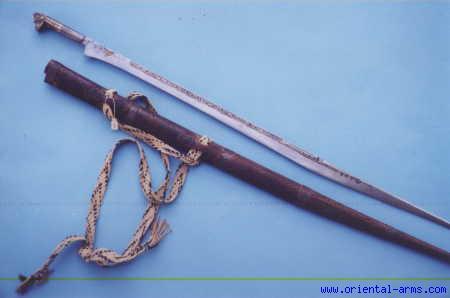
Flyssa
Flyssa
Photo from oriental-arms.com, found here.
Traditional sword of the Freelanders. Single-edged, with the blade tapering, then flaring out again before tapering to a full point. Deals d8+1 damage, cannot be purchased in towns.

Arrow-guide
The arrow-guide is placed on the interior side of a bow and allows for greater pulls on the bow and heavier arrows, yielding greater damage and armor penetration (though causing a penalty in accuracy). Users take a +2 bonus to their attack rolls, but will roll twice and take the worse result. Increase the bow damage die by one (so a shortbow fires at a d8, a longbow at a d10) while using heavier arrows. The arrow-guide costs 5 dinars; the heavier arrows cost double normal arrow costs.

Assegai
The assegai is a short (2') stabbing spear with a leaf-shaped blade, not suitable for throwing. It deals d8 damage but cannot be used for second-rank attacks. It costs 10 dinars. 

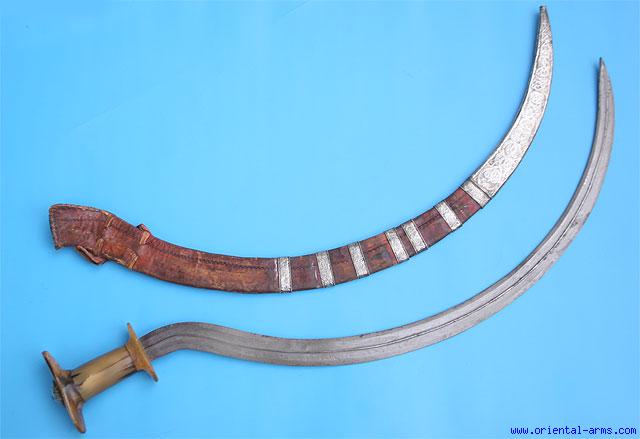
Shotel
The shotel is an extremely curved sword. Its unwieldy nature gives users a -1 penalty to hit in close quarters, but it deals 1d6+1 damage and ignores the presence of shields. 12 dinars.
Shotel
Photo from oriental-arms.com, found here

Naft Projector

Proposed Greek fire naval projection system, Haldon and Byrne
From Wikipedia's Greek Fire article
The naft projector, as designed, is not viable for individual use, but can certainly be mounted on ships or placed for structural point defense. Naft is similar to Greek fire; the projector heats the naft before spraying it out through a brass nozzle under pressure (50' range). Individuals within the firing arc of a naft projector must save vs. breath weapon or take 1d10 damage for 2d4 rounds. Not a staple naval weapon because you're creating a fire on board your ship and transporting an extremely hazardous chemical; choppy seas can result in... awkward results.

(I mention not viable for individual use "as designed" because I'm sure some murderhoboes are going to try and find a way to McGuyver this for use in a dungeon.)


Naft Grenade
Greek fire grenades
Athens National Historical Museum
From Wikipedia's Greek Fire article
The use of flaming oil has a long pedigree in D&D, but naft grenades make that easier. A naft grenade has a pre-inserted wick that can be lit and the grenade then thrown; it will deal 1d10 damage as long as it burns. Each round it burns, roll a d4; if the roll is greater than the number of rounds it's burned, then it keeps burning. (So on the first round of burning, it will continue to burn on a 2-4; on the fourth round, it will go out). Naft grenades are officially restricted to use by the military, but available on the black market for (d6+1)x10 dinars.


Lamellar Armor

Metal plates laced together to form armor; generally the heaviest armor that's regularly worn. Like scale armor, but lighter. AC 4, costs 50 dinars. While it counts as "heavy" armor for the purposes of environmental distress, distress checks are made with a +2 bonus (yay, airflow!)

Whipsword
Can be coiled up in a torc before being withdrawn. Deals 1d4+1 damage, but can be concealed easily. Available on the black market for (2d4)x10 dinars.
Whipsword
From Relaxic.net

Friday, March 1, 2013

Noms from the Bistro Californium

A German adaptation of In Viriconium
Flying from Albany to DC, I finally read through In Viriconium and the associated short stories by M. John Harrison. I'd read the first two Viriconium books, The Pastel City and A Storm of Wings, after my first go-around at the bar, but misplaced the omnibus during the move and hadn't had a chance to get to it again until now.

I will admit flat out that I didn't quite understand In Viriconium, at least in this first read. The individual scenes are there, I can point to how the characters move from point A to B to C, but it hasn't clicked for me as a unified story or a novel yet. I'll give it a second read in a while, I suspect - I had a similar thing happen to me with Lord of Light, when I read it several years ago.

The wonderful thing for me, though, was seeing the common threads dealt out in the various stories. The Pastel City sets out the basic components - Swordsman, Dwarf, Cellur, Viriconium Endangered - and tells a basic story. A Storm of Wings takes those same elements, shifts them around slightly, and tells a far more brainmeltier and interesting story, but one that follows on from the themes brought out in the first. Then In Viriconium takes the themes and elements and sets them at a 35 degree angle from their original point, while the short stories take the components and redeal them in small segments, like small readings from a tarot deck.

Anyway. A few D&D items came to mind from the books. This is a relatively boring thing to take from the books, with the far more interesting components being the ideas and feel of the novels. Perhaps in some ways this is even going against the spirit of the novels, given the rejection of a clearly defined and codified setting. I mean you do have Harrison quotes like this: "Worldbuilding is dull. Worldbuilding literalises the urge to invent. Worldbuilding gives an unneccessary permission for acts of writing (indeed, for acts of reading). Worldbuilding numbs the reader's ability to fulfil their part of the bargain, because it believes that it has to do everything around here if anything is going to get done." But screw it, here are some items anyway.

From Ian Miller's illustration of The Luck in the Head
Baan / Forceknife: These weapons range from knives to shortswords in size; glowing a thin blue when activated and making a whining hum, they ignore all armor bonuses and deal 1d8+2 damage. A baan can cut through any mundane material. When a baan is activated, roll a d8; on an 8+, the baan will run out of energy after the fight or use in question. Add 1 to the roll for each time beyond the first a baan is activated in a day.

Fulthor's Armor: This set of banded mail +1 emits a dull, pulsating blood-red glow. The strange joints make it uncomfortable for most wearers, giving them a -1 to their Dexterity and a -1 penalty to attack rolls. If the wearer encounters something technological or suitably ancient, roll a d20. On a 16+ the wearer understands the device's function and some of how to activate it; on a 2-4 the wearer goes into reverie for 1d6 hours, and on a 1 they enter reverie for 1d4 days. In the state of reverie, the wearer is locked into visions of the past and must babble unintelligibly about what they see. They can be led about, and can somehow fend for themselves in combat, but ohhh, it's going to be a long and frustrating time.

Iron Wife: This is a series of metal "bones," forming a second skeleton about the wearer. The Iron Wife rises to about 11 feet high; it is treated as the equivalent of plate mail, and its wearer's strength is raised to 18. The Iron Wife takes 30 minutes to power up from a cold start. Each hour of operation, the wearer needs to make an Int check to keep operating the Iron Wife. For every month the wearer is exposed to the radiation leaking from the Iron Wife, they must save vs petrification/paralysis or take a -1 to all saves, cumulative until there is a -5 penalty.

Sword: This is a plain, unassuming sword of dark, almost black, steel. Its leather grip is darkened from sweat and age. It has no magical properties whatsoever.

Monday, February 18, 2013

Magical Items of Sanctuary, Pt 2 of X

Abu Fadlan's Finger
This thin chisel is wrought in the shape of a stylized finger, with a perpetually flaking lacquer of dark green. It cannot be broken save by magical force of some kind. Use of the chisel will speed normal chiseling tasks by about 25%. It can be used to chisel a message or glyph into an individual's flesh, an extraordinarily painful process - however the resulting symbols can only be seen under a waxing or full moon. It is said that with the right rituals, the viewing conditions can be changed (so that the message might only be viewable with infravision, for example).

(Inspired by Beedo's post here and items from Planescape: Torment)


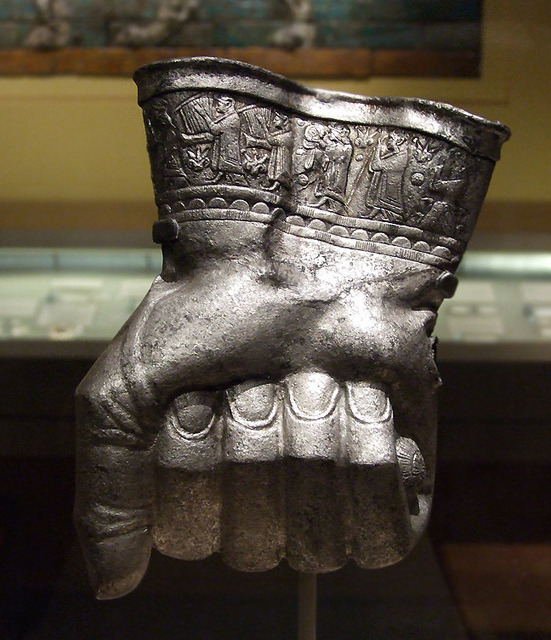
The Silver Fist
Actual artifact information here
Boston Museum of Fine Arts
Photo by Elissa Corlini 

This strange item is a hollow fist with several contradictory legends. There seems to be consensus that it was created by the sorceress Inaya the Seeker. Some say that it is to be used as a drinking vessel, and that drinking a cup of wine will imbue the drinker with great strength. There are also whispers of those who drank the blood of their foes - or their friends -from the fist and gained strange powers. These rumors have become stronger in the wake of the Forsaken War, given the horrific acts of the Awlad-i-Dimagh.

Others say that these legends are nonsense and that the fist is to be worn as a (very heavy) amulet. Calling out a name of a deity of the Many ("Ouathar") is supposed to reveal all magics within sight of the bearer, and that the Fist is able to store spells and magics within it for later use.

Still others insist that the Silver Fist is to be worn as a glove, that it can be used to strike the insubstantial and to unleash bursts of force upon striking a foe, knocking them back.

Rimeplate

Plate mail is exceedingly uncommon in the environs of Sanctuary, because of the fatigue and discomfort that generally accompany the armor. The Rimeplate is an exception to this general rule. A suit of glimmering blue-tinged plate, the Rimeplate is cold to the touch. If someone actually puts on the armor, they feel a freezing chill throughout their bones as the armor's magic activates, and frost actually begins to form on the edges of the armor. If donned, a wearer loses all Dex bonus and is at -1 to all attacks and  -2 to all saves from the cold, but the Rimeplate is AC 1 (or 19 if you prefer) and prevents any distress rolls due to hot weather conditions. If an enemy attack hits and would deal max damage, it must be rerolled once. At one point, the Rimeplate was in the hands of Caliph Perviz IV, who reportedly made one of his bodyguards wear the armor at all times, just in case the Caliph ever wanted a cold drink.


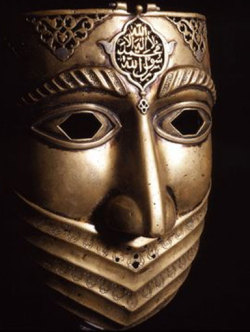
The Face of Battle


This war mask has been held for many years by marabouts of al-Kursi, one of the ribats located on the trade route back to the Imperial corelands. Passed down from one champion of the order to the next, the mask is said to have gazed upon countless conflicts and battlefields, even dating back to the time of the Bieth themselves.

The countless battlefields of slaughter that the mask has seen have imbued it with a deep knowledge of war; once per day its wearer may reroll an attack or damage roll that they have made,   or that was directed at them. If facing an unclean spirit or skinchanger, the holy verses inscribed on the forehead of the mask will glow a brilliant white, and the wearer will be able to strike more punishing blows at the being (reroll 1s on damage dice). However, in its zeal to strike down the foe, the mask urges its wearer into the fray; they must save vs spell in order to break away from a foe who they have engaged in melee combat. It also grants an extra saving throw against the first effect of the Zone its wearer encounters in a day.

After using the mask for approximately a week, the wearer's features will start to resemble the metallic features of the mask; their mouth will not disappear, but will start to conform to the v's of the mask's stylized beard. The wearer's dreams will always include battle.

Wednesday, October 24, 2012

Magical Items of Sanctuary, Pt 1 of X

Ayaz Bungu - a massive greatspear, with a heavy leaf-shaped blade. Weapon of a fallen mamluk, renowned for his strength. Ayaz Bungu requires a 16+ strength to wield. It deals 2d6+1 damage, requires both hands. On a successful first attack, wielder may make another attack against another enemy in the first or second rank. (Based on an actual mamluk of the Third Crusade, Ayaz the Tall.)

Steel-Weaver - this AC 4 chainmail hauberk is of fine make, but a good bit longer than normal, and will hang a bit baggily off anyone who wears it. Once each day while the wearer is not in combat, the armor will flash a bright electric blue, and the wearer will be healed of 2d6 hp in damage. However, any wounds will be sealed by metal stitches; over time the sealed wounds will gradually come to look and feel like chainmail, and the wearer will lose sensation in the affected areas. Steel-weaver comes with 2d10 charges; once those are used up for a wearer the armor's magic no longer functions for them.

Eye of Piercing - This amulet bears an ornate eye-in-pyramid sigil surrounded by mathematical formulae. The bearer gains infravision (or extends it another 30'), and is immune to the Evil Eye. Once per week, the bearer may fire a ruby ray of energy from their eyes at a given target (d4 damage and -1 to attacks/damage, save vs. wands to avoid). After the amulet has been worn for a week, the bearer's eyes will be yellowed and reptilian, and remain so even if the amulet is lost or removed. After 1d6+1 weeks, the bearer may start to notice scuttling red creatures at the corners of their vision...