Showing posts with label Arab Travelers. Show all posts

Friday, August 3, 2018

Incense of Integration

Feline Incense Burner - Louvre
Khorasan or Central Asia, 11th Century
A talisman is a spirit within a body...it is domination because its essence is coercion and control. It functions according to the purpose it was composed for: overpowering and coercing, by using numerical ratios and placing astrological secrets in certain bodies at certain times and by using incenses that are powerful and capable of bringing out the spirit of that talisman.

-- Anon., The Goal of the Wise (Picatrix), Trans. Hashem Atallah, Ouroboros Press, 2007

Talismanic magic, the domain of the most talented astrologers [and a likely new magic system to be detailed later -- Ed.] is a form of sympathetic magic. It requires that the magus establish arcane similarities between a configuration of the celestial spheres and an earthly vessel (a talisman), then use incense as a conduit for a minor jinn* to manifest and inhabit the talisman. Once the jinn has entered the talisman, the device becomes "charged" and will begin to enact its work.

Selection of the incense is therefore crucial. The right blend of ingredients to tie together the earthly requirements to align the talisman with its task, and the conditions of the talisman with the stars it seeks to emulate, is a delicate balance. An error in selection is therefore the difference between the lightning and the lightning bug.

Some of the foremost astronomers have developed incense of integration, a particular blend of ingredients which helps evoke the heavens and assists in aligning the physical construct of the talisman with the desired celestial configuration.

Mechanics:

Selection of the proper incense ingredients is made by rolling against the mage's Int on 4d6. The GM should provide bonuses if the player can present items which can establish a connection of sympathetic magic (hairs off the bandit's beard, resin from the Caliph's garden, etc.) and are present in sufficient quantities to make some incense.

Using incense of integration in the proposed blend allows the magus to reroll a failed Int check in incense selection. If, however, this second check is failed, there is a 2-in-6 chance that the talisman will operate in reverse.

*The term is...imprecise; this is as much a jinn as a Firanj "kobold" is a human.

This is my second entry in Dan D's #DIY30 Challenge.


Source: The Goal of the Wise (Picatrix), Trans. Hashem Atallah, Ouroboros Press, 2007

Thursday, August 2, 2018

Ghuleh, Ghuleh

Putrefaction
A scent that cursed be
Crawler from The Descent (2005)

Under cold dark dust
From the darkness
Rise a succubus
From the earthen rust

- Ghost, "Ghuleh / Zombie Queen"

Ghul
No. Enc.: 1d8 (1d6x10)
Movement: 120' (40')
Armor Class: 6 (hide)
Hit Dice: 2+2, or 6 (rais)
Attacks: 1
Damage: 1d8 (claws) or weapon
Save: F3, F6 (rais)
Morale: 9, 11 (rais)
Exp: 58, 820 (rais)

Hoard Class: IV (individual), XIV (group)

Hideous Regeneration: The first wound a ghul suffers in a combat will cause the ghul to take an additional 1 hp damage each round. However, if the the ghul is struck again, its jinn heritage will begin healing all of its wounds with diabolical speed; it will regenerate 1d10 hp per round for the rest of the day.

Rad-touched: Ghuls are immune to the effects of anomalies and other features of the Zone. 

Ghuls are mutants of the jinn - descendants of those trapped in the Zones and twisted by the horrid magicks of the Bieth. Twisted faces (always sporting twisted tusks), never-healing radiation burns, and withered limbs distort their forms. Confined to their warped and twisted physical forms, they are disdained by their jinn brethren, and feared by human city-dweller and nomad alike. Cast out from all society, pushed to the wastelands and ruins, ghuls regularly turn to banditry and slaughter to survive. Given their residence in the ruined and hollowed cities of the Zones, and the inhospitable nature of the wastes, many believe that they subsist on the vast necropolises and the corpses stored within. 

Despite their ill reputation, many ghuls dream of leaving their blasted homes and joining the societies they have dimly heard of. Given their immunities to the deleterious effects of the Zone and the perilous anomalies, ghuls will occasionally strike up relationships and even alliances with those striking out into the Zone. However, they are wary and paranoid, and many an alliance has been riven apart through betrayal and fear on both sides. 

Ghul bands of 20 or more have a 4 in 6 chance of being led by a rais (boss), a 6 HD ghul who can polymorph self (AEC 73) into any humanoid form three times a day. They are known to ride in great bronze chariots drawn by ostriches or eyeless dogs. 


O who will bear my news to the young men of Fahm
     of what I met at Riha Bitan?
Of how I met the ghul swooping down
     on the desert bare and flat as a sheet?
I said to her, 'We are both worn with exhaustion,
     brothers of travel, so leave my place to me!'
She sprang at me; then my hand raised
     against her a polished Yemeni blade.
Then undismayed I struck her: she fell flat
     prostrated on her two hands and on her throatlatch.
She said, 'Strike again!' I replied to her, 'Calm down,
     mind your place! For I am indeed stouthearted.'
I lay upon her through the night
     that in the morning I might see what had come to me.
Behold! Two eyes set in a hideous head,
     like the head of a cat, split-tongued,
Legs like a deformed fetus, the back of a dog,
     clothes of haircloth or worn-out skins!

-Ta'abbata Sharran, "How I Met The Ghul" (Irwin 24)

Notes:

  • Apparently ghuls eating the dead was an invention of Antoine Galland in his translation of the 1001 Nights (Al-Rawi). There certainly seem to be several tales and instances of MENA folklore where ghuls are shown eating corpses, but those tales postdate Galland's translation. This is honestly part of why I'm making Legacy of the Bieth in the first place - drawing upon MENA folklore and myth that tries to step away from The Arabian Nights (TM) and its dominant presence as the touchstone for "Islamic fantasy." 
  • This is my first entry in Dan D's #DIY30 challenge. Despite this post running on 8/2, I wrote it the night of 8/1, so it counts dammit. We'll see how long I can keep up.

Sources:
The Mythical Ghoul in Arabic Culture, Ahmed Al-Rawi, Cultural Analysis, 8, 45-65.
Night & Horses & The Desert, Robert Irwin
"Zerendac," Feminist Folklore
Folklore of the Holy Land, J.E. Hanauer (source here)


Wednesday, November 6, 2013

Arab Travelers: The Head of Badr

One of the marvels that occurred during that battle with the Franks [Baldwin II's attack on Damascus in 1129] was the following. In the army of Hama, there were two Kurdish brothers, one of them named Badr and the other named 'Annaz. Now, this 'Annaz had bad eyesight. And when the Franks were defeated and killed, some of the men cut off their heads and hung them off their saddle-straps. So 'Annaz cut off a head and hung it from his saddle-strap.

A group of men from the army of Hama saw him and said to him, 'Hey, 'Annaz, what's with that head you have with you?'

'Glory be to God,' he replied, 'for what happened between this man and me - I killed him.'

'Oh, man,' they told him, 'that's the head of your brother Badr!'

So he looked at the head, examining it. Sure enough, it was the head of his brother. And so in his shame before the men, he left Hama. We never knew where he set off for, nor did we ever hear any further news of him.

-Usama ibn Munqidh, The Book of Contemplation, p. 128. Trans. Paul Cobb, Penguin 2008.

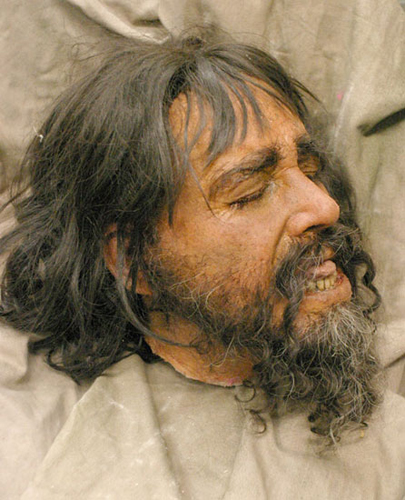
Head from Lone Wolf Effects
The shame 'Annaz felt for both his lies and the mutilation of his brother's corpse wound up imbuing Badr's head with strange energies. Badr was slain in defense of Damascus, and still seeks to do so from beyond the grave, but the actions of his brother torment Badr's spirit.

The head of Badr projects a 30' radius bless spell around it when held aloft by a member of the Faith or by someone defending a position. The person holding Badr's head is incapable of telling a lie. For every five rounds that Badr's head is held aloft, all persons affected by the bless spell must save or take 1d2 damage/level, as the pain of 'Annaz's betrayal cuts deep, and severe cuts appear around their necks.

The head of Badr may only be buried when Damascus is safe.

Monday, September 30, 2013

Arab Travelers: The Leopard

Fatimid pottery cup, 11th century.
From here.
Of all the animals, the leopard alone can jump more than forty cubits. In the church at Hunak, there was a window forty cubits in height above the floor. A leopard used to go there during the hottest part of the day, then jump down and go away. At the time, the landlord of Hunak was a Frankish knight called Sir Adam, a real devil of a Frank. He was told the story of the leopard, and he said, 'When you see the leopard, inform me of it.'

The leopard came as usual and jumped up to that window, so one of the peasants went and informed Sir Adam. Sir Adam put on his hauberk, mounted his charger, took up his shield and spear and went off to the church, which was in ruins except for one standing wall where the window was located. When the leopard saw Sir Adam, it pounced down from the window on top of him while Sir Adam was still on his charger and broke his back, killing him. It then went away. The peasants of Hunak used to call that leopard 'the holy-warrior leopard.'

One of the special qualities of the leopard is that if it wounds a man, and a mouse urinates on the wound, the man will die. A mouse never gives up trying to reach a man wounded by a leopard: one person, out of fear of the mice, even had a bed made for himself sitting in the water, with cats tied all around it.

-Usama ibn Munqidh, The Book of Contemplation, p. 123-124. Trans. Paul Cobb, 2008, Penguin.

Leopard, from "The Benefits of Animals"
Image from here.
"The leopard is a fierce enemy of man, unmanageable and ferocious. He eats only his own game. When satiated, he sleeps for three days and three nights in succession; (...) A sick leopard gets well by eating mice. His skin is tender and if he is wounded it breaks with a slight stroke.

The flesh and fat of a leopard, boiled in the juice of olives, serve as a good salve for the sores, abcesses and pimples that break out on the body; his blood is a preventive liniment for all skin diseases."

-Ibn Bakhtishu, The Benefits of Animals, quoted from 1001 Tales of History's post on the book - which you should totally check out, if only to see the other fascinating pictures and descriptions.

Well. There's clearly something up between leopards and mice, some connection here. But why would these two creatures be connected?

Hmm. I am reminded...
“I am reminded,” said the Mouser, “of what a witch told me about adepts. She said that, if an adept chances to die, his soul is reincarnated in a mouse. If, as a mouse, he managed to kill a rat, his soul passes over to a rat. As a rat, he must kill a cat; as a cat, a wolf; as a wolf, a panther; and, as a panther, a man. There he can recommence his adeptry. Of course, it seldom happens that anyone gets all the way through the sequence and in any case it takes a very long time. Trying to kill a rat is enough to satisfy a mouse with mousedom.”

- “Adept’s Gambit,” Fritz Leiber
Clearly the Mouser is misremembering (or the witch misspoke) and it was leopards, rather than panthers, that were in the adept chain of succession. But what if there were some way to short-circuit this process? What if an adept-turned-leopard-turned-mouse could easily slay a man while as a mouse? Perhaps through a wound that they had made as a leopard?

And this would explain why the mice never give up trying to reach the wounded man. Because if they can work their arts on the wounded...ah, the chance to be a human once more!

Perhaps some adept-leopards (leopard-adepts?) retain their loyalties in life, as the case of the holy-warrior leopard shows. Or perhaps this was merely an opportune moment for the adept to strike at a human and return to a human form. Yet it is curious that it did not attack the peasants...

Monday, September 23, 2013

Arab Travelers: Cave of the Seven Sleepers

My route took me by the Cave of the Seven Sleepers. So I stopped there and went in to pray at the mosque, but I did not go through the narrow passage that one finds there. One of the amirs of the Turks who were with me, called Barshak, came, wanting to enter by that narrow cleft.
Cave of the Seven Sleepers, near Amman, Jordan
Photo from itsanillution

I said, 'What are you doing that for? Come and pray outside.'

'There is no God but God,' he replied. 'I must be a bastard then if I can't get through that narrow cleft!'

'What are you talking about?' I asked.

He said, 'This is a place that no son of adultery can pass through - he cannot enter.'

What he said forced me to get up, enter by that spot, pray and come out again without - God knows - believing what he said. Indeed, most of the troops came and entered and prayed. 

Yet, in the army with me was Baraq al-Zubaydi, who had with him a slave of his, a black man - devout fellow, taken to praying a lot, and one of the tallest and leanest people. He came to that spot and tried with all his might to enter, but he could not get through. The poor fellow wept, moaning and sighing over and over, and then left after failing to enter.

- Usama ibn Munqidh, The Book of Contemplation, p. 23-24, Trans. Paul Cobb, 2008, Penguin Books.

This is one of ibn Munqidh's stories which has stuck with me. (Possibly because of his prompt emphasis on his own easy and unobstructed passage. Not that he believes in such superstition, of course.)

From a gaming standpoint, this is a helpful reminder to make a region feel alive through legends and folklore, stories tied to places. There doesn't always have to be anything major to the legends, mind you. It's completely legit to have an ancient hoary legend which doesn't actually have much backing it up! Certainly ibn Munqidh didn't encounter anything significant in visiting the cave...although perhaps Baraq's slave did.

Monday, July 1, 2013

T160K

The T160K project is soliciting donations to preserve manuscripts from the Timbuktu Library that were in danger of being destroyed during the recent conflicts in Mali. Folks went to great personal risk in order to safeguard these works and get them to a place of (relative) safety, but now the works are in danger of being damaged due to poor storage conditions.

Apparently they had an Indiegogo campaign that ended recently, which I had missed. But they can still use donations to preserve these works.

Given the inspirations for my setting and this blog, I feel like I ought to toss them a shoutout. If you can, try to chip in a few bucks over at their webpage. These guys would want you to.

Ibn Munqidh would probably even stop his intrigues against you*! (Dude loved books.)


*For an arbitrary amount of time. 

Monday, September 10, 2012

Arab Travelers: Ibn Khaldun on Adventurers

Ibn Khaldun was the author of the Muqaddimah, a text discussing historiography and sociology. Along with coming up with the Laffer Curve and busting out some vaguely Robert E. Howard-esque lines on civilization*, he had some thoughts on adventurers and fortune-hunters:

"Many weak-minded persons in cities hope to discover property under the surface of the earth and to make some profit from it. They believe that all the property of the nations of the past was stored underground and sealed with magic talismans. These seals, they believe, can be broken only by those who may chance upon the (necessary) knowledge and can offer the proper incense, prayers, and sacrifices to break them...

"In addition to a weak mind, a motive that leads people to hunt for treasure is their inability to make a living in one of the natural ways that earn a profit, such as commerce, agriculture, or the crafts. Therefore, they try to make a living in devious ways, such as (treasure hunting) and the like."

Ibn Khaldun, The Muqaddimah: An Introduction to History. Trans. Franz Rosenthal, Ed. N.J. Dawood. Princeton Classic Edition, 2005, p. 301-303

I'm going to take a look at the Muqaddimah's chapters on magic and see if there's something gameable in there. This Arab Travelers series has seriously been slowed by the fact that my copy of Ibn Munqidh is MIA.

Damn sneaky Ibn Munqidh.


*"It shows that the goal of civilization is sedentary culture and luxury. When civilization reaches that goal, it turns toward corruption and starts being senile, as happens in the natural life of living beings. Indeed, we may say that the qualities of character resulting from sedentary culture and luxury are identical with corruption." Muqaddimah 288

Saturday, July 14, 2012

Arab Travelers: Demon of the Desert


First entry in this Arab Travelers series, started here.

From Ibn Battutah:
Takshif is the name given to any man of the Massufah whom the people of the caravan hire to go ahead of them to Iwalatan with letters from them to their friends there, asking them to let houses to them and come four days' journey to meet them with water...Sometimes the takshif perishes in this desert and the people of Iwalatan know nothing of the caravan, and its people or most of them perish too. There are many demons in that desert. If the takshif is alone they play tricks on him and delude him til he loses his way and perishes. There is  no road to be seen in the desert and no track, only sand blown about by the wind. You see mountains of sand in one place, then you see they have moved to another. A strange thing I saw is that our guide was blind in one eye and diseased in the other, but he knew the route better than anybody else.
The Travels of Ibn Battutah (Picador, 2003), p. 282-23.


Demon of the Desert
AC: 4 OR 9, HD: 2-4, Mv: 120', Atk: sandblast (d6, 30' range) OR claws (d3)


Dust Devil photo taken from Universe Today
Demons of the Desert can shift between three forms: a flickering light kind of like a will-o'-wisp, a dust devil, or a tiny wizened creature 4' high. They can only exist in their will-o'-wisp form when there is a single sentient being (aside from other Demons of the Desert) watching. 

While a will-o'-wisp, they can cast some spells to lure travelers to their unfortunate demise. Roll a d4 to see what any individual Demon of the Desert can hurl:
1: hypnotism
2: hallucinatory terrain
3: wall of sand (as wall of fog)
4: ventriloquism


If they are seen by more than one sentient being at a time, they immediately shift from their will-o'-wisp form into a dust devil (first set of stats above) and must remain in that sort of form for 1d6 hours.

They can only feed on creatures that they themselves have not directly harmed, so they will use their dust devil forms only for self-defense. Striking the dust devil form disrupts the twisting column of air at the center, so that you can actually hurt the things.

Their third form is reserved for feeding, and it's this creepy wizened little human-like form 4' tall or so. Make it weird and creepy. It's got the lousy stats above (AC 9, d3 claw damage). If a Demon of the Desert is slain, it will shift into this form. Otherwise, it takes d3 rounds for a Demon to shift from one form to another.

Their MO, as suggested above, is to lure caravan guides and so forth away from the path to town, sucker them into the desert, and chow down once the entire group has died. (It beats the meager options they normally have open.)

If discovered, they are cowardly and seek to bargain for their lives. Demons of the Desert do not actually have any treasure of their own, but they are likely aware of that accumulated by their former victims, and any that might be readily visible in nearby ruins. 

Saturday, June 9, 2012

Arab Travelers - ibn Munqidh and ibn Battuta

I've been chewing over the Legacy of the Bieth setting for a while, and am unhappy with the "traditional" feel that it manifested in its latest Philly incarnation. Therefore, I'm going to be shifting it around and making it far more North African/Middle Eastern in inspiration, rather than the Ren Faire Europe that it had earlier. 


Two of my main sources for this are going to be the work of Ibn Battuta and of Usama ibn Munqidh. Both of their works have several anecdotes which make for great RPG fodder, which I'll be trying to get down on  Ibn Battuta you've likely heard of - Berber traveller, qadi, and Dude Sticking It To Marco Polo. Usama ibn Munqidh? Well, he's somewhat less familiar, and the Wikipedia link doesn't do him justice. 


So, let me present a synopsis of the first few chapters of his work, "The Book of Contemplation," that I had written up a while back.


Ibn Munqidh was a Syrian knight around the time of the 2nd Crusade. I had heard of his memoirs before - they were mentioned in a few of the books on the period I had read while growing up, but I had never seen a copy. Then last week, I wound up finding one at the Last Word, and immediately snagged it. Ibn Munqidh had been described as a super-chivalrous knight in the sources I had seen, but so far, he doesn't seem to be living up to that. Instead, he seems to be slightly engaged in conspiracies - up to his eyeballs. Y'know, just a little bit. 

The book opens with the earliest remaining fragment, which has ibn Munqidh serving Zangi, the governor (atabeg) of a Syrian province. After internal treachery on the part of another commander, ibn Munqidh fled Zangi's service and went to Mu'in al-Din, the ruler of Damascus, who took him in and did not in fact turn him over to Zangi. 

Then ibn Munqidh says that "certain things came to pass that necessitated my relocation to Cairo." The footnote clarifies that the "certain things" ibn Munqidh alludes to were likely intrigue against Mu'in al-Din, explaining why he then had to flee. When Mu'in al-Din sent his scribe to ibn Munqidh with a message professing friendship, ibn Munqidh then writes a poem back explaining how he was still al-Din's loyal servant, and left only to prevent trouble from falling on al-Din. No other reason! None whatsoever. 

So ibn Munqidh flees to Cairo, where the Caliph takes him in. After some time (and a feud between some of the caliph's troops, including some royal bodyguards), the Caliph dies and his son Al-Zahir ascends, appointing a fellow named Ibn Masal as his vizier. This appointment causes an amir of Al-Zahir's, Ibn al-Sallar, to fear for his life and/or try and stage a coup against Ibn Masal (but not against the caliph). Several of Al-Zahir's other amirs work with al-Sallar (and his stepson 'Abbas) to help against ibn Masal. Ibn Munqidh throws his lot in with al-Sallar also, and they kill Ibn Masal. Al-Sallar then becomes the new vizier.

Now, the Caliph is not thrilled with this, and plots to kill Al-Sallar (during Ramadan!). He sends some assassins after Al-Sallar, but they fail. Some of them flee to ibn Munqidh, who hides them and saves them. 

Then Abbas's son Nasr (so al-Sallar's step-grandson, I guess) works with the Caliph to assassinate al-Sallar. He sneaks into his grandmother's palace, decapitates al-Sallar, and brings the head to the Caliph, causing him to rise greatly in the Caliph's favor. The translator suggests that Nasr and the Caliph may have become lovers after this(there's a "giving head" joke in there somewhere...). Abbas is appointed the vizier in the wake of his stepfather's death. 

Abbas distrusts Nasr after this, though apparently more from getting cozy with the Caliph than from his murder of 'Abbas's stepfather. At one point they get into a fight, and ibn Munqidh intervenes on Nasr's behalf, saying "What then has he done wrong? He has not mistreated any of your companions, nor has he frittered away any of your money, nor has he criticized your regime. Indeed, he has risked his life so that you might attain this position." At which point father and son reconcile.

The very next section then mentions how the Caliph starts sending Nasr lavish gifts and trying to get him to kill his dad. (There's a bit in there where ibn Munqidhmentions how "during this whole period, I was with Nasr all the time. He wouldn't permit me to be absent night or day; I used to sleep with my head at the end of his pillow." And all the ibn Munqidh shippers cried out with glee...)

Anyway, Caliph trying to get Nasr to kill his dad. But that's going a bit too far for ibn Munqidh, who suggests to Nasr that unlike killing al-Sallar, killing his dad will likely doom his soul forever and is generally a Bad Prize. At which point Nasr goes, tells his dad everything, and then they murder the Caliph and his brothers. 

So. This is ibn Munqidh, and why he's interesting. Admittedly, the book gets a bit tamer after this, but I haven't started touching upon the Weird Bits that show up. 

I'm looking forward to writing these things up; I hope y'all are interested in reading.