Wednesday, February 26, 2014

Blood, Words, and Money: Organizations and Factions (Santicore 2013)

Santicore 2013 continues its triumphal march of destruction. Volume 2 just came out (get it here, and Vol. 1 is available here). My own contribution is in Volume 2, so now I'm free to post it here as well.

Blood, Words, and Money: Organizations and Factions
Organizations:

Determine the size of your organization, to figure out how many subgroups it will possess. "Small" organizations will have 1d4+1 subgroups, medium organizations 1d6+1, and large organizations 1d8+1. These things will get byzantine quickly so be warned. I recommend something like five groups as a manageable yet intricate balance. (Hey, it works for Magic: the Gathering...)

Subgroups and Powers:

For each subgroup present in your organization, roll a d6 on this chart to see what sort of a role it plays. 
1
Intelligence - Gathers information for the organization in some capacity. Magical scrying? Wiretaps? Are they looking at communications, individuals, social context, or even just basic facts? They're likely to have the most on-the-ground contacts, familiarity with locations - and the most information about what other parties are doing.
2
Resources - This can either be equipment - something like James Bond's Q Branch, putting together gadgets - or it can be finances, false identities, forged documents, and the like. Their focus is eliminating sources of friction and allowing other groups to complete their objectives; throw enough money at Resources and problems melt away. <
3
Administration - Avoid making this an executive group, and skew towards administrative, managerial and human resources issues. Personnel, staffing, and coordination. Sounds bland, but they've got their fingers in everything. There's a reason Stalin made sure to secure the personnel and assignment apparatus in his rise to power - personnel assignments mean that they've got control over who works where, and also who has access to what.
4
Operations - This group takes active steps to implement things. Generally filling the "field agent" category, and the most likely group to be authorized for use of force. They'll have personnel with the most field experience.
5
Internal Affairs - This group watches the watchers, and quite possibly sticks them underneath a bright light and asks them a bunch of terrifying questions. They have investigative authority over the other groups, even at very high levels - but nobody trusts them for obvious reasons. 
6
Roll again twice and combine both rolls.* 

*If this result comes up on the reroll, do not merge two groups, but create a "Communications” subgroup instead. Communications groups are responsible for the security of information transmission - which means that they have access to all of it. (It's a rarer group to encounter than the rest, but once in a while it will pop up.)

Depending on the independence of each sub-group, you're likely to have some elements of each role present in each subgroup. For example, it's reasonable for an Action group to create its own dead drops, caches, and the like, to ensure that there's less chance of the resources getting compromised. Of course, these grey areas are the subject of wrangling and infighting.

Good intelligence work, Control had always preached, was gradual and rested on a kind of gentleness. The scalphunters were the exception to his own rule. They weren't gradual, and they weren't gentle either. 
- John le Carre, Tinker Tailor Soldier Spy

George Smiley, Tinker Tailor Soldier Spy
Actions

Once you've created your subgroups, figure out how specialized they are at their given task on a scale of 1-20 (1 being not at all, 20 being hyper-specialized; these scores should be in the 13-20 range, since each group is inherently specialized). When a subgroup takes a significant action relating to its specialty (a field operation for Operations, an investigation for Internal Affairs, a major R&D project for Resources, etc) they need to roll underneath their specialization score. When a subgroup takes a significant action outside of its specialty (Intelligence running an investigation into Internal Affairs because they think that IA is compromised) they need to roll over their specialization score.

If a roll fails, roll a d6 to figure out why:

1-2
Misfortune: Bad luck, someone in the wrong place at the wrong time - it was all going smoothly, but unforeseeable events resulted in failure.
3-4
Hostile Intervention: Everything your organization did was fine, but an unexpected intervention (another subgroup? A hostile organization?) wound up interfering with your plans.
5
Incompetence: Worse than a crime, it was a blunder. Someone in the subgroup messed things up, whether in planning, execution, or somewhere in between. 
6
Managerial Intervention: DAMMIT! Meddling and micromanagement, whether from the subgroup's leader or from the head of the organization, has caused this action to fail. 
If needed, use the margin of the failed d20 roll to figure out how visible the failure is. On a margin of 1 or 2, it's a failure, but nobody knows about it and the damage is contained. On a margin of 3 or 4, the subgroup needs to choose between losing resources (cutting agents loose, massive bribes, etc.) or having a failure become public knowledge. If the margin's 5 or greater, you lose the resources and the failure is public. 

Alliances/Conflicts:

Arrange the subgroups within the organization in a circle. Adjacent nodes interact often; opposing nodes are rivals, compete for resources and budgets, or otherwise antagonistic towards each other.
Paranoia is just having the right information. 
- William S. Burroughs
Subgroup Goals:

Roll a d6:
1
 Expand: Grow larger, acquire more resources. Use as a default behavior for organizations if you don’t want subgroup goals.
2
Replace / Eclipse: Supplant another subgroup within the organization.
3
Suborn: Gain control of another subgroup.
4
Crown: Promote head of this subgroup to head of the organization.
5
Realign: Swap places with another subgroup (re: alliances/conflict above).
6
Defect: Leave the organization, either to an opposing organization or to become independent.

“Management is proving beyond a shadow of a doubt they don't have enough to do," she murmured back. "So they've invented a new acronym.” 
- Connie Willis, Bellwether

Representative NPC:

Need to have an encounter with someone from this group? Roll on this chart! (Nomenclature format cribbed from Echo Bazaar: echobazaar.failbettergames.com ). 

1
Bored Bureaucrat
2
Unlikely Academic
3
Passive-Aggressive Clerk
4
Jovial Amateur
5
Bluff Professional
6
Ambitious Underling
7
Powerhungry Boss
8
Burned-out Workaholic
9
Rebellious Naysayer
10
Recalled Veteran
11
Disinterested Middle Management
12
Charismatic Leader
13
Evangelist “Team Player”
14
Jaded Outcast
15
Foreign Contractor
16
Detestable Visionary
17
Giggly Social Climber
18
Shameless Brown-noser
19
Punctilious Charmer
20
Useless Wanker

“It is a truth universally acknowledged that a sane employee in possession of his wits must be in want of a good manager.” 
- Charles Stross, The Fuller Memorandum

Subgroup Quirks:

Roll twice. The first roll is what the group’s friends think of them; the second is what their enemies or opposition think (or suspect).

1
Use secret signals extensively
2
Are older than they seem
3
Are suspected of brainwashing their members
4
Will accept anyone
5
Are behind on their taxes
6
Were acquired in a hostile takeover
7
Have distinctive facial tattoos
8
Have friendly ties with (Table A)
9
Are well-known about town
10
Rob from the (Table B), give to the (Table B)
11
Operate by night
12
Use exotic animals as messengers
13
Swallow up real estate
14
Use offensive tactics (PETA offensive? Kneecapping offensive? Up to you)
15
Have ferocious, almost inhuman, discipline
16
Are fiscally irresponsible
17
Have a naïve mission or motivations
18
Have a highly placed deep cover asset within (Table A)
19
Have horrendous uniforms
20
Focus on long-term strategy 


Table A
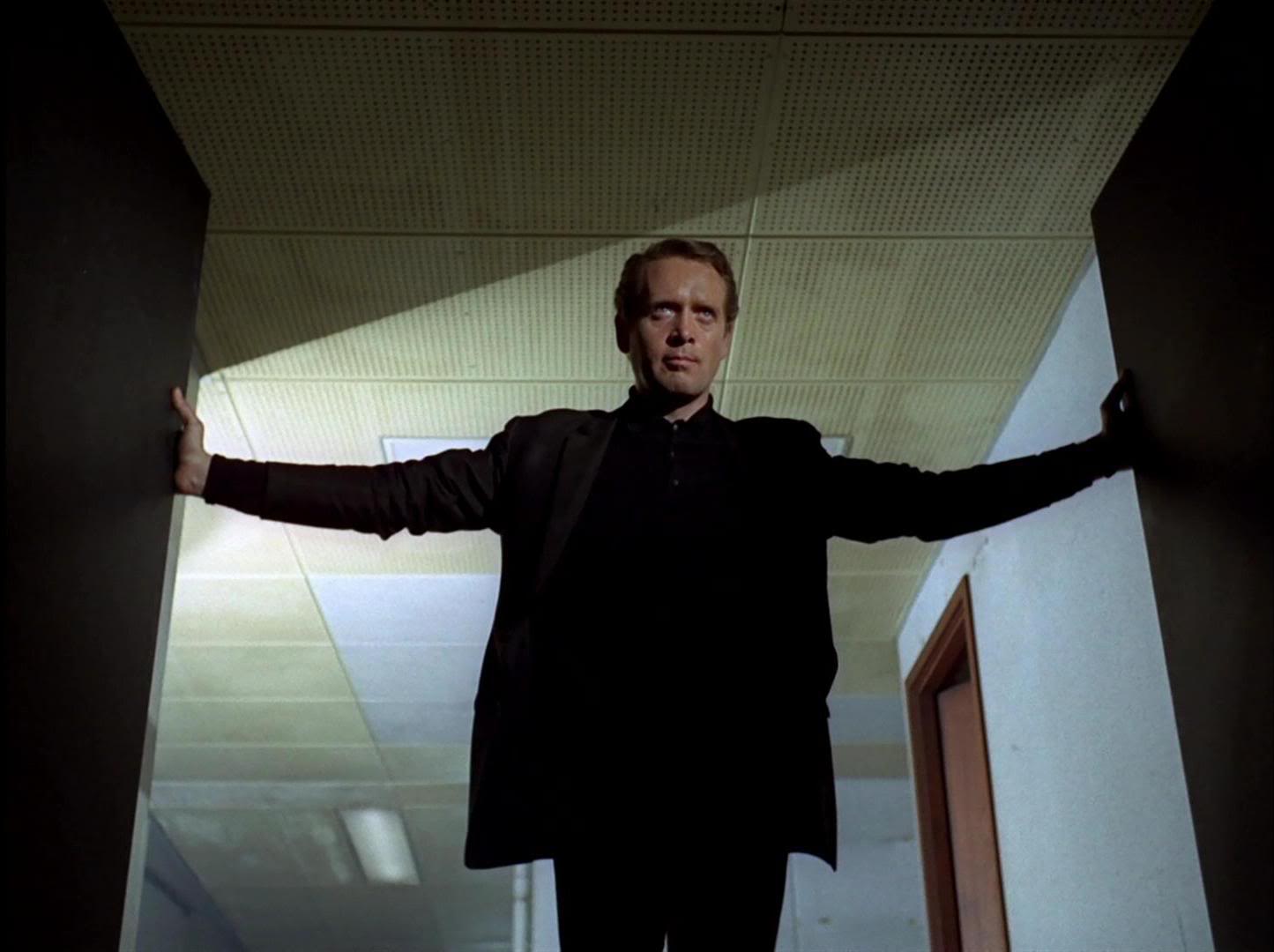
The Prisoner

1-2
Another subgroup within the organization
3
Local government
4
A faction within another organization
5
Organized crime
6
Revolutionaries / Dissidents

Table B

1
Rich
2
Poor
3
Religious
4
Academic
5
Labor
6
Management

Major Influences: 

Paranoia – Allen Varney, 2005, RPG
Tinker, Tailor, Soldier, Spy – John le Carre, 1974, novel
The Atrocity Archives – Charles Stross, 2004, novel

Thanks to Mikah McCabe (http://thebonehenge.blogspot.com/ ) for her assistance and feedback and love of ridiculous lists. 

I live in the Managerial Age, in a world of "Admin." The greatest evil is not now done in those sordid "dens of crime" that Dickens loved to paint. It is not done even in concentration camps and labour camps. In those we see its final result. But it is conceived and ordered (moved, seconded, carried, and minuted) in clean, carpeted, warmed and well-lighted offices, by quiet men with white collars and cut fingernails and smooth-shaven cheeks who do not need to raise their voices. Hence, naturally enough, my symbol for Hell is something like the bureaucracy of a police state or the office of a thoroughly nasty business concern. 
- C.S. Lewis, The Screwtape Letters (preface)

Saturday, January 18, 2014

"Worms upon a Piece of Wood" - Arabian Nights Seas, Joesky Credit #3

When the Muslims took possession of Egypt, 'Umar b. al-Khattab wrote to 'Amr b. al-As and asked him to describe the sea to him. 'Amr replied: 'The sea is a great creature upon which weak creatures ride - like worms upon a piece of wood.'

-Ibn Khaldun, the MuqaddimahTrans. Franz Rosenthal, Ed. N.J. Dawood. Princeton Classic Edition, 2005, p. 209.

Anthony, blogging over at Straits of Anian, asked me way back when for some saltbox components: ocean encounters and a weird island generator. Here's what we got.


Note: As I've written before, I normally try to eschew Arabian Nights influence, but Sindbad's voyages are so crucial and fundamental to my visions of a saltbox in this context that I can't get away from them. (Wait, does that make Sindbad the Old Man of the Sea? Damn you, mixed metaphors!) The bulk of these entries are a lot more gonzo and fairy-tale than the stuff I'm running, and most wouldn't fit into my conception of Legacy of the Bieth. I'm going to need to figure out what oceanic, corsair-like, and piratical components are in LotB itself. I know that there are totally corsairs, and the sea vast terrible and terrifying, but not too much beyond that. 

Ocean Encounters

Deep Dweller: roll a d6. 1-2 idling along minding its own business; 3-4 hunting your ship; 5-6 fleeing something else (reroll on this table)

Ship of the Marids
"Flaming Scimitar" from Dreadfleet
Painted by Centerpiece Miniatures
1   Kraken - Deep Dweller.
2   TO BE REVISED
3   Dendan - a giant fish capable of swallowing ships in a single convulsive gulp. Deep Dweller.
4   Ship of the Marids - Overly ornate and florid pleasure vessel being propelled by air elementals or djinn blowing at the sails. Will likely have a utterly decadent prince(ss) of the Marid on board, leisurely sailing along, willing to gamble with mortals (or demand that they suffer to provide entertainment).
5   Black Mountain  - this ominous peak off in the distance inexorably drags ships towards it. As they approach, the iron fittings and nails of the ship begin to tear out of the wood (along with anything else that might be on board, like most weapons) and surge towards the mountain, while the ships break apart and sink. Legend has it that a brass man on a brass horse sits atop the peak of the mountain, and about his neck hangs the tablet which causes the mountain to continue its reign of destruction.
6   Ship in Distress - Unexpected rocks, treacherous seas, attacks from below...something nasty has hit this ship. Roll 1d4 to see who's in trouble: 1 Local islanders, 2 Merchant vessel 3 Foreign dignitary 4 Corsair
7   Local Islanders - trade, supplies, local news. If you feel like, roll on the Weird Island Generator below to see whether these guys are coming from someplace weird.
8   Foreign Voyager - Some folks from way the hell elsewhere. Visiting dignitary? Crazy random traveler? 
9   Corsairs - Yeaaah they probably want your stuff. Deep Dwellers, reroll 1s.
10 Spinning Djinn Whirlpool - This djinn is spinning in place, generating a giant whirlpool about himself (or herself). Why? Any way to reason with them?
11 Uncanny Storm - Maybe it's a giant roiling thundercloud in an otherwise-clear sky. Maybe it's crackling fluorescent pink lightning striking down and turning the water to ice. Maybe it's just some St. Elmo's Fire that's bobbing throughout the ship and making friends with the crew.
Skeletal Serpent
(Serpent d'ocean, by Huang Yong Ping)
12 Skeletal Serpent - A giant sea serpent comes slithering out on the waves - skeletal, possessed of a horrible intelligence, red gleam in its eyes - offers awful bargains and knowledge from the black realms of the sea.
13 Shoal of Talking Fish - Deep Dweller, but 3-4 they're hunting your ship to ask the PCs a favor. Maybe they're spellcasters.
14 TO BE REVISED
15 Cloud of Hate - As per Fritz Leiber. This deep white fog possesses those with an overwhelming capacity for hate and turns them into ravenous killing machines. In dire straits, it will form tentacles and a giant eye and strike out directly at those who oppose it, taking up the weapons of its former ravenous killing machines.  It is an avatar of HATE, and a lucky strike that severs its connection to its worshipers will prevent it from forming again for a year and a day.
16 Ghost Ship - a ghostly apparition of a ship that sails just above the waves. No visible crew, no recognized markings.  roll a d6. 1-2) ignores nearby ships, 3-4 )moves to "ram" nearest target, 5-6) targets nearest ship and attempts to superimpose itself on the unfortunate vessel.
Dreugh Concept Art
Morrowind
17 Dreugh Swarm - a swarm of these half-octopi, half-humanoid awful creatures. Deep Dwellers. Can survive outside of the water, so may in fact clamber onto your ship and try to drown your crew.
18 Roc - roll 1d6; 1-3 has prey already, 4-6 is looking for something new, big, and tasty.
19 Wereshark - roll a d6: 1 seeking a particular target; 2 seeking to feed; 3 trying to raid the PCs' ship; 4 spying on the PCs; 5 ; 6 Vietnamese-New Hampshire elven wereshark.
20 Tortoise Island - It's got some snazzy resource on its shell (diamonds! Rare woods! Fresh water...?), but the tortoise is about to dive, or is likely to dive if you start picking up the resources.

Weird Island Generator

First, roll 1d4 to see what's weird about this island. 

1 Inhabitants
2 Environment
3 Monsters
4 Reroll twice, ignore 4.

"Pointy Hats"
By Fredrik Rahmqvist
Inhabitants
1 Island is populated by giant talking versions of a regular animal (birds, horses, etc). Ruled over by a monarch of that species (a phoenix or simurgh for the birds, a Houyhnhnm for horses, etc.) who is able to speak, arch, sneering and dismissive of humanity. Cut a careful line between the fairy-tale nature and the physical, animal nature of the ruler; emphasize its physicality and power. 
2 Culture has one of the Seven Deadly Sins (plus bonus) as a core virtue. Roll 1d8: 
1. Sloth: Megacephalic petty sorcerers carried about on litters by lobotomized slaves.
2. Pride: Societal status determined by individualized duels of some sort; visitors are of course at bottom of hierarchy until they duel.
3. Avarice: Corsairs who loot and pillage from the neighboring islands. They do not sow. You have only what you can take, and you're always in a race to keep taking. 
4. Wrath: Curious and horrendous custom of torturing all who come to their island.
5. Lust: The island has some strange feature inhibiting traffic, and the inhabitants of the island are all desperate to leave (terminal boredom? despotic or murderous overlord?), and will do anything to put together an escape plan; this "anything" is likely to sabotage the PCs. Think an island full of amoral versions of Number Six (McGoohan, not Helfer). 
6. Vanity: Solipsistic and dubious about the idea that anything could exist outside their island. 
7. Envy: The islanders will latch on to all facets of the PCs and try to mimic their mannerisms and culture. They won't want to let the PCs leave, because they're starved for new ideas.
8. Gluttony: Population is ludicrously obese. I'm not talking anything that's within the realm of normal human weights.* I'm talking Fatties obese, Jabba the Hutt obese. Possibly using mass as a measure of social ranking. Possibly being fattened up as food / incubators / survival mechanism for something weird that happens on the island. 
3 Inhabitants are very welcoming to outsiders, but have strange customs which wind up causing pain. Sinbad encountered this with the islanders who insisted he marry one of them, but then revealed that if one spouse dies, the other is buried alive with them. Some other examples might be ritual sacrifice 
4 Inhabitants are laboring under a major curse. Roll 1d6: 1) During the days their lower halves turn to blocks of marble 2) They forget the events of the previous day at the stroke of midnight 3) They are all vertically bisected (but still able to live and function and speak, just really sad and awkward and hopping around on one leg) 4) All inhabitants of the island have been turned into some small animals, which can speak and lament their fate. 5) The oracular talking bird that guides them continually lies, sending them further into misrule. 6) The inhabitants are obsessing over a zahir that is trapping their thoughts and gradually erasing the island from reality itself. 
5 The ruler of these islanders is a decapitated head, placed in a bowl containing vital essences to keep the head alive. The ruler seeks to acquire a new body by some means fair or foul. 
6 They're cannibals. To be expected, since frickin' half the Arabian Nights stories mentioning sea voyages have this come up - to say nothing of Odysseus's voyages, and Polyphemus. 

Edmund Dulac
Environment 
1 Perfectly symmetrical island. When structures are built on one side facsimiles will appear on the other. Same for the remains of any sapient being. Every day that a facsimile is separated from the island, roll a d6; on a 3+ the facsimile disappears. 
2 Island suspended in the middle of a whirlpool by vast pillars of rock, making transit to and from the island incredibly perilous. 
3 Sunken, inverted step pyramid filled with water in the center of the island. There are paths of open air mimicking the passages within a normal pyramid, and it is possible to explore the pyramid, walking on the strangely high-surface-tension water; however, treading too heavily, bearing too much weight, or piercing the surface of the water may cause the passages to start leaking and filling up. (The corridors will will unflood and the surface tension reform within 24 hours if broken.)
4 Island is a biome that does not normally appear in the climate (tundra, perhaps?). Optionally, the island is actually a gate to another location; if you lose sight of the shoreline or objects there, you wind up shifting fully to the location being gated to. (Lose sight of the shoreline in Madagascar, and you wind up in Siberia...)
5 One cave has historically been used for dark necromancies. As it is approached, people take on the nature of an undead equal to their HD/level (so a level 1 wizard will have the benefits and penalties of being a skeleton and a wizard; a 5 HD cyclops will become a wraith-cyclops, etc.). Have some undead stats handy, and try to have some unusual undead available so that transformations aren't all the standard platitudes. As affected individuals leave the area, they return to normal. 
6 The underground palace of a djinn princess (or prince) is located on the island, and is said to contain a pathway to the City of Brass itself. But no sign of movement has come from the palace in quite some time...

Monsters 
1 Coven of necromancers with giant undead servitors
2 Flock of monstrous avians (harpies, perytons, etc.)
3 Demon-possessed large animals (think the Lions of Tsavo but worse and all demonic) committed to terrorizing the locals. No interest in rulership or gross consumption, but to cause pervasive terror. Or they're waiting for something, killers even more horrendous than the animal that they now ride... 
4 Colony of ghuls - erudite, urbane, eaters of the dead, and running out of consumable corpses. 
5 Sorcerer keeping the populace in thrall through use of charm spells to set up a secret police. No, everything's fine here in this little island village, how are you
6 Conclave of giants being held at the center of the island. Think a cross between Tolkien's Entmoot and a high-value drug deal, only with forty or fifty participants, all of whom are ready to resort to violence. 

* Don't be a dick and mock actual fat people if this entry comes up.

Influences: Clark Ashton Smith, esp. Island of the Torturers and Quest of the Gazolba
Jorge Luis Borges.
The Thousand and One Nights.

Friday, January 3, 2014

Punk-Dark Imperium: Looking at the Ultra-Marines (WD 97)


WD 97 (via dakkadakka.org)
Happy New Year, folks!

I've been working on my Punk-Dark Imperium setting for Starslugs, and have made a reasonable chunk of progress. Still need to flesh out the careers, since I'm adjusting Mongoose Traveller for 40K assumptions rather than its existing Golden Age ones. The basic combat rules are good to go in theory, but will need playtesting. Over New Years', I began rolling up my subsector; right now the process is more tedious than engaging, but I suspect that it may yet grow on me.

Going back to my musings on theme, tone, and game style, I found an old White Dwarf (#97) that had an article on the "Ultra-Marines." Interesting to look at how things have changed in GW-land...

Originally...

  • The Ultra-Marines (yes, hyphenated every time) were founded "during the inter-legionary wars of the thirty second millennium" - a conflict now known by GW as the Horus Heresy and expanded in excruciating detail from its hazy, nebulous, and evocative roots. Current GW materials call the chapter the Ulrmarines and state that their founder essentially created the Marine System of Organization (tm), called the Codex.
  • The Ultra-Marines got the kit and paraphernalia of a disgraced legion that had been banished to the Eye of Terror, interestingly enough. Generally a no-no in later 40K.
  • They are one of the few Space Marine chapters to be called "Adeptus Astartes;" the term is reserved for marine chapters that also hold planetary governor positions. Later 40K sees all Space Marines called Adeptus Astartes.
  • Their home planet of Macragge is an inhospitable shithole with an economy based around shrimp farming from dust oceans. Current 40K has it all idyllic and just and Grecian.
  • Official positions within the chapter aren't restricted to Space Marines; regular folks "(or even morphs or half-humans)" can can hold the rank of Master within the Ultra-Marines. Current 40K has everything entirely Space Marine all the time, barring some flunkies designated as "chapter serfs." In the original writeup, they're just bluntly called slaves.
  • Scouts are not young neophytes being sent in to prove their worth, but regular troops wearing power armor and jetpacks. Because, y'know, you might actually want to have effective scouts. 
  • THERE ARE BROWN FOLKS IN THE CHAPTER WTF GUYS. Characters have names like Cha Lee, Asata, Singa, Yu-Wan, Butt, Hajadin, and Idu. This is throughout the command structure - senior officers, junior officers, and staff officers. (Current 40K can barely acknowledge that Spess Mehreens might not have names so Gothic that they shit cathedrals.)
  • Also, go back to the bit about having staff officers, like a military organization that isn't a bunch of dumbasses.
  • One of the masters of the chapter is a half-elven (excuse me, half-eldar) psyker who's served with other Space Marine chapters. (Ah, how far current 40K has fallen from ELVES IN SPAAAAACE!)
  • The Master of the Ships is named Christo Columbine. The half-eldar psyker is named Illiyan Natase, apparently riffing off of a Romanian tennis player from back in the day.
  • Ultra-Marines using camouflage!
    (From WD 105, via Arcadia Prime)
  • The chief medical officer of the Ultra-Marines "has an acute if rather unnerving love of chainswords, having the idea firmly set in his mind that this is the only way to remove troublesome armor when attempting to deal with a wound."
OK, so what's the upshot of all of this?
Early 40K has a sense of humor (I suspect that there are other pun names I didn't pick up on). It's got a greater willingness to approach things from a "classical wargaming" standpoint, with a lot of discussion of things like communications, medical systems, and ecologies, even though the article is ostensibly just about the Ultra-Marines.


The Space Marines are not shown as being fundamentally removed from humanity, and there's a much greater integration into human society. Think Dune's Sardaukar, an elite force but with still human concerns and outlook, versus the mono-murder-machines of current 40K. Look at the images below - same fella, Marneus Calgar, Chapter Master of the Ultra-Marines - but such a difference in proportion! And that also applies to how they interact with the setting; later 40k seeks to have its Space Marines mythic and gigantic and writ large, while this look, at least, has them human in scale, rocking goofy looking cloaks, and dealing with paperwork.
 

Also, the WD 97 version has dinosaurs, because fuck you, that's why.

Marneus Calgar then and now...
Image comparison by HakoMike, here.

Saturday, November 30, 2013

On Theme

Rey had a nifty post over here discussing a cool idea, where fighters can wear ridiculous outfits and gain the equivalent of chainmail armor class. My first thought was "I totally want to steal that" and my next thought was "Definitely shouldn't steal that."

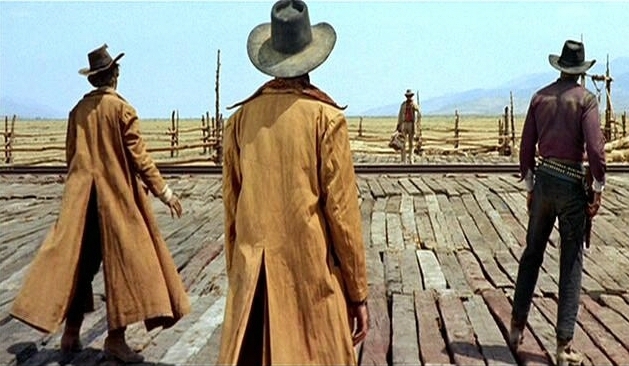
Or at least, definitely shouldn't steal it for Legacy of the Bieth. I'm shooting to have a certain theme and atmosphere in my setting, where things are washed out and sun-blasted and Sergio Leone cinematography, even in the Zone itself. The fancy peacock outfits of the Imperials and other city slickers wilt and fade in the borderlands. Life means little, death sometimes has its price.

Once Upon a Time in the West
I find myself finding all sorts of things that sound really cool, but I've got to keep reminding myself about what I want in my setting and how I need to get that across. Once I've gotten that established in the setting (and importantly, convinced myself I've gotten that established in the setting), then I can maybe start to expand other areas and use some of the cool bits I've seen elsewhere. But until my stuff...makes its bones, for lack of a better term, I don't want to start heading out of the areas I need to get right.

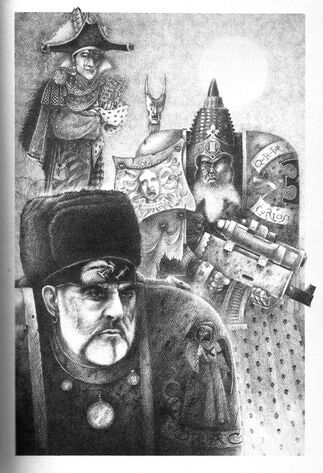
The same thing applies with the 40K stuff I'm working on. I need to get the right balance between the weird and grotty John Blanche of the early days

"Jaq Draco" - John Blanche
"Ryan, be careful what you shoot at.
Shome things in here don't react too well
to bolter shells."

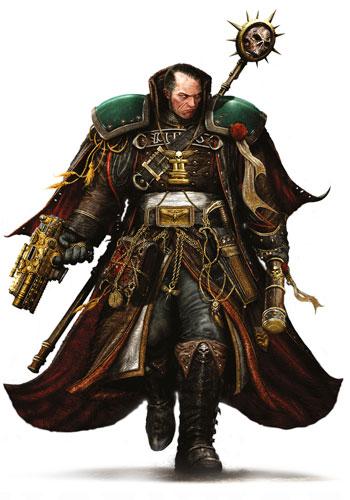
...with the slick fancy Adrian Smith stuff

"Eisenhorn" - Adrian Smith
"I am a badass despite the fact
that I am also ludicrously microcephalic."

And the question there is going to determine how I reshape everything. I know I want to have something that embraces a lot of the universe and setting assumptions of early 40K, but I know that I want something of the slickness and baroque tomfoolery that goes along with Dark Heresy and the Abnettquisition works. Early 40K fits in really well with Traveller (at least the STARSLUGS Traveller I've been playing recently), but it's an Abnettquisition premise that I've been noodling at for about two years that's got me started on the conversion process in the first place. 

None of this is dealing with players, mind you. They're going to keep engaging in their ridiculous-awesome plots and crazy shenanigans and not giving a crap about my fretting over themes. As well they should. 

Joesky Note: Dark Heresy weapons and armor would be a pain in the ass to convert into Traveller's regular combat system. Thankfully, the alternate combat system that Sun-Lord Chris posted over at Hill Cantons actually allows for really rapid conversion. The penetration and armor values from Dark Heresy can come over into Traveller almost directly (with a few tweaks to account for Traveller's baseline weapons assumptions). 

(Yeah, this isn't a full tax. Shut up, I'll do more later.)

Saturday, November 23, 2013

STARSLUGS Signatory, Punk-Dark Imperium of Man

With my primary gaming campaign being on a bit of an SF kick these days, I've been getting more and more excited about an idea I had a few months ago, using Traveller to run Warhammer 40K games. (I have the Dark Heresy RPG and find it extremely impenetrable, though very pretty and with some very cool bits.)
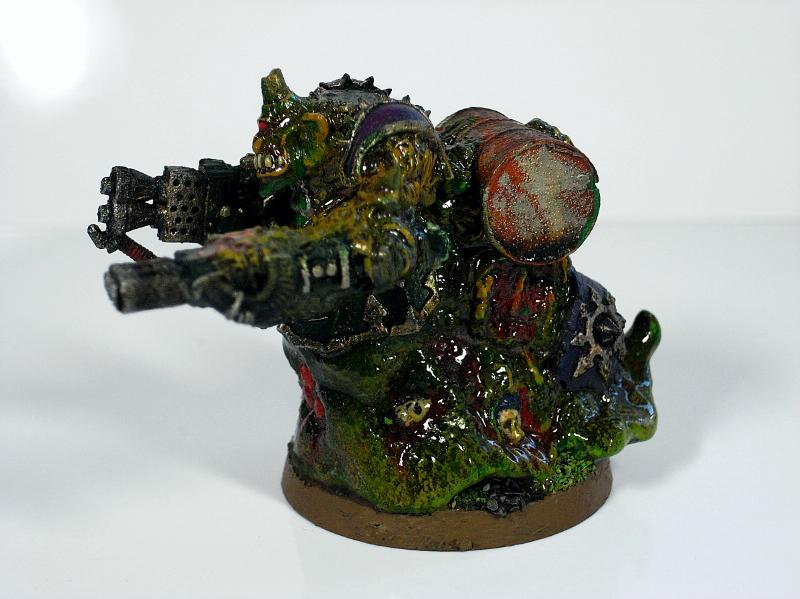
"Nurgle Slug Obliterator," by Panic
CoolMiniOrNot
Now both Chris and Evan have begun running Traveller games, with the interstellar equivalent of a FLAILSNAILS Convention: the STARSLUGS Convention. (see below)

And this has gotten me excited enough to start getting my 40k system tweaks fully set up for Traveller. I'm envisioning a combination between the wild craziness of the first 40K work, Rogue Trader (gonzo, punk, cynical satire, extremely 2000 AD), and the no less grim but significantly more heroic Dan Abnett envisioning of the setting (not everyone is an asshole, even though life sucks; Chaos is likely going to eat everything but you can still win victories against it.)

So expect some more posts on the matter. The primary areas I'm expecting to work on are going to be creating a new equipment list (using these alternative rules for combat) and a career/lifepath system splitting the difference between WFRP and Mongoose Traveller careers. 

So. Announcing the Punk-Dark Imperium of Man. Let's see where this goes. 

Oh, and related inspirational art blog.

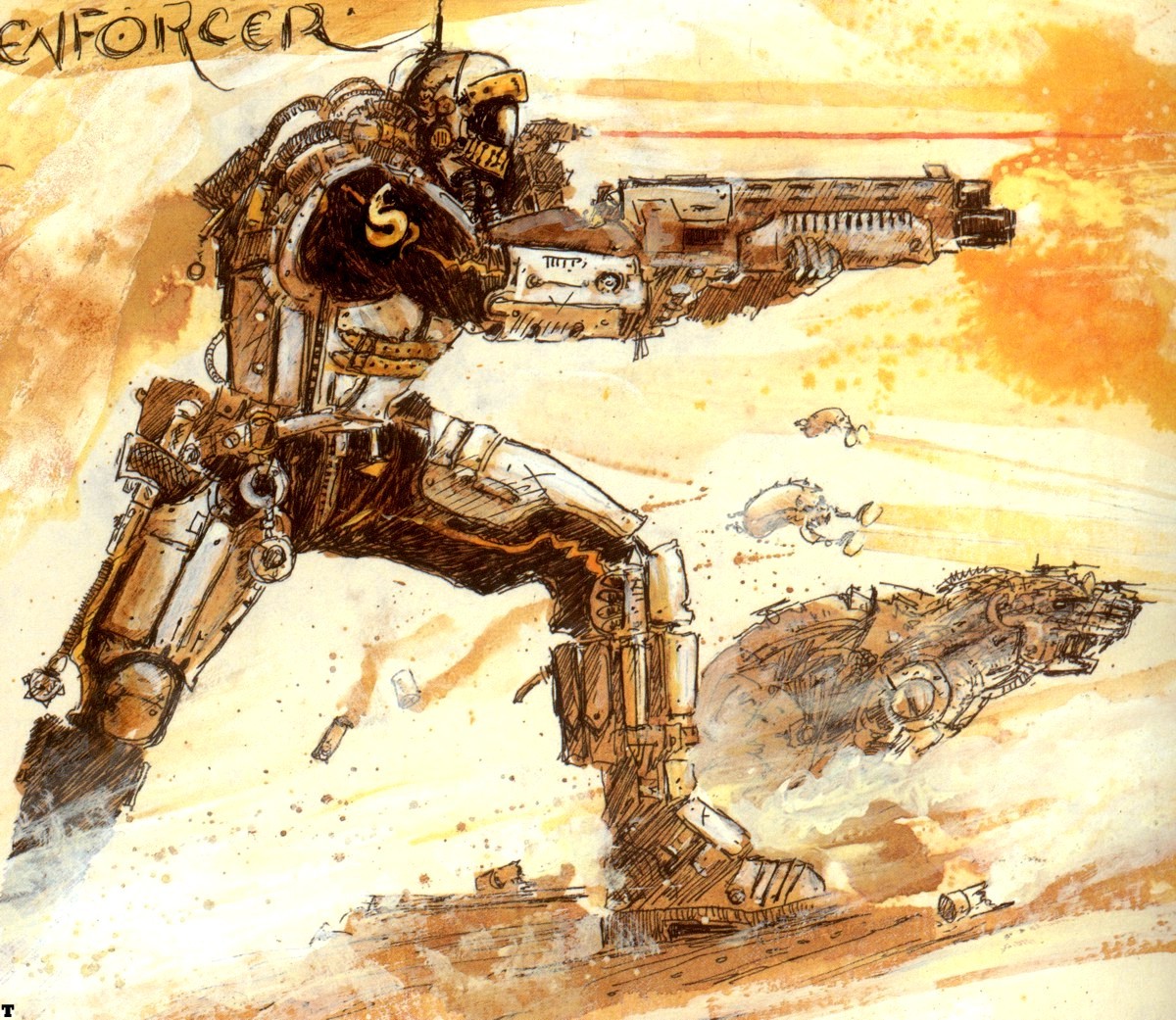
"Enforcer," John Blanche
Simple Translation Agreement Rules Simulating Lastingly Unified Galactic Sectors
In order for freetraders in the Space Cantonment, Directorate Space, and other willing sectors, to prosper and thrive, the referees of those campaigns have set out the following articles in order to ease movement between them.

Article 1
Characters may move between Directorate Space and the Space Cantonment freely provided they meet the standards required in other articles.

Article 2
Characters are bound by the rules of the version of Traveller being used in the game they are currently playing.  This includes things such as the rules for combat (both personal and ship-based), weapon damage, the functions of certain technological items, etc.

Article 3
There is one exception to the rule presented in Article 2: skills.  Characters use whatever skill they possess that is closest to the one in the system currently being run.  This means that characters from the Cantonment (and possibly other CT games) possess broader skill categories than those the Directorate.  Skill acquisition is also based on the characters native system, and not on the system currently being run.  Skill rolls function as other items described in Article 2.

Article 4
Characters may bring their own personal effects with them, but not those held in common with other members of their party/crew.  This includes any ships the characters rolled on the benefits table, assuming the ship is being used by other party members.

Article 5
Psions, astropsychics, and aliens must submit their characters to the referee at least 48 hours in advance so that the referee has the time to read over any relevant sections of their rules/come up with how certain foreign abilities work in their area of space-time.

Wednesday, November 6, 2013

Arab Travelers: The Head of Badr

One of the marvels that occurred during that battle with the Franks [Baldwin II's attack on Damascus in 1129] was the following. In the army of Hama, there were two Kurdish brothers, one of them named Badr and the other named 'Annaz. Now, this 'Annaz had bad eyesight. And when the Franks were defeated and killed, some of the men cut off their heads and hung them off their saddle-straps. So 'Annaz cut off a head and hung it from his saddle-strap.

A group of men from the army of Hama saw him and said to him, 'Hey, 'Annaz, what's with that head you have with you?'

'Glory be to God,' he replied, 'for what happened between this man and me - I killed him.'

'Oh, man,' they told him, 'that's the head of your brother Badr!'

So he looked at the head, examining it. Sure enough, it was the head of his brother. And so in his shame before the men, he left Hama. We never knew where he set off for, nor did we ever hear any further news of him.

-Usama ibn Munqidh, The Book of Contemplation, p. 128. Trans. Paul Cobb, Penguin 2008.

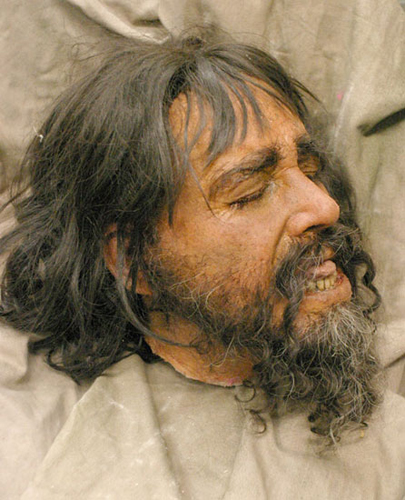
Head from Lone Wolf Effects
The shame 'Annaz felt for both his lies and the mutilation of his brother's corpse wound up imbuing Badr's head with strange energies. Badr was slain in defense of Damascus, and still seeks to do so from beyond the grave, but the actions of his brother torment Badr's spirit.

The head of Badr projects a 30' radius bless spell around it when held aloft by a member of the Faith or by someone defending a position. The person holding Badr's head is incapable of telling a lie. For every five rounds that Badr's head is held aloft, all persons affected by the bless spell must save or take 1d2 damage/level, as the pain of 'Annaz's betrayal cuts deep, and severe cuts appear around their necks.

The head of Badr may only be buried when Damascus is safe.

Monday, September 30, 2013

Arab Travelers: The Leopard

Fatimid pottery cup, 11th century.
From here.
Of all the animals, the leopard alone can jump more than forty cubits. In the church at Hunak, there was a window forty cubits in height above the floor. A leopard used to go there during the hottest part of the day, then jump down and go away. At the time, the landlord of Hunak was a Frankish knight called Sir Adam, a real devil of a Frank. He was told the story of the leopard, and he said, 'When you see the leopard, inform me of it.'

The leopard came as usual and jumped up to that window, so one of the peasants went and informed Sir Adam. Sir Adam put on his hauberk, mounted his charger, took up his shield and spear and went off to the church, which was in ruins except for one standing wall where the window was located. When the leopard saw Sir Adam, it pounced down from the window on top of him while Sir Adam was still on his charger and broke his back, killing him. It then went away. The peasants of Hunak used to call that leopard 'the holy-warrior leopard.'

One of the special qualities of the leopard is that if it wounds a man, and a mouse urinates on the wound, the man will die. A mouse never gives up trying to reach a man wounded by a leopard: one person, out of fear of the mice, even had a bed made for himself sitting in the water, with cats tied all around it.

-Usama ibn Munqidh, The Book of Contemplation, p. 123-124. Trans. Paul Cobb, 2008, Penguin.

Leopard, from "The Benefits of Animals"
Image from here.
"The leopard is a fierce enemy of man, unmanageable and ferocious. He eats only his own game. When satiated, he sleeps for three days and three nights in succession; (...) A sick leopard gets well by eating mice. His skin is tender and if he is wounded it breaks with a slight stroke.

The flesh and fat of a leopard, boiled in the juice of olives, serve as a good salve for the sores, abcesses and pimples that break out on the body; his blood is a preventive liniment for all skin diseases."

-Ibn Bakhtishu, The Benefits of Animals, quoted from 1001 Tales of History's post on the book - which you should totally check out, if only to see the other fascinating pictures and descriptions.

Well. There's clearly something up between leopards and mice, some connection here. But why would these two creatures be connected?

Hmm. I am reminded...
“I am reminded,” said the Mouser, “of what a witch told me about adepts. She said that, if an adept chances to die, his soul is reincarnated in a mouse. If, as a mouse, he managed to kill a rat, his soul passes over to a rat. As a rat, he must kill a cat; as a cat, a wolf; as a wolf, a panther; and, as a panther, a man. There he can recommence his adeptry. Of course, it seldom happens that anyone gets all the way through the sequence and in any case it takes a very long time. Trying to kill a rat is enough to satisfy a mouse with mousedom.”

- “Adept’s Gambit,” Fritz Leiber
Clearly the Mouser is misremembering (or the witch misspoke) and it was leopards, rather than panthers, that were in the adept chain of succession. But what if there were some way to short-circuit this process? What if an adept-turned-leopard-turned-mouse could easily slay a man while as a mouse? Perhaps through a wound that they had made as a leopard?

And this would explain why the mice never give up trying to reach the wounded man. Because if they can work their arts on the wounded...ah, the chance to be a human once more!

Perhaps some adept-leopards (leopard-adepts?) retain their loyalties in life, as the case of the holy-warrior leopard shows. Or perhaps this was merely an opportune moment for the adept to strike at a human and return to a human form. Yet it is curious that it did not attack the peasants...

Monday, September 23, 2013

Arab Travelers: Cave of the Seven Sleepers

My route took me by the Cave of the Seven Sleepers. So I stopped there and went in to pray at the mosque, but I did not go through the narrow passage that one finds there. One of the amirs of the Turks who were with me, called Barshak, came, wanting to enter by that narrow cleft.
Cave of the Seven Sleepers, near Amman, Jordan
Photo from itsanillution

I said, 'What are you doing that for? Come and pray outside.'

'There is no God but God,' he replied. 'I must be a bastard then if I can't get through that narrow cleft!'

'What are you talking about?' I asked.

He said, 'This is a place that no son of adultery can pass through - he cannot enter.'

What he said forced me to get up, enter by that spot, pray and come out again without - God knows - believing what he said. Indeed, most of the troops came and entered and prayed. 

Yet, in the army with me was Baraq al-Zubaydi, who had with him a slave of his, a black man - devout fellow, taken to praying a lot, and one of the tallest and leanest people. He came to that spot and tried with all his might to enter, but he could not get through. The poor fellow wept, moaning and sighing over and over, and then left after failing to enter.

- Usama ibn Munqidh, The Book of Contemplation, p. 23-24, Trans. Paul Cobb, 2008, Penguin Books.

This is one of ibn Munqidh's stories which has stuck with me. (Possibly because of his prompt emphasis on his own easy and unobstructed passage. Not that he believes in such superstition, of course.)

From a gaming standpoint, this is a helpful reminder to make a region feel alive through legends and folklore, stories tied to places. There doesn't always have to be anything major to the legends, mind you. It's completely legit to have an ancient hoary legend which doesn't actually have much backing it up! Certainly ibn Munqidh didn't encounter anything significant in visiting the cave...although perhaps Baraq's slave did.

Sunday, September 15, 2013

Making Exploration Fun

This is a cross-post from a forum I frequent, Intangibility. A lot of the stuff here is commonplace wisdom among the folks likely reading this blog, but I figure it's worthwhile for me to get my thoughts out on this, if nothing else. 

So over on RPGnet someone posted a question about how to make exploration exciting and fun in RPGs. I've been having some good luck with this in the Hill Cantons (~2 years now, forth the Nefarious Nine!) so I thought I'd start the ball rolling on a parallel discussion here.

Chris has a few thoughts here and here.

From the player perspective, some things that have worked well for exploring the Hill Cantons (but now flipped around as statements to the GM) have been:

Dungeons
a) Having a coherent theme/themes. It's important to have dungeons that are not only weird and fantastic, but also have a structure and logic to them. Being able to determine things about the dungeon from your surroundings helps fix the environment together and provide ideas for what else can be around, driving exploration efforts. 


Concept Art for Linage II
b) Using random encounters to provide time pressure. This means that choices have a significance to them because the longer you take to explore, the more dangerous the site becomes. 

c) Jacquaying the dungeon. Creating interesting structures to explore, that have multiple branching paths. Weird geometry, shortcuts, loops - these things make exploration exciting, provide opportunities for sudden windfalls, and suggest new ideas. ("This flooded tunnel might be a path to the next level; let's see if we can figure out some way to get through it!")

Wilderness
Unsure of this image's origin, alas
a) Provide options. In contrast to the dungeon, where you're navigating a presumably utterly unknown environment, I think wilderness exploration benefits from having known landmarks as guideposts to provide immediate areas of choice. The dungeon provides a series of constrained options ("doors are north, south, and the trap door in the corner leading down") but the wilderness is wide open. Give players a map and let them know what the major things around them are! Those options serve as the initial "dungeon doors" of exploration, providing the option for players to set goals and formulate plans. But remember Korzybski here: the map is not the territory. Toss in curveballs, make the map inaccurate (maybe let the players know beforehand that it may be inaccurate!) and add in things that the mapmaker may not have known about.

b) Provide for altering the wilderness. In the HC, we're in a pseudo-domain-game stage, which requires clearing and holding hexes (exploring to make sure they're safe for regular folks, then establishing control over them through patrols), giving us an opportunity and incentive to interact with the environment. 

Both
a) Recognize that you're going to create and prep areas which may not see the light of day. THAT IS OK. Part of exploration means that you're likely going to miss things. 
b) Have interacting parts. Don't make each hex / dungeon zone it's own little bubble. Have groups move around and interact with each other and make use of their surroundings. (A multitude of factions also provides players with another reason to explore: being able to find allies and/or Yojimbo their way through trouble.)


All of these are centered around making exploration contain meaningful choices. Someone on the RPGnet thread suggested that exploration is like a slot machine hit. I think it ought to be more like a hand of poker or blackjack; a slot machine is completely random, but blackjack and poker both require the application of skill along with the randomness to provide an (arguably) more compelling experience. Chance should most certainly play a role, but exploration should also make use of player agency and decisions.

Wednesday, September 4, 2013

Equipment List Additions

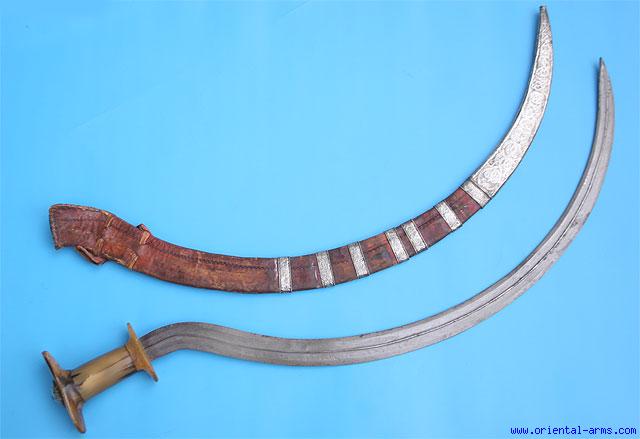
Flyssa
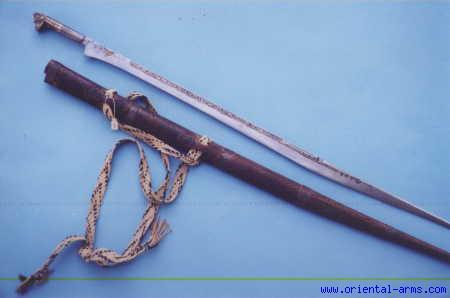
Flyssa
Photo from oriental-arms.com, found here.
Traditional sword of the Freelanders. Single-edged, with the blade tapering, then flaring out again before tapering to a full point. Deals d8+1 damage, cannot be purchased in towns.

Arrow-guide
The arrow-guide is placed on the interior side of a bow and allows for greater pulls on the bow and heavier arrows, yielding greater damage and armor penetration (though causing a penalty in accuracy). Users take a +2 bonus to their attack rolls, but will roll twice and take the worse result. Increase the bow damage die by one (so a shortbow fires at a d8, a longbow at a d10) while using heavier arrows. The arrow-guide costs 5 dinars; the heavier arrows cost double normal arrow costs.

Assegai
The assegai is a short (2') stabbing spear with a leaf-shaped blade, not suitable for throwing. It deals d8 damage but cannot be used for second-rank attacks. It costs 10 dinars. 

Shotel
The shotel is an extremely curved sword. Its unwieldy nature gives users a -1 penalty to hit in close quarters, but it deals 1d6+1 damage and ignores the presence of shields. 12 dinars.
Shotel
Photo from oriental-arms.com, found here

Naft Projector

Proposed Greek fire naval projection system, Haldon and Byrne
From Wikipedia's Greek Fire article
The naft projector, as designed, is not viable for individual use, but can certainly be mounted on ships or placed for structural point defense. Naft is similar to Greek fire; the projector heats the naft before spraying it out through a brass nozzle under pressure (50' range). Individuals within the firing arc of a naft projector must save vs. breath weapon or take 1d10 damage for 2d4 rounds. Not a staple naval weapon because you're creating a fire on board your ship and transporting an extremely hazardous chemical; choppy seas can result in... awkward results.

(I mention not viable for individual use "as designed" because I'm sure some murderhoboes are going to try and find a way to McGuyver this for use in a dungeon.)


Naft Grenade
Greek fire grenades
Athens National Historical Museum
From Wikipedia's Greek Fire article
The use of flaming oil has a long pedigree in D&D, but naft grenades make that easier. A naft grenade has a pre-inserted wick that can be lit and the grenade then thrown; it will deal 1d10 damage as long as it burns. Each round it burns, roll a d4; if the roll is greater than the number of rounds it's burned, then it keeps burning. (So on the first round of burning, it will continue to burn on a 2-4; on the fourth round, it will go out). Naft grenades are officially restricted to use by the military, but available on the black market for (d6+1)x10 dinars.


Lamellar Armor

Metal plates laced together to form armor; generally the heaviest armor that's regularly worn. Like scale armor, but lighter. AC 4, costs 50 dinars. While it counts as "heavy" armor for the purposes of environmental distress, distress checks are made with a +2 bonus (yay, airflow!)

Whipsword
Can be coiled up in a torc before being withdrawn. Deals 1d4+1 damage, but can be concealed easily. Available on the black market for (2d4)x10 dinars.
Whipsword
From Relaxic.net