AbuFadlan'sFinger
This thin chisel is wrought in the shape of a stylized finger, with a perpetually flaking lacquer of dark green. It cannot be broken save by magical force of some kind. Use of the chisel will speed normal chiseling tasks by about 25%. It can be used to chisel a message or glyph into an individual's flesh, an extraordinarily painful process - however the resulting symbols can only be seen under a waxing or full moon. It is said that with the right rituals, the viewing conditions can be changed (so that the message might only be viewable with infravision, for example).
(Inspired by Beedo's post here and items from Planescape: Torment)
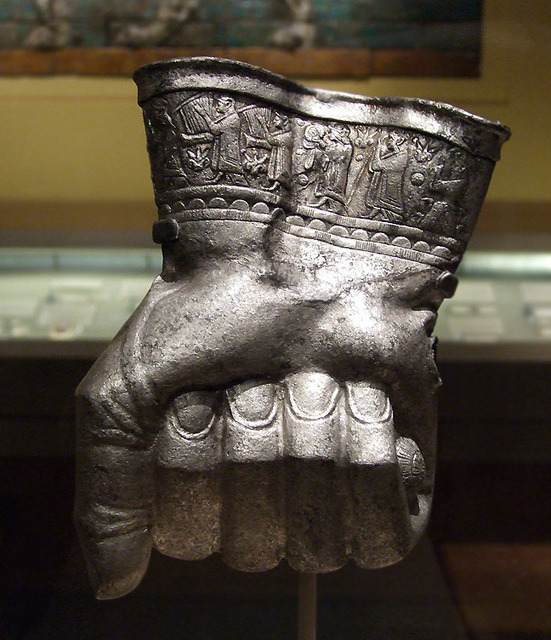
The Silver Fist
Actual artifact information here
Boston Museum of Fine Arts
Photo by Elissa Corlini
This strange item is a hollow fist with several contradictory legends. There seems to be consensus that it was created by the sorceress Inaya the Seeker. Some say that it is to be used as a drinking vessel, and that drinking a cup of wine will imbue the drinker with great strength. There are also whispers of those who drank the blood of their foes - or their friends -from the fist and gained strange powers. These rumors have become stronger in the wake of the Forsaken War, given the horrific acts of the Awlad-i-Dimagh.
Others say that these legends are nonsense and that the fist is to be worn as a (very heavy) amulet. Calling out a name of a deity of the Many ("Ouathar") is supposed to reveal all magics within sight of the bearer, and that the Fist is able to store spells and magics within it for later use.
Still others insist that the Silver Fist is to be worn as a glove, that it can be used to strike the insubstantial and to unleash bursts of force upon striking a foe, knocking them back.
Rimeplate
Plate mail is exceedingly uncommon in the environs of Sanctuary, because of the fatigue and discomfort that generally accompany the armor. The Rimeplate is an exception to this general rule. A suit of glimmering blue-tinged plate, the Rimeplate is cold to the touch. If someone actually puts on the armor, they feel a freezing chill throughout their bones as the armor's magic activates, and frost actually begins to form on the edges of the armor. If donned, a wearer loses all Dex bonus and is at -1 to all attacks and -2 to all saves from the cold, but the Rimeplate is AC 1 (or 19 if you prefer) and prevents any distress rolls due to hot weather conditions. If an enemy attack hits and would deal max damage, it must be rerolled once. At one point, the Rimeplate was in the hands of Caliph Perviz IV, who reportedly made one of his bodyguards wear the armor at all times, just in case the Caliph ever wanted a cold drink.
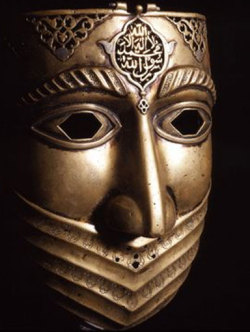
The Face of Battle
This war mask has been held for many years by marabouts of al-Kursi, one of the ribats located on the trade route back to the Imperial corelands. Passed down from one champion of the order to the next, the mask is said to have gazed upon countless conflicts and battlefields, even dating back to the time of the Bieth themselves.
The countless battlefields of slaughter that the mask has seen have imbued it with a deep knowledge of war; once per day its wearer may reroll an attack or damage roll that they have made, or that was directed at them. If facing an unclean spirit or skinchanger, the holy verses inscribed on the forehead of the mask will glow a brilliant white, and the wearer will be able to strike more punishing blows at the being (reroll 1s on damage dice). However, in its zeal to strike down the foe, the mask urges its wearer into the fray; they must save vs spell in order to break away from a foe who they have engaged in melee combat. It also grants an extra saving throw against the first effect of the Zone its wearer encounters in a day.
After using the mask for approximately a week, the wearer's features will start to resemble the metallic features of the mask; their mouth will not disappear, but will start to conform to the v's of the mask's stylized beard. The wearer's dreams will always include battle.
Telecanter has a very nice simple mechanic for weather and survival here. Copying it in full: "Each hour you're in distress, roll under your Constitution or take 1 point of damage per level."
I'm going to modify this a little bit, as Telecanter suggests, to account for the weather-specific needs of Legacy of the Bieth. So what are some of the conditions where weather causes distress around Sanctuary?
In the scrublands, it's rocky terrain with scrub brush and other light vegetation around. You don't need to worry about distress unless a weird storm comes up. Folks wearing heavy armor make distress rolls every 4 hours, generally.
In the deep desert, characters will generally make one distress roll if active during the heat of the day. Characters in heavy armor will make one distress roll an hour. Fighting or other strenuous activity will increase these rolls, to one an hour (normal) or one a ten-minute turn (heavy armor).
Being near a Zone anomaly may result in severe distress - all characters in proximity make a distress roll every round.
Thanks to Robert over at Rogues and Reavers for giving me the push on this.
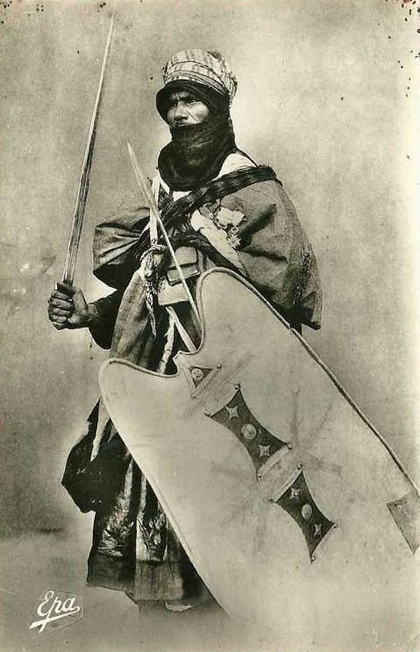
The Freelander is a ranger variant for Legacy of the Bieth, unique to the nomads of the desert. These are the outriders and scouts of the nomads, the warriors of the tribe. New PCs are likely members of the Bani Khalil or Bani Juzayy tribes, which are both relatively near Sanctuary.
Requirements: Str 12, Con 12
Fights and saves as Fighter, XP as ranger from Advanced Edition Compendium
Adept Scout: Freelanders are surprised only on a 1 on 1d6; if on familiar ground, their party will surprise opponents on a 1-3 on 1d6. While in familiar ground, they may also hide and move silently as a thief of their level, provided they are not wearing any armor heavier than leather. It takes 1d6 weeks for a Freelander to become familiar with a given region. Freelanders may track as an AEC ranger.
Hated Foes: Just as with any other ranger generated for Legacy of the Bieth, Freelanders may choose a hated foe from the list below. Every level, the Freelander gains +1 to attack and damage rolls against their chosen type of foe.
Undead
Skinchangers
Demons
Servitors
Mutants
Bieth Constructs
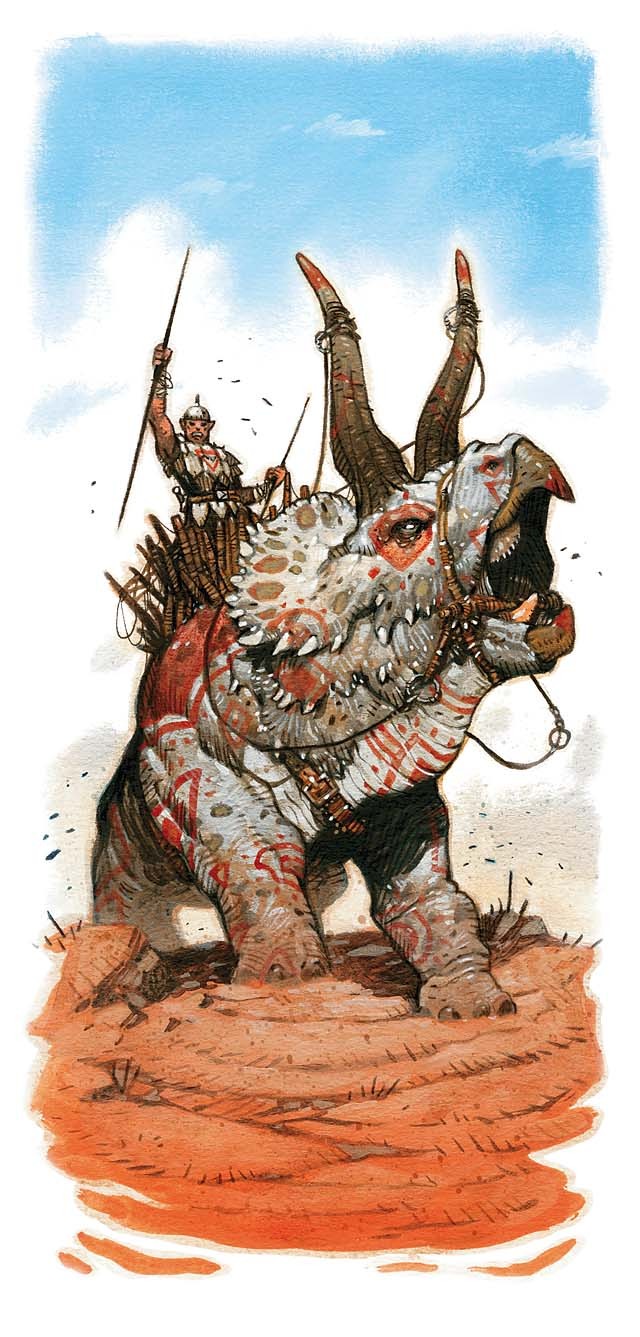
Daring Cavalry: While mounted, Freelanders may make an attack at any point during their movement (rather than moving and attacking at the end of the move). Starting at 4th level, they may also apply their Strength, Wisdom or Charisma modifier (whichever one is highest) to their reaction rolls in order to try and tame some ridiculously badass creature like a triceratops as a mount.
No Spells: Freelanders do not gain spellcasting abilities.
There's a campaign map up over at the main G+ page for Legacy of the Bieth. On it, you can see that there is an arrow marking where the lands of the Forsaken are.
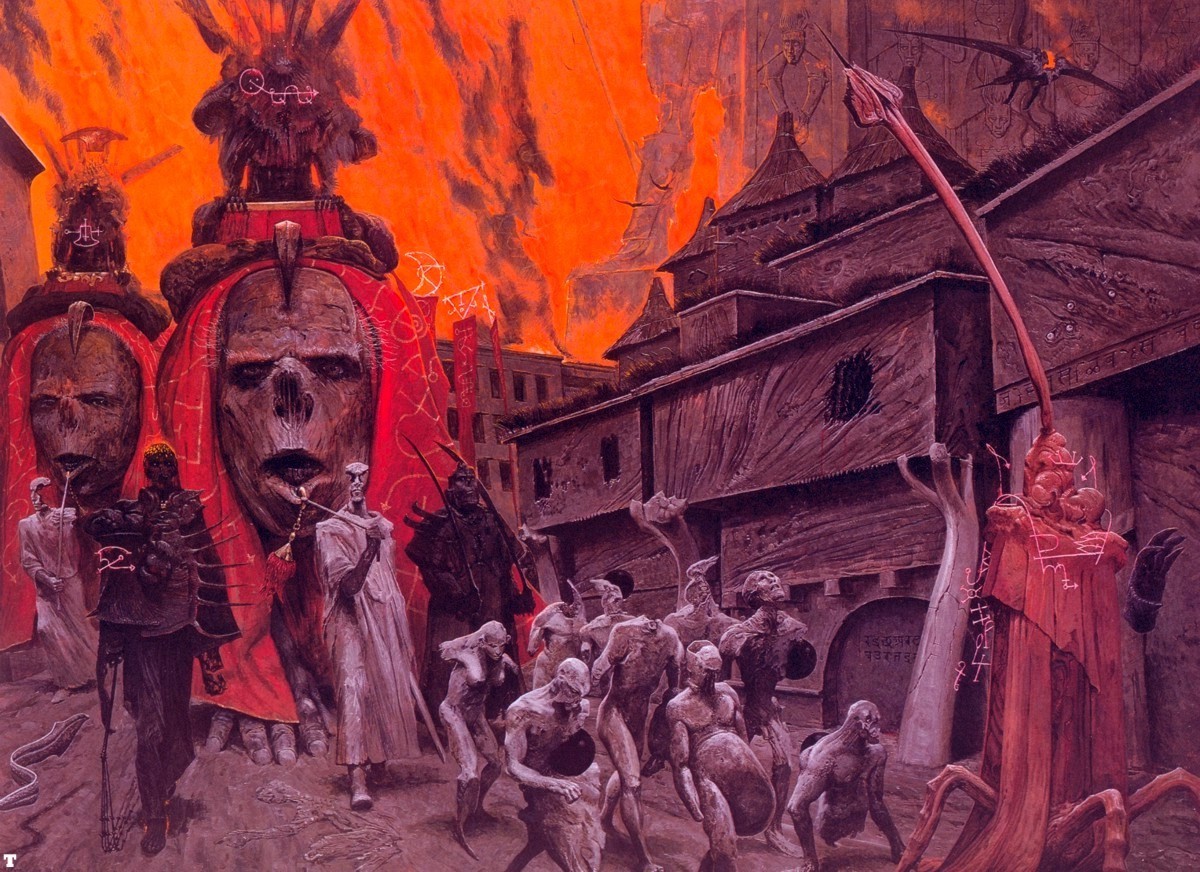
The Forsaken look like the denizens of Hell as illustrated in Wayne Barlow's Inferno, the results of living for generations in areas ravaged by the now-uncontrolled Bieth magics. They crouch in the remains of Bieth cities, expanding the subterranean tunnels and growing their civilization beneath the sands. They largely keep to the ruined cities, but some have started to expand outwards.
Interior of a Forsaken city.
From Wayne Barlow's Inferno.
About ten years ago, Caliph Abu Qasim decided that he wanted to expand the Empire's borders, secure some trade routes that didn't go right next to a Zone. Taking the results of a few Bani Khalil nomad skirmishes with the Forsaken as justification, he launched an invasion of their lands. It was expected to be a sudden quick strike. Neither the Caliph nor his advisors expected the hordes of Forsaken warriors boiling out from their cities, or the Bieth weaponry and constructs that they brought with them.
The fighting went badly for the Empire; whole units were annihilated by the dark fires of Forsaken weaponry. The arrival of the Awlad-i-Dimagh, the new order of Psychic Warriors, was able to stabilize the fighting and even push the Forsaken back across the Muqabla River, where the lines held. Only after the fighting did the Imperium find out about the horrors that the Awlad-i-Dimagh had been concealing...
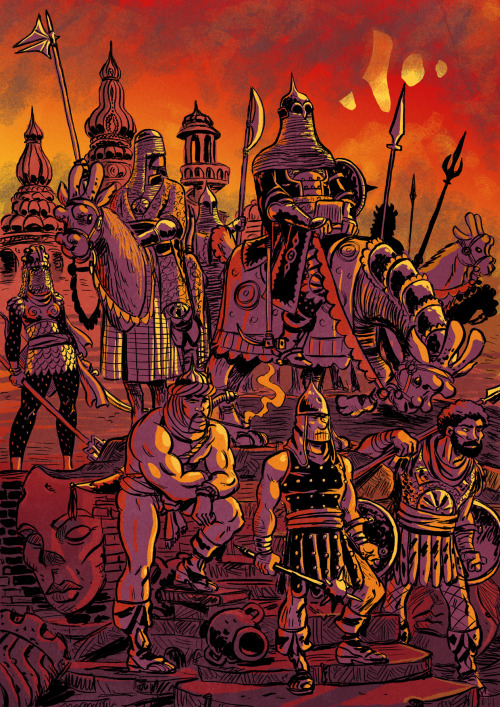
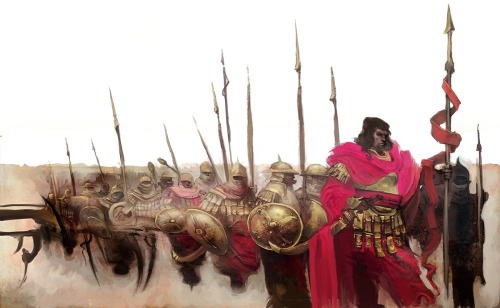
Imperial troops preparing for war.
Piece at Una The Blade.
It was at this time of stalemate that Caliph Abu Qasim suddenly and tragically passed away - a rapid and sharp onset of acute metal poisoning (a sword through the belly). His daughter Zainab, the new Calipha, apprehended the assassins (personally executing them before anyone could put them to the question), then offered peace to the Forsaken, seeking to end the war and consolidate her new reign. The Empire pledged that it would remain on the eastern side of the Muqabla in return for the Forsaken withdrawing from the ruined city of Qasr al-Malik.
Most Imperial soldiers returned to their homes, but many still haunt Sanctuary as laborers, mercenaries, and burned-out drunks (sometimes filling more than one category).
Evan's got a nice desert setting blurb up over at In Places Deep, definitely worth checking out.
* * *
I'm still working on putting together a few sites to get the G+ game up and running. For whatever reason, I find the process of stocking a dungeon to be interminable, even when I'm stocking a pre-existing map and not drawing my own dungeon. I could likely wing it, or put minimal prep in - just draw a line in to part of the dungeon saying "kobolds, traps" and improvise as the PCs approach. I feel comfortable enough with that approach that I can get a good game session in with it. But I don't know that it holds up in campaign play, because dungeons aren't generally one-shot and leave. They're explored over time, and that means having records of what's where and remembering what's changed (and what's stayed the same) since the last time players were in an area.
Robert Parker's Rogues and Reavers has a few excellent posts on civilization and the concept of "hardboiled fantasy." Since one of the key inspirations for Legacy of the Bieth is the spaghetti western, this is a topic of great interest to me.
Robert's posts start with examining some of the works in Appendix N of the 1e DMG, and some of the thoughts on game design that emerge. Check them out: Eyes of the Overworld by Jack Vance - picaresques, plot hooks, and the necessity of mischief The Snow Women by Fritz Leiber - hardboiled scenario design, and presenting a setting that can foster hardboiled fiction's themes of moral ambiguity Ginger Star by Leigh Brackett - hardboiled settings' take on civilization, social class, and how to make that pop in play.
Robert's quite right to point out that Vance's work thrives on both whimsy and the ubiquity of swindles. (See also: Bob the Angry Flower on Vance). For Legacy of the Bieth, I don't want too much setting-loaded whimsy - after all, Roadside Picnic is another inspiration here! - but the ubiquity of swindles is definitely something to keep in mind. Everybody's got an angle that they're playing; this isn't evidence of any particular moral calumny, but just the way of the world.
In the book 10,000 Ways to Die (pdf link) Alex Cox takes a look at the spaghetti western, and divides the spaghetti western protagonists into (of course) the Good, the Bad, and the Ugly. PCs will by and large fall into the categories of Good and Ugly here; the Bad represents the entrenched elements of society, which is at odds with the PC's role as a Free Agent (as per Robert's characterization in the Ginger Star essay). In discussing the Good, Cox notes:
Interviewed in a documentary about Eastwood, Leone said that what had attracted him about the actor (who he'd only seen in episodes of 'Rawhide,' speaking in a language Leone couldn't understand) was his indolencia. This easy idleness, often translated into laziness, was to become a regular heroic characteristic...The hero is never seen working hard at anything. He cannot slave like a peon or run a saloon, because regular work is one of society's demands - like ostensible submission to the law.
This fits in excellently with the Free Agent PCs, who certainly can't fit into the straits or confines of society, because why the hell else would they be digging into tombs and running from horrible monsters? Robert brings up a point in The Snow Women essay regarding balance:
"I suspectthis is the "sweet spot" where D&D works best - the protagonists vary between wretchedly self-interested and morally decent, at times robbing tombs and at others saving villages. Presenting opportunities for both should be the goal of any campaign."
This melds interestingly with the distinction that Cox draws between the Good and the Ugly in spaghetti westerns: the Good is often the ice-cold revenger, remarkably adept with weapons but unable to relate to the people he interacts with, an elemental force of violence. In contrast, the Ugly is the human one of the trio, living life with gusto, comic, but with a sliver of decency hidden away. And ideally the PCs are balancing between these two extremes as well, it seems.
Cox notes that "even more than the Good man, the Ugly would in an American western have been a villain of major proportions - the bandit chief in THE MAGNIFICENT SEVEN for instance...Ortiz and Hugo in MINNESOTA CLAY and DJANGO are undoubtedly villains - they ambush, torture, and kill without compunction - but there is something attractive about them. Physically they are big and fat and jolly-looking. They deck themselves out in paramilitary outfits...like the director [sic] of some banana republic. They laugh a lot, though what they laugh at is often questionable..."
Sorry if this all seems a bit disjointed. I'm still chewing over how to best express the disaffected feeling common to spaghetti westerns and Roadside Picnic into the atmosphere of my game, without having it be omnipresent message-y nonsense.
JOESKY TAX
Powder of the Moon: a powdered compound with coarse bone dust mixed with several alchemical preparations. When the powder is sprinkled upon a corporeal undead being, it is treated as though a fifth-level cleric was attempting to turn the undead. If the turning attempt is successful, the undead retreats and seeks to lie down in its grave once more, for 1d6 hours. If the turning attempt fails, or the undead had no grave to begin with, then it is tormented by visions of a proper burial, and attacks with a +2 bonus to attack and damage rolls.
This guy was originally called the Crystal Butterfly, but after some PCs encountered it, they dubbed it the Blooderfly instead.
Like this, but no amber in the wings.
Oh, and with a 30 foot wingspan.
Blooderfly
Big-ass butterfly (30' wingspan) with crystalline wings that glitter beautifully. Too bad it's trying to drain your blood.
No. Encountered: 1 Movement: 120' AC 5 HD 5 Attacks: Blood drain - gaze attack 2d6 dmg, save vs pet/poly for half damage. Blood comes out of someone's body in a thin red mist, goes into the butterfly's wings and makes them a nice pink. Balefire - After 3 successful drains, it can fire a balefire blast from its antennae - HDd8 blast damage in 20' radius, save vs BW for half, it's immune to its own blast. Balefire can sometimes generate/cause illnesses. Defenses: The Crystal Butterfly is immune to clerical magic, being a creature of the Bieth. Morale: 8 XP: 5 HD: 800 6 HD: 1320 7 HD: 2040
OK. Go and listen to Blue Oyster Cult's "Veteran of The Psychic Wars." You want to do something with psychic warriors now, right? If not, what is wrong with you?
Look, never mind. Just take a look at this class. It's a bit fiddly, moreso than I generally like my D&D classes to be. On the other hand, it doesn't have a giant spell list like clerics and wizards have, so I guess that evens out in terms of complexity and selection. This is just going to present the class, I'll make another post discussing how psychic warriors (or Awlad-i-Dimagh, Children of the Mind) are viewed in Sanctuary.
This is a pretty fiddly class, and it could definitely use some feedback, so please feel free to chime in on that score.
This is how they start out...
Oh yeah, FYI, somewhat gory image near the bottom of the writeup, in case that sort of thing bothers you. Psychic Warrior
Psychic Warriors are fighters who have been enhanced using strange techniques. They can manifest energy blades from their fists (d6 damage, energy) and can access strange mental powers. As they become more accustomed to their powers they gain access to greater and greater powers, but run the risk of burning themselves out sooner rather than later.
At some point, though, they're going to burn out and die from their powers; even if they don't use them, the process is fatal within a few years.
"A candle that burns twice as bright burns half as long, and you have burned very brightly, Roy..." - Dr. Tyrell.
Requirements: Str 12, Con 12, Wis or Cha 15
Legacy of the Bieth-specific: do not roll on the backgrounds chart, you've got enough wackiness as it is.
* Cannot wear any armor, shields, or other protective devices/magic items
* Their normal AC improves 1 point per level, to a maximum of AC 0 [20]. If surprised, this bonus does not apply.
* Damage bonus of +1 per 2 levels as they can establish better control over their psychic blades
* They are a beacon for any psionically active creatures
* Any time they roll a 1 or a critical failure when a psi power is in use (including their psychic blades), the psychic warrior will get a burnout point.
Biofeedback - A psychic warrior may pour more energy into their physical actions, for example in combat situations or a chase or whatever. You can use this Called Shot mechanism but divide the bonus points up any way you like to physical stuff, so you can be boosting AC, damage, your to-hit roll, or your actual stats for a physical activity, lasting 1 round per level. Like your CON gets temporarily treated as 19 or 20 for the purposes of resisting that lightning bolt, but you don't get increased hit points. Of course, any time you roll a failure while using biofeedback, you get a burnout point, and take damage equal to the number of points you boosted by, for as long as your power would last.
Example: Yaqub is a 3rd level psychic warrior. He wants to avoid getting hit in combat, so he boosts his AC by 5 points. He can stay this way for 3 rounds, but every time he rolls an attack or does something requiring a d20 roll, he wants to avoid getting a 1-6. If he gets a 1 through 6 on the d20 roll, he will take 5 points of damage for 3 rounds and gain a burnout point - ouch!
Staving Off Burnout - There are ways to stave off burnout for a little while, but as you keep going, they become less and less effective. Each method will let you add a certain number of temporary burnout points to your register. They're not completely reliable, though - any time you would gain a burnout point, you must roll above your current total of points to use one of the temps instead of your regular track. You can have a pool of temporary burnout points equal to the highest of your Strength, Constitution, Wisdom, or Charisma modifiers (as per Labyrinth Lord rates), plus your level.
Example: Yaqub has 5 burnout points and 2 temporary burnout points when he rolls a 1 on an attack roll. He needs to roll a 6+ on a d20 in order to use one of the 2 temporary burnout points in his pool.
Psi-drugs - you can buy or synthesize a dose of drugs for 300 gp, that will provide 1 temporary burnout point; this point will disappear in 2 days, though, as the drugs leave your system. The components are hard to find. Memory Sift - a psychic warrior can scan the mind of someone in REM sleep and steal away some of their memories in order to serve as a buffer for their own burnout pool, but the subject will realize upon waking that they have lost all memories of their mother during their teenage years, or something similar. This will gain d2 temporary burnout points, with no expiry point. Spinal Tap - a psychic warrior may drink the cerebrospinal fluid (or equivalent) of a sapient being in order to gain d3 temporary burnout points, with no expiry point. Cerebrovore - a psychic warrior may consume the brain of another sapient being in order to gain temporary burnout points; 1 temporary point per pound of brain consumed, with no expiry point.
Stronghold - At 9th level, a Psychic Warrior may cr...HAHAHA no.
A Psychic Warrior starts with d6 burnout points, 1 dose of psi-drugs, and a bronze straw that may be used for trepanning someone and removing cerebral matter. They also have 1d6+2 years to live before the procedures start catching up with them; at that point they gain 1 burnout point per day.
Burnout Track
1 Mind Shielding - +2 on saves against charms, compulsions, confusion spells, that sort of thing
2 Metabolic Control - Feign death for 1d6 x level turns
3 Battle Trance - when activated, have +1 AC and may dodge missile weapons on a Breath Weapon saving throw. Think bullet time.
4 Ineffective Medications - You can no longer gain temporary burnout points from use of psi-drugs.
5 Mind Block - reroll failed saves against charms, compulsions, confusion spells, that sort of thing
6 Frayed Nerves - At this point you can no longer get temporary burnout points through memory sifting. You do get to increase one of your stats by 1, though - your choice.
7 Disappear in Smoke - You can turn your body into a purple haze for a short duration as per gaseous form; use 1x/day, lasts for d4 rounds. Your energy blades still function while you're in purple haze mode.
8 The Shakes - everyone gets the shakes after picking up a burnout point, but anytime you use a psy power, or are placed in a stressful situation, save vs paralysis - fail, you get the shakes for 1d10 rounds and are incapacitated
9 Psychic Siphon - When you damage a sapient enemy with an energy blade, you gain 1 hp.
10 Thousand Yard Stare - immunity to charms, compulsions, fear and fear-based effects, but anytime that they'd trigger on you, save vs paralysis to avoid d4 rounds of shakes
11 This Chart Goes Up To 11 - you can no longer gain temporary burnout points from spinal taps.
12 Mind Crusher - Gain access to Zak's awesome psionic system, as described over here - with the exception that any time you gain feedback (not just a botch) from this, you gain a burnout point.
13 Stressed System - save vs paralysis or lose a point from a random ability (d6, 1: str, 2: dex, and so forth)
14 Irreparable Damage - You can no longer gain temporary burnout points.
15 Weakening Body - As Stressed System, above, but two saves.
16 Uncontrolled Powers - At their option, the GM may make you roll a save vs magic to avoid activating your powers in a stressful situation
17+ Morituri. You start glowing a bright purple all over; have a +10 to all rolls for 1d6 rounds, and ignore any 1s you roll, it's not like it matters now. At the end of those rounds, roll a d4 to see what happens:
1. Explode - chunks of you go everywhere, those adjacent take 2d6 damage (save for half).
2. Electrocute - you start twitching uncontrollably and arcs of psychic lightning go everywhere. 30' radius, all within take 3d6 damage (save for half), and treat as though a dispel magic spell were cast in that area as well.
3. Exsanguinate - You bleed out from all orifices; it's pretty damn gross. Takes d4 rounds, you're completely incapacitated (but can make dying declarations and all that)
4. Evaporate - your purple energy increases in intensity and you quickly get a snazzy teleporter like effect. Unfortunately there's no rematerialization.
...but this is how they often end up
Level
XP
HP
Dmg Bonus
Paralyze
Poison
Breath Weapon
Magical Device
Magic
1
0
1d6
+1
14
12
15
13
16
2
2,500
+d6
+1
14
12
15
13
16
3
5,000
+d6
+1
14
12
15
13
16
4
10,000
+d6
+2
12
10
13
11
14
5
20,000
+d6
+2
12
10
13
11
14
6
40,000
+d6
+3
12
10
13
11
14
7
80,000
+d6
+3
10
8
11
9
12
8
160,000
+d6
+4
10
8
11
9
12
9
320,000
+d6
+4
10
8
11
9
12
10
480,000
+1
+5
8
6
9
7
10
11
720,000
+1
+5
8
6
9
7
10
12+
150,000/level
+1
+1/2 levels
8
6
9
7
10
Inspirations: Blue Oyster Cult's "Veteran of the Psychic Wars," Hawkwind's "Psychedelic Warlords," S.T.A.L.K.E.R.'s Snork, RIFTS's Juicer, Psylocke, and Strikeforce: Morituri.
Thanks to Robert, Richard, for their suggestions, comments, and stolen systems, and to Cole for helping me track down Strikeforce: Morituri.
Ayaz Bungu - a massive greatspear, with a heavy leaf-shaped blade. Weapon of a fallen mamluk, renowned for his strength. Ayaz Bungu requires a 16+ strength to wield. It deals 2d6+1 damage, requires both hands. On a successful first attack, wielder may make another attack against another enemy in the first or second rank. (Based on an actual mamluk of the Third Crusade, Ayaz the Tall.)
Steel-Weaver - this AC 4 chainmail hauberk is of fine make, but a good bit longer than normal, and will hang a bit baggily off anyone who wears it. Once each day while the wearer is not in combat, the armor will flash a bright electric blue, and the wearer will be healed of 2d6 hp in damage. However, any wounds will be sealed by metal stitches; over time the sealed wounds will gradually come to look and feel like chainmail, and the wearer will lose sensation in the affected areas. Steel-weaver comes with 2d10 charges; once those are used up for a wearer the armor's magic no longer functions for them.
Eye of Piercing - This amulet bears an ornate eye-in-pyramid sigil surrounded by mathematical formulae. The bearer gains infravision (or extends it another 30'), and is immune to the Evil Eye. Once per week, the bearer may fire a ruby ray of energy from their eyes at a given target (d4 damage and -1 to attacks/damage, save vs. wands to avoid). After the amulet has been worn for a week, the bearer's eyes will be yellowed and reptilian, and remain so even if the amulet is lost or removed. After 1d6+1 weeks, the bearer may start to notice scuttling red creatures at the corners of their vision...
Ibn Khaldun was the author of the Muqaddimah, a text discussing historiography and sociology. Along with coming up with the Laffer Curve and busting out some vaguely Robert E. Howard-esque lines on civilization*, he had some thoughts on adventurers and fortune-hunters:
"Many weak-minded persons in cities hope to discover property under the surface of the earth and to make some profit from it. They believe that all the property of the nations of the past was stored underground and sealed with magic talismans. These seals, they believe, can be broken only by those who may chance upon the (necessary) knowledge and can offer the proper incense, prayers, and sacrifices to break them...
"In addition to a weak mind, a motive that leads people to hunt for treasure is their inability to make a living in one of the natural ways that earn a profit, such as commerce, agriculture, or the crafts. Therefore, they try to make a living in devious ways, such as (treasure hunting) and the like."
Ibn Khaldun, The Muqaddimah: An Introduction to History. Trans. Franz Rosenthal, Ed. N.J. Dawood. Princeton Classic Edition, 2005, p. 301-303
I'm going to take a look at the Muqaddimah's chapters on magic and see if there's something gameable in there. This Arab Travelers series has seriously been slowed by the fact that my copy of Ibn Munqidh is MIA.
Damn sneaky Ibn Munqidh.
*"It shows that the goal of civilization is sedentary culture and luxury. When civilization reaches that goal, it turns toward corruption and starts being senile, as happens in the natural life of living beings. Indeed, we may say that the qualities of character resulting from sedentary culture and luxury are identical with corruption." Muqaddimah 288
So Chris did an animal variety table about horses. At Scrap Princess's suggestion/command, I'm going to do one about camels.
First, basic information.
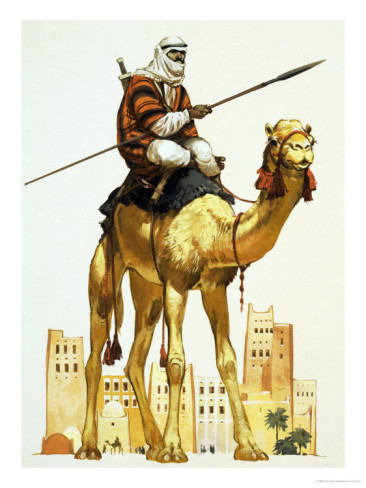
Your basic camel in Legacy of the Bieth is a dromedary, or single-humped camel. They are a 3 HD creature that has MV 21 - faster than a medium or heavy warhorse, but slower than a light warhorse or riding horse. They can carry about as much as a medium warhorse (whatever amount that is). They can average about 1.5 times the overland speed of horses when trying to cross rough terrain (less need for foraging, greater endurance), but aren't as great in combat - they're far less obedient and more likely to try and get out of dodge. They will also engage in wacky hijinks far more than horses, and will spit in your face on occasion if they are ornery. Horses within 20' of camels are generally spooked and will have a -2 penalty to their morale.
So now you're all educated about camels, great, how much do they cost and what cool ones can you get?
Well, let's say that they cost 110 gp - between a light warhorse and a riding horse. Use the "purchasing" and "mount quality" tables from the Hill Cantons post on horses (linked again here).
There is a 15% chance that an unusual type of camel is available. If so, roll on this table to see what the camel is like.
01: White Camel Snow-white camel, not the cream color that most are. Beloved of certain nomad tribes, and considered to be almost sanctified. Riders of white camels will get bonuses to reactions with said tribes...unless they are mistreating the camel, in which case it will likely be liberated from its cruel owner. Base price 3x normal - but priceless to said tribes. Has an unexplained fondness for bananas.
02: Wrestling Camel: Bad tempered, but can strike in melee for d4/d4 as it bites and stomps and is generally ornery. Uses its neck to knock targets down.
03: Bactrian Camel: AKA the two-humped fuzzy one. What the heck is it doing here? Regardless it has a large carrying capacity, about that of a draft horse. MV 18, though. It's also far more prone to spitting (50% chance to spit at random target during combat, save or be blinded for d3 rounds). Base price 120 gp.
04: Crooked Hump Even though it's not your fault and is in fact a perfectly natural occurrence, everyone sees the crooked hump of your camel and assumes you've been doing a crappy job taking care of it. Lots of unsolicited advice. 75% base price.
05: Camelopard Spots like a leopard. Purrs once in a while, and my those teeth do look kind of sharp. Has two backwards curving horns which could do d6 damage. 150% base price.
06: Firebreather MV 22, occasionally breaths fire in a 5' cone for d4 points of damage. Puffs of smoke occasionally rise from nostrils. Answers to "Joe."
07: Symbiotic Camel: The camel can provide its rider with some of its vitality while the rider sits atop its hump. No need for rations or water! After d6 months, the rider starts growing coarse hair all over their body, avoiding meat, and their eyes shift a bit towards the sides of their head. At this point they can't leave the camel's side for more than d6 days or else they'll start to weaken. If the camel dies, they die. 08: Black Camel: Favored by poets and angsty teenagers. Viewed as a sign of ill omen, but anyone attacking the rider has a -1 to hit and damage.
09: Red Ghost Camel: Blood red fur. Can only carry one rider ever. If they die, the camel will keep them upon their back and go on a murderous rampage. When rampaging, treat as a 5 HD monster, d10 damage with hooves, and it becomes omnivorous.
10: Water Hump: This is the one which made all of the legends. It actually stores water in its hump rather than fat. Very hard to ride, but you can slit open the hump and siphon water out if you need to. Of course the camel will likely object to this.
11: Magic Eater: Somehow this camel is immune to magic and mutation. Will calmly chew down on strange anomalies. Of course, if magic is causing something else to do damage (rock dropped on head), then the camel is going to be sad. Oh, and predators find these critters incredibly tasty. 100x base price.
12: Nourishing Camel: Camel mare. A cup of its fresh milk can serve as a healing potion for d6 points, but after taking d4 doses, you start to develop a tolerance to it and it will only heal 1 point of damage. 20x base price.
13: Allocamelus: Body of a donkey, head of a camel. Stats and price as a donkey, but moves through desert as a camel.
14: Acid Spit Camel: Can be coaxed to spit its strangely acidic cud at enemies. If it hits, deals d4 damage and blinds the opponent for d4 rounds. Camel can spit once every 8 hours.
15: Racing Camel This one has MV 25, but is far more prone to injury and needs rest more often. (Sprints, not long hauls.) Reduce overland speed to horse speeds. Everyone comments on what a graceful and beautiful camel you have. It knows it and acts like a total prima donna. Base price 2x normal.
16: Camel...spider? Has eight legs; positioned more like a spider than Sleipneir. MV 30, but people think that it's damn freaky. I can't imagine why. Horses are even more agitated around the spider camel and I don't blame 'em.
17: Dancing Camel Occasionally stops and starts rocking out to music only it can hear. Seeing the camel dancing has a 50% chance of breaking any compulsion or charm that an individual is under. Irrational dislike and distrust of any monkeys or apes.
18: Five-Legged Camel The fifth leg is located just behind the hump and curves upwards like a scorpion's tail. Generally doesn't hit the rider in the head too much. Can strike for d8 damage in melee.
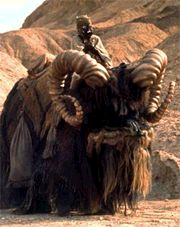
19: War Camel This one's been trained, somehow, for obedience and combat. 3+3 HD, less likely to try and run in combat, and will protect its rider if they fall, attacks for d6/d6 dmg. Base price 350 gp. 20: That's no camel, that's a space bantha! Somehow the camel salesman has a bantha. Big, fuzzy, giant horns. Treat as a heavy warhorse that can move through badlands at camel speeds. Deals d8 damage with its horns. Base price 600 gp. Tusken Raider costume does not come with bantha.
A long-ass post answering some setting issues for Legacy of the Bieth! Via Jeff's Gameblog, 20 setting questions.
What is the deal with my cleric's religion?
The dominant religion in the region is that of ar-Rahman (think a Church of Law). There is grudging tolerance for the worship of other deities, who are collectively called "The Many" by Ar-Rahman's faithful.
Where can we go to buy standard equipment?
The souq is the big open-air marketplace in Sanctuary where you can pick up 'most anything that you need.
Where can we go to get platemail custom fitted for this monster I just befriended?
You can't get any platemail at all around Sanctuary, unfortunately. You can get some leather or chain barding custom made in Sanctuary probably, or you could try commissioning it at one of the smaller towns dotting the region.
Who is the mightiest wizard in the land?
Practicing magic is kind of frowned upon, so there aren't too many renowned wizards. The name of Zouman ibn Zouman (a great seer and mystic) would probably be first on people's lips.
Who is the greatest warrior in the land?
Tawnat bint Ziyad is probably the most renowned faridah (masc. faris; think a combination of ronin and gunslinger) in the region around Sanctuary, although with the continual influx of new mercenaries and adventurers, who can say?
Who is the richest person in the land?
Here it would be Umm Susa, the head of the Merchants' Association; she's been one of the chief beneficiaries of the taxes laid upon the various gold and salt caravans passing through sanctuary. Although the pirate chieftain Red Firouz might have something to say about that...
Where can we go to get some magical healing?
You can turn to the masjid of ar-Rahman, or you could seek out a priest of the Many. There are rumors that a hobgoblin sage has set up shop in one of the towers along the east side of Sanctuary, and she's reputed to be a healer as well.
Where can we go to get cures for the following conditions: poison, disease, curse, level drain, lycanthropy, polymorph, alignment change, death, undeath?
Poison can be treated by an apothecary, wise woman of the nomad tribes, or priest of some deity. Priests can deal with curses, and sometimes diseases. As for the rest, you're on your own.
Is there a magic guild my MU belongs to or that I can join in order to get more spells?
Not at all. Magic-users are a secretive lot in general.
Where can I find an alchemist, sage or other expert NPC?
Sanctuary has some chance of having experts (it depends on the field you're looking for), and the hobgoblin sage mentioned above is definitely in Sanctuary. If they're not there, you'll likely have to head back to the corelands, maybe to the capital or to the independent city of Vornheim.
Where can I hire mercenaries?
Mercenaries are showing up to Sanctuary in greater and greater numbers these days - partially to serve as caravan guards for the caravans that run through the city, but also because conflict seems to be brewing between the Empire and some of the nomad tribes in the area. Nothing's happened yet, but tensions have been growing. There are also the Blood Moons, who are a local mercenary band/death cult.
The Blood Moons, with their commander Atlas in the lead.
Is there any place on the map where swords are illegal, magic is outlawed or any other notable hassles from Johnny Law?
The cities are generally more regulated, and guards will look askance at folks who are running around festooned in weaponry, but there aren't any notable hassles as such. Folks will be creeped out by the use of magic, but it's not particularly outlawed unless you start doing stupid crap like assaulting people. In which case, y'know, assault.
Which way to the nearest tavern?
Two streets down from the souk, take a right, and you're at Yahya's. Decent place, and most times the wine isn't sour.
What monsters are terrorizing the countryside sufficiently that if I kill them I will become famous?
There are always Bieth monstrosities lurching about the sands and scrublands, but there has been a rash of killings within Sanctuary itself recently. There have also been attacks by landsharks and a crystal butterfly on some caravans in recent weeks.
Are there any wars brewing I could go fight?
See above re: mercenaries.
How about gladiatorial arenas complete with hard-won glory and fabulous cash prizes?
None, ah, overt in Sanctuary. If you dug a bit, you might be able to find a few, but I'm not sure how fabulous the cash prizes are.
Are there any secret societies with sinister agendas I could join and/or fight?
There are murmurs of a cabal called the Circle, led by a fellow named Shafiq the Grey, but that's about it. Oh, and there are those Cultists of the Yellow Hand, nobody really knows what their deal is.
What is there to eat around here?
A typical well-to-do meal in town might include some lamb kebab with yogurt, bread, rice, and some vegetables. For the peasantry, there's less meat and more lentils involved. Well, "more" is perhaps the wrong word, since the meals are pretty meager.
Any legendary lost treasures I could be looking for?
The Bieth were said to have a series of magical wonders and terrors within their spires. It's rumored that there is a device that will reshape an individual's mind and possibly inculcate them with the knowledge of sorcery. It is also said that those who fought the Bieth created a method by which clay servitors could be animated to serve as untiring warriors. In more recent developments, the axe known as Djala Bone Hewer is said to have been lost near Sanctuary.
Where is the nearest dragon or other monster with Type H treasure?
There aren't any known large creatures with Type H treasure around these parts.
Ability scores generation method?
3d6 in order, straight down - but if you are FLAILSNAILing, go with whatever.
How are death and dying handled?
Being reduced to -1 HP makes you roll on the Death & Dismemberment table.
What about raising the dead?
You're outta luck, friend. Reach for your 3d6. If FLAILSNAILing you can try and resurrect the character somewhere else that you've adventured, or head to the Bleaklands.
How are replacement PCs handled?
If you have a henchman/hireling handy, you can start running them. Your new PC can join up when you get back to town.
Initiative: individual, group, or something else?
Group initiative on a d6.
Are there critical hits and fumbles? How do they work?
Yes, you crit on a 20 and fumble on a 1. Crits do max damage, and something else cool at the discretion of the GM.
Do I get any benefits for wearing a helmet?
Yes, help on the death/dismemberment table, plus any common sense bonuses.
Can I hurt my friends if I fire into melee or do something similarly silly?
A-yup. Unlike some cruel, cruel, heartless GMs, I will let you know who is in your line of fire. Did I mention cruel?
Will we need to run from some encounters, or will we be able to kill everything?
Run, little monkeys. Run.
Level-draining monsters: yes or no?
Not at this time; it seems like a hassle to deal with.
Are there going to be cases where a failed save results in PC death?
Yes.
How strictly are encumbrance & resources tracked?
Not all that strictly. I'll ask about light and so forth, but I'm not going to freak out over your equipment list unless you are being particularly egregious. "So...you brought 2 blue whales into a 10x10 room?"
What's required when my PC gains a level? Training? Do I get new spells automatically? Can it happen in the middle of an adventure, or do I have to wait for down time?
Experience is awarded at the end of adventures; you do not level mid-adventure. You don't need to go through training; you don't get new spells automatically though.
What do I get experience for?
Grabbing gold and treasure. Defeating monsters. Exploring new areas that nobody has gotten to in-campaign yet.
How are traps located? Description, dice rolling, or some combination?
Anyone can find a trap through description of what they're doing and looking for. A thief can also use dice rolling as a form of "saving throw" before tripping a trap.
Are retainers encouraged and how does morale work?
Retainers are encouraged. Morale is likely going to be as per AD&D 2e rules (d20 roll, modifiers as appropriate.)
How do I identify magic items?
Just look for the blue saran wrap glow...oh, we're not playing Morrowind? Right. Look for fancy inscriptions (and particularly Bieth writing). If you don't have access to a wizard in the party, the town mage ought to be able to toss a detect magic on your stuff. For a price.
Can I buy magic items? Oh, come on: how about just potions?
Potions from the local town mage.
Can I create magic items? When and how?
Yeah, sure. I need to figure out how; it'll probably require setting up a laboratory.
Not quiiiite my usual line of stuff, but this seemed like fun.
This Labyrinth Lord-based class is for a friend who's a huge fan of Mega Man. It may be a good fit for use in Reynaldo's Barovania campaign setting.
Mega Robot
-1 Str, +1 Dex, +1 Con, -1 Wis
Requisites: Dex 12, Con 9
HD: d6, 2d6 at first level BUT cannot be targeted with healing magic, can repair 1d3 hp per day (with an additional +1 hp for each day of rest).
Immune to poison
Base AC of 5
Basic attack - d6 (mega buster, +1 to hit, range 60') OR d8+1 (energy sword)
Special Abilities
Infravision 90', but deals 1 hp/hr of activation
Charging Weapons
A Mega Robot can spend a round to charge up their weapon. For each HP that they sacrifice during the charging round, the next attack from their Mega Buster or energy sword will deal +1 damage. (1 hp/+1 dmg)
Powerups
Any rod/staff/wand or other suitable mechanical/magical device, taken from a being that they have killed, can be integrated into the Mega Robot's system. The Mega Robot may freely choose to use this weapon instead of their Mega Buster / Energy Sword. (Think Jeremy's Vat-Spawn, but with mechanical rather than biological components.)
Armor
Mega Robots cannot wear more armor - they're already made of metal - but they can increase their defenses by consuming magical armor or shields. Each consumed item improves their AC by one for each +1 or special ability the armor possessed. This can be repeated until the Mega Robot has an AC of 0.
First entry in this Arab Travelers series, started here.
From Ibn Battutah:
Takshif is the name given to any man of the Massufah whom the people of the caravan hire to go ahead of them to Iwalatan with letters from them to their friends there, asking them to let houses to them and come four days' journey to meet them with water...Sometimes the takshif perishes in this desert and the people of Iwalatan know nothing of the caravan, and its people or most of them perish too. There are many demons in that desert. If the takshif is alone they play tricks on him and delude him til he loses his way and perishes. There is no road to be seen in the desert and no track, only sand blown about by the wind. You see mountains of sand in one place, then you see they have moved to another. A strange thing I saw is that our guide was blind in one eye and diseased in the other, but he knew the route better than anybody else.
The Travels of Ibn Battutah (Picador, 2003), p. 282-23.
Demon of the Desert
AC: 4 OR 9, HD: 2-4, Mv: 120', Atk: sandblast (d6, 30' range) OR claws (d3)
Demons of the Desert can shift between three forms: a flickering light kind of like a will-o'-wisp, a dust devil, or a tiny wizened creature 4' high. They can only exist in their will-o'-wisp form when there is a single sentient being (aside from other Demons of the Desert) watching.
While a will-o'-wisp, they can cast some spells to lure travelers to their unfortunate demise. Roll a d4 to see what any individual Demon of the Desert can hurl:
1: hypnotism
2: hallucinatory terrain
3: wall of sand (as wall of fog)
4: ventriloquism
If they are seen by more than one sentient being at a time, they immediately shift from their will-o'-wisp form into a dust devil (first set of stats above) and must remain in that sort of form for 1d6 hours.
They can only feed on creatures that they themselves have not directly harmed, so they will use their dust devil forms only for self-defense. Striking the dust devil form disrupts the twisting column of air at the center, so that you can actually hurt the things.
Their third form is reserved for feeding, and it's this creepy wizened little human-like form 4' tall or so. Make it weird and creepy. It's got the lousy stats above (AC 9, d3 claw damage). If a Demon of the Desert is slain, it will shift into this form. Otherwise, it takes d3 rounds for a Demon to shift from one form to another.
Their MO, as suggested above, is to lure caravan guides and so forth away from the path to town, sucker them into the desert, and chow down once the entire group has died. (It beats the meager options they normally have open.)
If discovered, they are cowardly and seek to bargain for their lives. Demons of the Desert do not actually have any treasure of their own, but they are likely aware of that accumulated by their former victims, and any that might be readily visible in nearby ruins.
I am working on a few posts (some 40K random generation tables) and putting together an Ibn Battuta fantastic/magic items post (since my copy of ibn Munqidh is inaccessible ATM).
While those are in production, I proffer Howard Andrew Jones on ibn Munqidh and on fantastic Arabian literature (going beyond the Arabian Nights! Who knew?!) Jones's Dabir and Asim work (The Desert of Souls and The Waters of Eternity) are really well-done, and strong influences on Legacy of the Bieth. I will unashamedly admit that I have stolen at least one plothook & setup from Jones somewhere.
(Also holy crap, The Desert of Souls is on sale for $10. All y'all should totally pick that up.)
I've been chewing over the Legacy of the Bieth setting for a while, and am unhappy with the "traditional" feel that it manifested in its latest Philly incarnation. Therefore, I'm going to be shifting it around and making it far more North African/Middle Eastern in inspiration, rather than the Ren Faire Europe that it had earlier.
Two of my main sources for this are going to be the work of Ibn Battuta and of Usama ibn Munqidh. Both of their works have several anecdotes which make for great RPG fodder, which I'll be trying to get down on Ibn Battuta you've likely heard of - Berber traveller, qadi, and Dude Sticking It To Marco Polo. Usama ibn Munqidh? Well, he's somewhat less familiar, and the Wikipedia link doesn't do him justice.
So, let me present a synopsis of the first few chapters of his work, "The Book of Contemplation," that I had written up a while back.
IbnMunqidh was a Syrian knight around the time of the 2nd Crusade. I had heard of his memoirs before - they were mentioned in a few of the books on the period I had read while growing up, but I had never seen a copy. Then last week, I wound up finding one at the Last Word, and immediately snagged it. IbnMunqidh had been described as a super-chivalrous knight in the sources I had seen, but so far, he doesn't seem to be living up to that. Instead, he seems to be slightly engaged in conspiracies - up to his eyeballs. Y'know, just a little bit. The book opens with the earliest remaining fragment, which has ibnMunqidh serving Zangi, the governor (atabeg) of a Syrian province. After internal treachery on the part of another commander, ibnMunqidh fled Zangi's service and went to Mu'in al-Din, the ruler of Damascus, who took him in and did not in fact turn him over to Zangi. Then ibnMunqidh says that "certain things came to pass that necessitated my relocation to Cairo." The footnote clarifies that the "certain things" ibnMunqidh alludes to were likely intrigue against Mu'in al-Din, explaining why he then had to flee. When Mu'in al-Din sent his scribe to ibnMunqidh with a message professing friendship, ibn Munqidh then writes a poem back explaining how he was still al-Din's loyal servant, and left only to prevent trouble from falling on al-Din. No other reason! None whatsoever. So ibnMunqidh flees to Cairo, where the Caliph takes him in. After some time (and a feud between some of the caliph's troops, including some royal bodyguards), the Caliph dies and his son Al-Zahir ascends, appointing a fellow named Ibn Masal as his vizier. This appointment causes an amir of Al-Zahir's, Ibn al-Sallar, to fear for his life and/or try and stage a coup against Ibn Masal (but not against the caliph). Several of Al-Zahir's other amirs work with al-Sallar (and his stepson 'Abbas) to help against ibn Masal. IbnMunqidh throws his lot in with al-Sallar also, and they kill Ibn Masal. Al-Sallar then becomes the new vizier. Now, the Caliph is not thrilled with this, and plots to kill Al-Sallar (during Ramadan!). He sends some assassins after Al-Sallar, but they fail. Some of them flee to ibn Munqidh, who hides them and saves them. Then Abbas's son Nasr (so al-Sallar's step-grandson, I guess) works with the Caliph to assassinate al-Sallar. He sneaks into his grandmother's palace, decapitates al-Sallar, and brings the head to the Caliph, causing him to rise greatly in the Caliph's favor. The translator suggests that Nasr and the Caliph may have become lovers after this(there's a "giving head" joke in there somewhere...). Abbas is appointed the vizier in the wake of his stepfather's death. Abbas distrusts Nasr after this, though apparently more from getting cozy with the Caliph than from his murder of 'Abbas's stepfather. At one point they get into a fight, and ibnMunqidh intervenes on Nasr's behalf, saying "What then has he done wrong? He has not mistreated any of your companions, nor has he frittered away any of your money, nor has he criticized your regime. Indeed, he has risked his life so that you might attain this position." At which point father and son reconcile. The very next section then mentions how the Caliph starts sending Nasr lavish gifts and trying to get him to kill his dad. (There's a bit in there where ibnMunqidhmentions how "during this whole period, I was with Nasr all the time. He wouldn't permit me to be absent night or day; I used to sleep with my head at the end of his pillow." And all the ibnMunqidh shippers cried out with glee...) Anyway, Caliph trying to get Nasr to kill his dad. But that's going a bit too far for ibnMunqidh, who suggests to Nasr that unlike killing al-Sallar, killing his dad will likely doom his soul forever and is generally a Bad Prize. At which point Nasr goes, tells his dad everything, and then they murder the Caliph and his brothers.
So. This is ibn Munqidh, and why he's interesting. Admittedly, the book gets a bit tamer after this, but I haven't started touching upon the Weird Bits that show up.
I'm looking forward to writing these things up; I hope y'all are interested in reading.
While my focus in gaming is pretty much back to RPGs and computer games these days, I have a soft spot in my heart for wargames. I'm a big fan of the 40K setting, both its current incarnation in the hands of Dan Abnett and Sandy Mitchell, and its early days with Elves! In! Spaaaaaace!
I prefer the Abnett-verse for my 40k RPG needs, but if I play the wargame, my inclination is towards the ridiculous gonzo early days - both the 2nd Edition (same basic premise as the current setting, but sillier and more 2000 AD showing through), and Rogue Trader (no Chaos explicitly mentioned, half wargame/half RPG, Space Marines are crazy psychos instead of boring warrior-monks).
While checking around for resources to run a Dark Heresy game over G+ using a system that's not the FFG Dark Heresy ruleset, I happened across this fellow, who's blogging about an OSR movement in 40K. I'm absurdly happy about more folks being interested in what I find to be some of the coolest stuff in 40K.
(Oh, and ol' Mandamus gets a shout-out there too!)
And now I'd better get back to this final paper. Last one for law school...!
The wastelands near Sanctuary are a grim enough place, and it's always nice to have a little bit of color, glamour, and spectacle to liven up the land. Even if the color, glamour, and spectacle is as terrifying as Mistress Meena's Travelling Circus.
Mistress Meena appears human, but she's been around for hundreds of years. Probably since the Bieth fell. Her circus takes in the wretched, the poor, the dying, and those simply down on their luck. She doesn't flinch from the sick, the leprous, those twisted by the magic coursing through the wastelands.
That's because she changes them. She shapes their bodies, ripping and tearing, fusing metal and wire and wood to flesh and bone, and reweaves them into what she needs.
The acrobats that dash across the stage have springy spurs of bone emerging from their calves, allowing them to bounce and bob with the utmost dexterity. When they spread their arms wide, the scarlet, pink, and blue ribbons stretch from their arms down to their ribcage.
The clowns have had the color bleached out of their skin and concentrated into their hair and nose, their lips swollen comically, their eyes cartoonishly large.
The harp that plays itself has a human head, with golden tresses, and she sings to accompany herself. The graceful arc of the harp's body used to be her spine. Arms and legs, she has none. The trapezes used to be two lovers, and now they come close each night but never touch.
Mistress Meena seems to be the only unshaped person in the circus. She never doffs her black domino mask.
The circus caravan proceeds through the worst parts of the wasteland. They never turn aside, and never seem to be molested by the wild creatures or bandits.
When the circus comes, you do not turn it away. Once in a while someone from an outlying village, or even Sanctuary or Lithquil, will approach Mistress Meena after the show. She will smile kindly, and touch their arm, and lead them away. Sometimes their friends see them again, changed into another component of Mistress Meena's show. If they do, they always regret it.
Think: Freaky batshit John Blanche art, travelling circuses, and Alistair Reynolds's Diamond Dogs with a creepy-ass Zatanna as Dr. Trintignant.
(Disclaimer: idea cribbed from a description of the Circus Tresaulti I heard, but I haven't read any of the stories yet.)
Relevant quote from the Amazon preview: "Their dancing names are Sunyat and Sola, Moonlight and Minette. (Their real names don't matter; no one in the circus is real anymore.)"
This is a little trick I came up with when trying to come up with cool bits to work into my D&D homebrew setting, but it can work with most any fantasy setting.
First, a little background. If you're not interested, skip over it and get to the bolded part.
There's a Twitter game I play called Echo Bazaar. In Echo Bazaar (or #ebz as it is sometimes abbreviated) a lot of the various NPCs you encounter are not named, but given suitable epithets. An adjective, and then a title. To wit: a Retiring Blackmailer, a Winsome Orphan, a One-Eyed Bishop, a Wry Functionary, and so forth.
A few weeks ago, I was trying to come up with some tidbits to make my homebrew campaign setting more interesting and alive. I was looking through the Roleplaying Tips magazine, and came across the Idea Seeds method by Mike Bourke.
The gist of the Idea Seeds method is to list a bunch of nouns, say 12, which are to show up in your campaign ("goblin, king, mercenary"). Assign each one an adjective ("heroic goblin, sad king, grizzled mercenary"), use the noun-adjective in a sentence ("the heroic goblin slew the evil dragon"), and...well, it goes on from there.
The noun-adjective thing reminded me of Echo Bazaar, and how powerful those two-word descriptors can be.
And then I had my moment of inspiration. The card game Dominion is themed around a medieval low-fantasy setting. I could use that to generate even the nouns...
So Here's How To Do It
Go to a Dominion set generator (I like this guy) and generate a set of 10 cards. Use all the expansions you want.
This will give you a set of 10 cards. You don't care about anything except the names. Arrange them in 5 pairs of two.
For example, I just got:
Vineyard and Upgrade Secret Chamber and Tactician Shanty Town and Royal Seal Alchemist and Venture Lookout and Minion
Right. Now, grab a random adjective generator. I like this guy, because Exalted names have awesome punchy adjectives. Generate a list of ten adjectives, and assign them in order to your nouns. (Yes, you could do it out of order, picking and choosing, but then that is NO FUN.)
In the example, I would get:
Secret Vineyard and Crimson Upgrade Savage Secret Chamber and Stalwart Tactician Bounteous Shanty Town and Grey Royal Seal Ebon Alchemist and White Venture Exaltant Lookout and Sagacious Minion
Now assign temporal states to the examples, alternating between current and past.
(now) Secret Vineyard and Crimson Upgrade (past) Savage Secret Chamber and Stalwart Tactician (now) Bounteous Shanty Town and Grey Royal Seal (past) Ebon Alchemist and White Venture (now) Exaltant Lookout and Sagacious Minion
The pairs are (or were) interacting, somehow, in your setting. Figure out where, and put it in!
In some cases, this may come up with stuff which just feels stupid ("Savage Secret Chamber" sounds pretty dumb, even though Stalwart Tactician sounds awesome). I recommend tossing the pair out entirely, if one is mediocre. The good thing about this method is that it is pretty quick, so generating multiple sets of 10 doesn't take very long at all.
OK. First a few magic items, converted over from a few places.
Earthdawn
Targeting Eye
"A targeting eye is a magically treated piece of quartz hollowed out, filled with a gel worm and nourishing fluid, then attached to an eye patch. When worn, the worm burrows into the wearer's eye, destroying it. Though the fluid in the gem makes this process relatively painless, the wearer" loses one HP permanently. When making a missile attack or sufficiently similar action, the wearer may take a +4 penalty to initiative to gain a +1 bonus to their attack roll. "A targeting eye cannot be removed, and the damage point can never be healed." -quoted text p. 259, Earthdawn rulebook (1e?). Italics mine.
Blood Pebbles
"Blood-pebble armor is a form of living, elemental armor. Hundreds of small elemental stones are embedded in the wearer's skin, drawing power from the magic in his blood. A character wearing this armor takes 4 Damage Points," (loss of 4 HP, easy enough) "which cannot be healed as long as the character wears the blood pebbles. Implanting or removing blood-pebble armor requires eight hours of work by a trained Weaponsmith." (Or a nasty Bieth laboratory, which could likely do it much quicker. Magical AIs are wondrous useful things!) Blood-pebble armor provides AC 5, improves all saves by +1, and allows for a saving throw vs. magic missile spells. -quoted text p. 255, Earthdawn rulebook. Italics mine.
OK. Next, let's bring in some cool things from Warhammer Fantasy. These spells are taken in concept from the WFRP 2e supplement "Realms of Sorcery".
Warhammer Fantasy Roleplay: Realms of Sorcery
The Beast Broken (p 138)
Level 1 M-U Spell (replaces Mending)
Duration: Permanent
Range: 36'
"You break the wild spirit of a single animal (that can be domesticated) within 12 yards. These animals include horses, dogs, and some birds of prey. It does not include normally wild animals like wolves, bears, snakes, and so on...On a failed test" (aka failed save vs spell) "it remains docile towards Humans, Elves, Dwarfs, and Halflings forever, though it is still likely to be afraid - and rightly so - of creatures like Greenskins, Skaven, and those tainted by Chaos." Replace Humans, Elves, etc. with 'PC races,' unless you want to make it specific - a bit of anti-Dwarf prejudice? - and similarly, broaden the Greenskins et. al. to just include inhuman beings. This spell functions as a poor man's 'Charm Animal,' but adds a significant deal of flavor to the abilities of an M-U, permanently dominating the mind of an animal and exerting arcane influence over Nature. Druids ought to flip out if they find an animal that has been mentally gelded in this fashion.
"You...write a subtle message in the stars. The message is not detailed and can only serve to communicate complex ideas if you and the one you intend to receive the message have discussed the signs you intend to send in advance." Anyone with significant knowledge of astronomy or astrology can observe the sky and see that someone has cast this spell; however, "without knowledge of what you intend to communicate...the meaning cannot be easily divined."
I'd like to convert some of the rituals included (particularly The Impossible March of the Damned Soldier, p. 168). I also plan to convert the demonic bargains options available to the Demonologist into retroclone/similar format.
NPCs:
This is less for posting new and creative ideas and more to force me to start fleshing out NPCs within the LotB setting. Right now, it's an extremely basic sandbox with a few sparse NPCs, and that needs to change. Sanctuary is an interesting place, but just telling the folks that it's interesting won't cut it!
So.
Murdach (hob m F2): Murdach is a travelling peddler and sometime fence, usually roving between Sanctuary, Kwannom, and points south.. He seeks to circumvent the taxes on the Bieth relic trade. Murdach is a bulky ruddy-skinned hobgoblin, carrying a curved sword at his side and a large smile on his face. His left eye is glazed over and his left ear is forked - courtesy of a wild magic zone that he and his partner Feihong traveled through to escape Ungern's riders back in the day.
Friendly and garrulous, Murdach nevertheless deflects discussion of any shady wares away ("Artifacts? Nonsense! But if you want wondrous items, observe this beautiful teapot..."). It will take a bit of coaxing before he can start to show the Real Goods. Feihong (h m Lvl 0) is Murdach's partner, a thin man dressed in green wearing a box cap. As Murdach rattles on, Feihong will quietly and solemnly display their wares. He hardly ever speaks - not from any desire to keep a mysterious demeanor, but because he has been cursed to spit out a small creature (snake, frog) each time he gives voice. It's pretty awkward all around, but it makes him a good partner for Murdach. While the hobgoblin babbles and distracts, Feihong inspects their potential trading partners.